In This Article
The License Conversion Process Explained
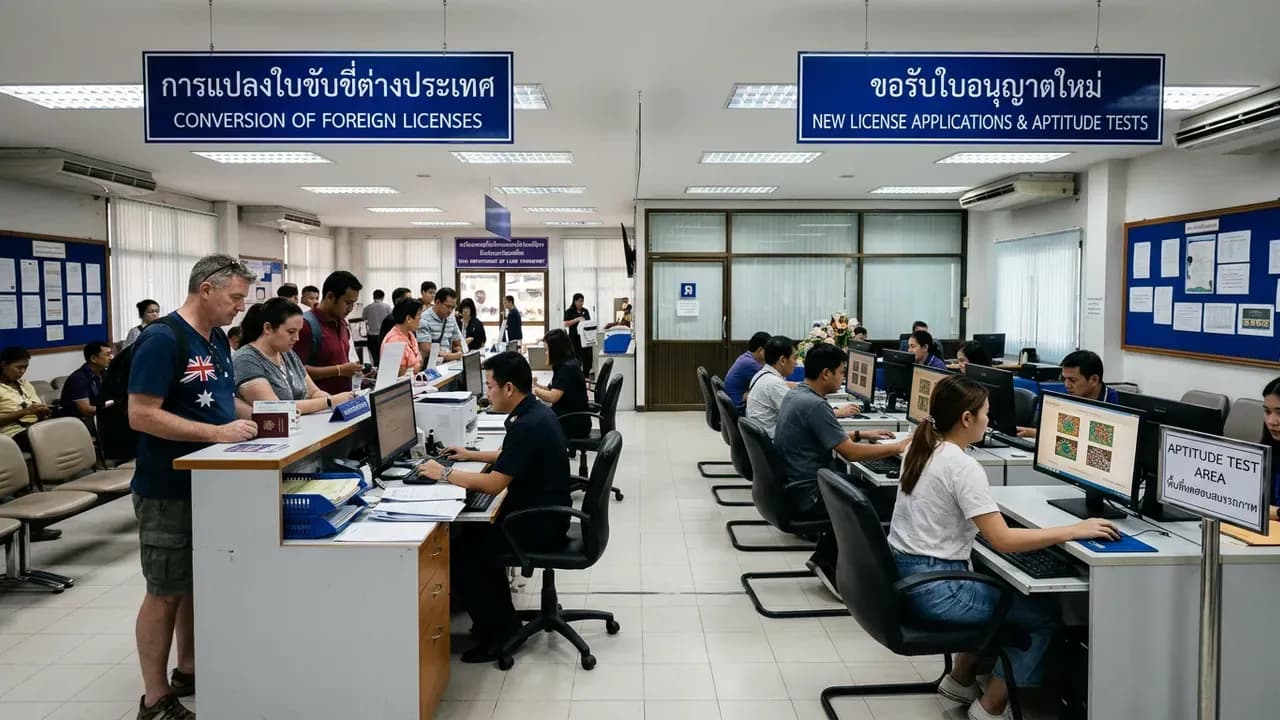
License conversion allows you to exchange your valid foreign driving license for a Thai driving license without taking the practical driving test. This is the preferred route for most foreigners because it saves considerable time and eliminates the stress of the on-road test. To convert, you need your original foreign license (it must be current and not expired), an official translation or verification of your license (requirements vary by country — some need embassy authentication, others need a certified translation), a medical certificate from a Thai clinic, a residence certificate from Immigration, passport copies, and the DLT application fee. At the DLT office, you will take a colour-blindness test, a depth perception test, a peripheral vision test, a reaction time test, and a brake reaction test. These are simple physical tests done on machines at the DLT office and take about 15-20 minutes. You do NOT take the written theory test or the practical driving test when converting. The entire DLT visit typically takes 2-4 hours depending on the queue. Not every country's license qualifies for conversion — Thailand has bilateral agreements with many countries, but the specifics can change. As of 2026, licenses from the US, UK, Australia, most EU countries, Japan, and many others are accepted for conversion.
The New License Process (From Scratch)
If you do not have a valid foreign license to convert — perhaps your home license expired, you never had one, or your country is not recognised for conversion — you can apply for a Thai driving license as a new applicant. This process requires the same documents as conversion (medical certificate, residence certificate, passport copies) but you do NOT need a foreign license. Instead, you must complete the full testing process. This includes the same physical tests (colour-blindness, depth perception, peripheral vision, reaction time, brake reaction), plus a written theory test of 50 multiple-choice questions (available in English, with a passing score of 45 out of 50), plus a practical driving test. The written theory test covers Thai traffic laws, road signs, and driving etiquette. Study materials are available from the DLT website and various apps. The practical driving test varies by DLT office but generally includes driving forward in a straight line, reversing, parking (parallel or bay), stopping at a designated point, driving on a slope, and navigating an S-curve or other manoeuvres. Some offices use a closed course, while others include an on-road component. The full new-license process usually requires two visits to the DLT: one for the theory test and one for the practical test, though some offices can accommodate both in a single day.
Time Comparison: Which Is Faster?
License conversion is significantly faster. The document preparation phase is similar for both routes — you need 1-3 days to get your medical certificate, residence certificate, and photos ready. The key difference is at the DLT office itself. For conversion, you complete the physical tests and receive your license in a single visit of 2-4 hours. For a new license, you need to pass both the written and practical tests, which may require two separate visits. If you fail either test, you must return another day to retake it. The written test can be retaken the next business day, but practical test retake slots may be limited depending on the office. Factoring in document preparation and DLT visits, the conversion route typically takes 3-5 days total from start to license in hand. The new license route takes 5-10 days if everything goes smoothly, and potentially longer if you need to retake a test. One additional time factor for conversion: getting your foreign license translated or authenticated. Some embassies can do this in one day; others take up to two weeks. Check with your embassy before starting the process. Overall, if speed is your priority and you have a valid foreign license, conversion is the clear winner.
Cost Comparison: Conversion vs New License
The government fees at the DLT are identical for both routes: 205 THB for a car license and 105 THB for a motorcycle license. The medical certificate (100-200 THB) and passport photos (100-200 THB) are the same for both. The residence certificate costs 500 THB from Immigration regardless of which route you choose. Where costs diverge is in license translation and authentication. For conversion, you may need an embassy-certified translation of your foreign license, which can cost anywhere from 500-3,000 THB depending on the embassy. Some embassies charge significantly more. If you use a service or agent, the fees are generally similar for both routes, ranging from 5,000-15,000 THB depending on what is included. Some agents charge a premium for new license applications because the practical test requires more logistical support (vehicle provision, practice time). In total, the do-it-yourself cost for conversion is approximately 1,100-4,000 THB (depending on embassy translation fees), while the DIY cost for a new license is approximately 1,000-1,100 THB (no translation needed). The conversion route may cost slightly more out of pocket due to the translation requirement, but many people consider that extra cost worthwhile given the time savings and elimination of the practical test.
Which Route Should You Choose?
Choose license conversion if: you hold a valid, non-expired driving license from a country Thailand recognises; you want to avoid the written and practical tests; speed is a priority; and you are comfortable paying the embassy translation fee. Conversion is the most popular route among expats for good reason — it is faster, simpler, and less stressful. Choose a new license if: you do not have a foreign license; your foreign license has expired and cannot be renewed from Thailand; your country is not recognised for conversion; or you lost your foreign license and cannot get a replacement. While more involved, the new license process is entirely manageable with preparation. The written theory test has widely available study materials and a high pass rate among prepared applicants. The practical test requires basic driving competence but is not designed to be difficult. There is also a hybrid scenario: if your foreign license recently expired (within the last year in some cases), some DLT offices may still accept it for conversion, though this is not guaranteed and varies by office. It is always worth asking. If you are unsure which route applies to your situation, a consultation with a license service like TDL Service can clarify your options quickly and save you from wasted trips to the DLT.
Not sure which option is right for you?
Our team provides free consultations to help you choose the best path for your situation.