In This Article
Do You Actually Need Driving School?
Unlike many Western countries, Thailand does not require you to attend driving school before applying for a driving license. You can walk into any DLT office, take the tests, and receive your license without ever having taken a lesson. Driving school is entirely optional. So when does it make sense? If you are converting a foreign license, you do not take the practical driving test at all — driving school is unnecessary. If you are applying as a new applicant and you already know how to drive (you have experience from your home country but your license expired or is not eligible for conversion), you probably do not need formal lessons. Practicing the specific DLT test manoeuvres (parking, S-curve, hill start) for an hour or two in a parking lot may be sufficient. However, driving school is worth considering if: you have never driven before and need to learn from scratch; you are unfamiliar with driving on the left side of the road (Thailand drives on the left); you want structured practice of the DLT practical test manoeuvres; or you want to learn how to ride a motorcycle safely before taking the test. Driving schools also provide a vehicle for practice, which is important if you do not own or have access to one. Some schools will even provide a vehicle for your DLT practical test.
Driving School vs Self-Study vs Using a License Service
There are three approaches to preparing for your Thai driving license, and they serve different needs. Driving school focuses on teaching you to drive. You learn vehicle operation, road rules, and practice the specific manoeuvres required for the DLT practical test. Schools provide a vehicle and an instructor. This is the right choice if you need to develop or improve your actual driving skills. Cost: 3,000-15,000 THB depending on the number of hours and the school. Self-study means preparing on your own. For the written test, you study using free materials from the DLT website, mobile apps (e.g., Thai Driving License Test apps), and online resources. For the practical test, you practice with your own vehicle or a friend's. This is the cheapest option but requires self-discipline and access to a vehicle. Cost: essentially free (beyond the standard license fees). A license service (like TDL Service) focuses on the administrative and bureaucratic side. Services handle document preparation, residence certificates, embassy translations, DLT appointments, and accompaniment on test day. Some services also provide a vehicle for the practical test and brief practice sessions, but they are not driving schools — they do not teach you to drive. This is the right choice if you know how to drive but want to avoid the paperwork hassle. Cost: 5,000-15,000 THB. Many foreigners combine approaches: they use a license service for documents and DLT logistics while taking a few driving lessons if they need to brush up on skills or learn the left-side-of-the-road adjustment.
Driving Schools in Bangkok
Bangkok has the most driving schools in Thailand, but finding ones that cater specifically to foreigners with English-speaking instructors requires some research. Notable options include: 1) Gateway Driving School — One of Bangkok's better-known schools for expats, offering both car and motorcycle courses in English. Located near Ekkamai, they offer packages ranging from basic refresher courses (5 hours, approximately 5,000 THB) to comprehensive beginner courses (15-20 hours, approximately 12,000-18,000 THB). They can also provide a vehicle for the DLT practical test. 2) SS Driving School — A larger Thai driving school with some English-speaking instructors available on request. Multiple locations across Bangkok. More affordable than foreigner-focused schools (3,000-8,000 THB for 5-10 hours) but the English instruction quality varies. 3) Private instructors — Several independent English-speaking driving instructors operate in Bangkok, advertising through expat Facebook groups and forums. Rates are typically 500-800 THB per hour, and quality varies significantly. Always check reviews. For motorcycle training specifically, options are more limited. A few schools offer basic motorcycle courses, and some motorcycle rental shops in tourist areas provide informal lessons. For proper motorcycle training, consider the Safety Riding courses occasionally offered by Honda or Yamaha dealerships, though availability in English is limited.
Driving Schools in Pattaya and Chiang Mai
Pattaya and Chiang Mai both have driving school options for foreigners, though the market is smaller than Bangkok. Pattaya: The Pattaya area has a few driving schools that serve the large expat community. Pattaya Driving School offers car courses in English with packages starting around 4,000 THB for 5 hours. Several independent instructors also operate in the area — check the Pattaya expat Facebook groups for recommendations. Some license services in Pattaya include a brief practice session (1-2 hours) as part of their package, which can be sufficient if you already know how to drive but want to rehearse the DLT course manoeuvres. Chiang Mai: Chiang Mai has a growing number of driving schools catering to the digital nomad and expat community. Chiang Mai Driving School and a handful of smaller operators offer English-language car instruction at rates of 400-600 THB per hour. For motorcycle training, Chiang Mai is actually one of the better cities due to the active motorcycle culture and the availability of motorbike rental shops willing to provide basic instruction. Several tour companies that offer motorcycle tours also provide riding lessons for beginners. In both cities, the most practical approach is often to contact the DLT office or a license service and ask them to recommend local instructors. License services typically have relationships with driving instructors and can arrange practice sessions as an add-on to their document handling package.
What to Expect from a Thai Driving School
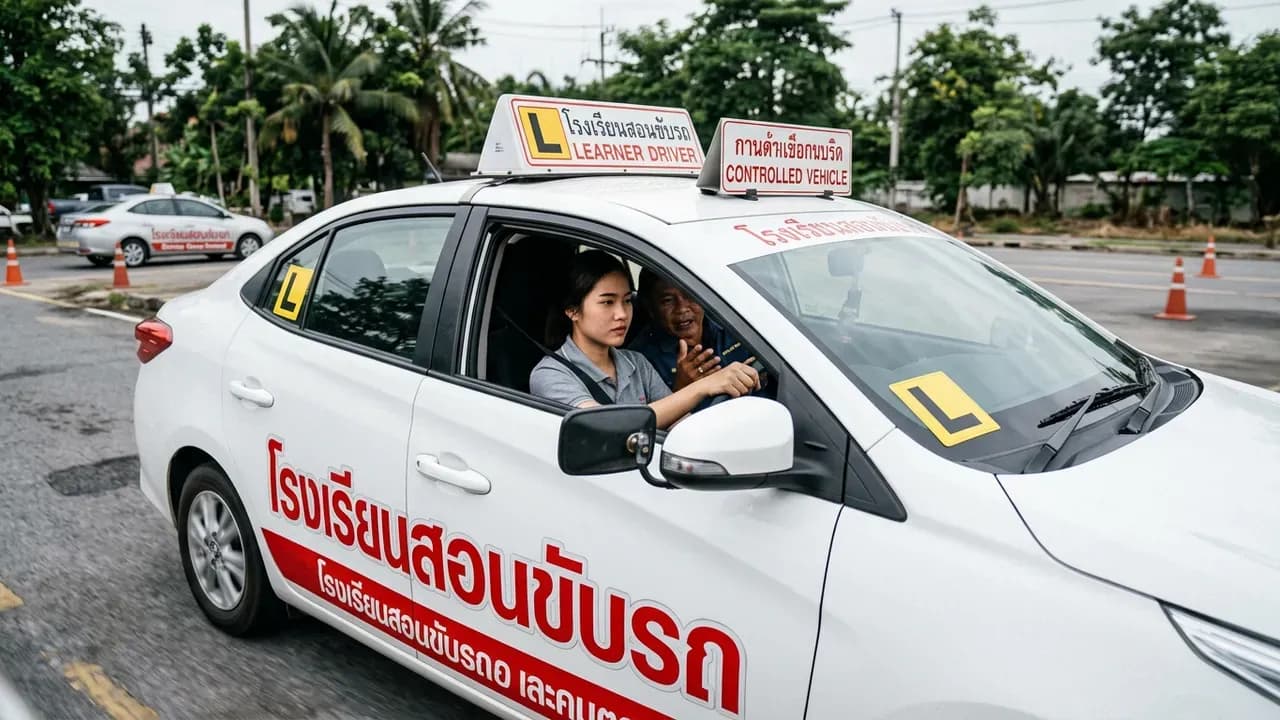
Thai driving schools operate differently from those in Western countries. There is no standardised curriculum mandated by the government, so quality and content vary significantly between schools. A typical driving school experience for a foreigner includes: an initial assessment of your current skill level; classroom or in-car instruction on Thai traffic laws and road signs (varying depth depending on the school); behind-the-wheel practice in a dual-control training vehicle (for car courses); specific practice of DLT test manoeuvres (parallel parking, bay parking, S-curve, hill start, emergency stop); and general road driving practice in real traffic conditions. Course lengths range from a basic 5-hour refresher to a comprehensive 20+ hour beginner course. Most schools are flexible and will customise the programme based on your experience level. For motorcycle courses, expect: basic motorcycle operation (starting, stopping, turning, gear shifting for manual bikes); low-speed balance exercises; the specific DLT motorcycle test manoeuvres (straight-line slow ride, elevated plank, figure-eight, slalom); and some road riding in lighter traffic areas. One important note: Thai driving schools generally do not include the written theory test in their curriculum. You will need to study for the written test separately using DLT materials, apps, or online practice tests. The school focuses on practical driving skills and the practical test.
Not sure which option is right for you?
Our team provides free consultations to help you choose the best path for your situation.