In This Article
Overview and Purpose of the Aptitude Tests
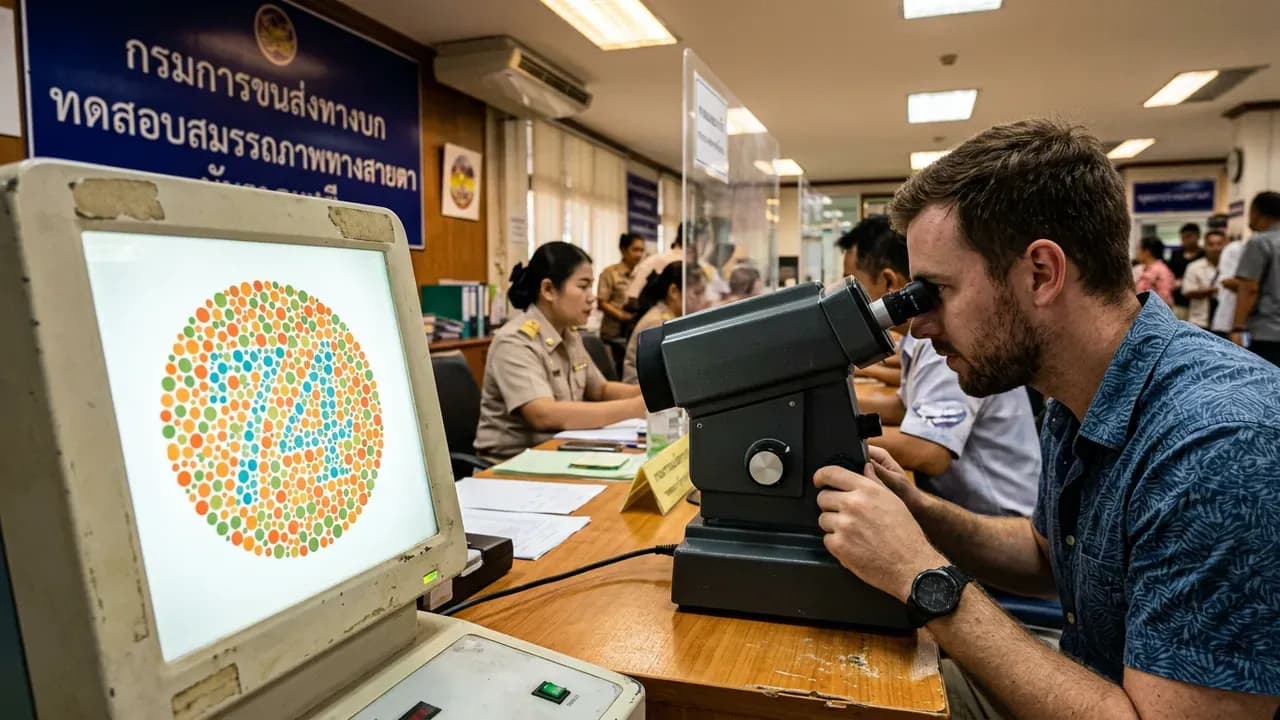
Before you take the written test or practical driving test, every applicant for a Thai driving license must pass four aptitude tests at the DLT office. These tests assess your basic physical fitness to operate a vehicle safely. The four tests are: color vision, depth perception, reaction time, and peripheral vision. All four tests are machine-based, meaning you interact with specialized testing equipment rather than filling out a paper form. The entire sequence takes approximately 10 to 15 minutes to complete, and you move from one machine to the next in order. The pass rate for the aptitude tests is extremely high, estimated at 95% or above. The vast majority of healthy adults pass without any difficulty or preparation. These tests are designed to screen out people with significant physical limitations that would make driving genuinely dangerous, such as complete color blindness, severely impaired depth perception, very slow neurological reaction times, or extremely narrow peripheral vision. If you have normal or corrected-to-normal vision and no known neurological conditions, you should pass without concern. That said, understanding what each test involves beforehand eliminates any surprise or anxiety on test day. Some people fail simply because they do not understand the instructions, which are sometimes given in Thai with minimal English explanation. Knowing the procedure in advance helps you stay calm and perform naturally.
Color Vision Test: Procedure and Tips
The color vision test checks whether you can distinguish the three colors used in traffic signals: red, yellow, and green. The testing machine displays colored lights one at a time, and you must verbally identify each color as it appears. The officer operating the machine will listen to your answers and record whether you are correct. The sequence typically includes 5 to 8 lights shown in random order. You simply say the color out loud: red, yellow, or green. You can say the color in English, Thai, or point to a reference card if there is a language barrier. The test is straightforward for anyone with normal color vision. If you have partial color blindness, which affects approximately 8% of men and 0.5% of women, the outcome depends on the severity. Many people with mild deuteranomaly, which is the most common type of color vision deficiency, can still distinguish traffic signal colors because the lights are large, bright, and spaced apart. Real traffic signals also use position as a cue, with red always on top and green on the bottom, but the DLT test may show colors without positional context. If you know you have color vision deficiency, practice identifying red, yellow, and green lights in various conditions before the test. If you have severe color blindness, such as complete inability to distinguish red from green, you may not pass this test. In rare cases, the DLT may issue a restricted license or require a medical evaluation. The specific policy varies by office, so consult with the DLT directly if you have a diagnosed color vision condition.
Depth Perception Test: Alignment Technique
The depth perception test measures your ability to judge relative distances, which is critical for safe driving activities like parking, maintaining following distance, and judging gaps in traffic. You look into a machine that contains two thin vertical rods positioned at different distances from your eyes. Using a button or dial, you move one rod forward or backward until you believe both rods are at the same distance from you. The machine measures the difference between the two rods after you confirm your answer. If the difference is within the acceptable tolerance, you pass. This test can be tricky because binocular depth perception is subtle and the rods look very similar. Here is the most reliable technique: look at both rods with both eyes open and make your best initial adjustment. Then briefly close one eye and observe whether the rods appear to shift position relative to each other. If they do, they are not yet aligned. Make a small adjustment and check again. When closing one eye no longer causes an apparent shift, the rods are very close to the same distance. Confirm with both eyes open and submit your answer. Common mistakes include rushing through the test without using the one-eye check technique, making large adjustments instead of fine-tuning, and not understanding the controls. The button or dial may move the rod in small increments, so press or turn it gently and observe the result before pressing again. If you wear glasses or contact lenses, make sure to wear them during this test, as uncorrected vision impairment directly affects depth perception accuracy. People who have had recent eye surgery, particularly LASIK, should ensure their vision has fully stabilized before attempting this test.
Reaction Time Test: Gas-to-Brake Procedure
The reaction time test simulates an emergency braking scenario. You sit in a chair in front of a machine that has a gas pedal and a brake pedal on the floor, similar to the pedals in a car. You place your right foot on the gas pedal and look at a signal light. The light starts green, and at a random interval it changes to red. When you see the red light, you must move your right foot from the gas pedal to the brake pedal as quickly as possible. The machine measures the time in seconds from when the light turned red to when you pressed the brake pedal. Your reaction time must be under 0.75 seconds to pass. This threshold is generous. The average healthy adult reaction time for this type of visual stimulus is 0.3 to 0.5 seconds, so you have a significant buffer. Most people pass this test easily. To optimize your performance, keep your foot hovering lightly on the gas pedal rather than pressing it firmly. This allows you to lift your foot quickly. Position your foot so that your heel is roughly between the gas and brake pedals, allowing a quick pivot rather than a full leg lift and repositioning. Stay focused on the light and do not let your attention wander. The random timing of the light change is designed to prevent you from anticipating it, so you must genuinely react rather than guess. Avoid looking at anything other than the signal light. If you are drowsy, caffeinated, or distracted, your reaction time will be slower. Get a good night's sleep before your DLT visit and avoid any medications that cause drowsiness. The test is typically run twice, and your better result is used. If you fail, some offices allow an immediate retest. Elderly applicants and those on certain medications should be aware that reaction time tends to increase with age, though the 0.75 second threshold accommodates normal age-related slowing.
Peripheral Vision Test: Achieving 120 Degrees
The peripheral vision test measures the width of your visual field. You look straight ahead into a machine while keeping your head still and your eyes focused on a central point. Small lights appear at various positions along the edges of your visual field, starting from the sides and sometimes from above or below. When you see a light appear in your peripheral vision, you press a button or verbally confirm. The machine measures the angle in degrees from the center at which you can detect the lights. You must demonstrate a minimum field of vision of 120 degrees to pass. Normal human peripheral vision spans roughly 180 to 200 degrees horizontally, so the 120-degree threshold is well within the range for most people. However, certain conditions can narrow your visual field: glaucoma, retinal detachment, stroke, certain neurological conditions, or even wearing glasses with thick frames that physically block side vision. During the test, the most important thing is to keep your head absolutely still and your eyes fixed straight ahead. The natural temptation when you sense something in your periphery is to turn your head or shift your gaze toward it. Doing so defeats the purpose of the test and may result in an inaccurate measurement. Focus on the central point and only press the button when you genuinely detect the peripheral light without moving your eyes. Relax and breathe normally. Tension tends to narrow your visual attention, making it harder to notice stimuli at the edges of your field. If you wear glasses, make sure they are clean and positioned properly on your face. Large frames or thick rims can physically reduce the angle at which light reaches your eyes. If possible, use contact lenses for this test, as they provide the widest unobstructed field of vision.
What Happens If You Fail an Aptitude Test
Failing one or more aptitude tests is uncommon but not unheard of. If you fail, the course of action depends on which test you failed and the policies of your specific DLT office. Many offices allow same-day retakes for the aptitude tests, especially if the officer suspects you failed due to misunderstanding the instructions rather than a genuine physical limitation. For instance, if you failed the depth perception test because you did not understand how the controls worked, a brief explanation and a second attempt usually resolves it. If you fail the color vision test and you have a diagnosed color vision deficiency, the DLT may request a medical certificate from an ophthalmologist confirming whether your condition is compatible with safe driving. In some cases, a restricted license may be issued, or alternative testing methods may be used. If you fail the reaction time test, you may be asked to retake it after a brief rest. Fatigue, stress, or unfamiliarity with the equipment can cause artificially slow reaction times. If you consistently fail below the 0.75-second threshold, a medical evaluation may be recommended to rule out neurological issues. For the peripheral vision test, failure is most commonly associated with existing eye conditions. If your visual field is genuinely below 120 degrees, the DLT will likely require an ophthalmologist's evaluation before proceeding. In all cases, failing the aptitude tests does not permanently disqualify you from obtaining a license. The DLT provides pathways for medical review and accommodation. However, the process may take additional time and office visits.
Tips for Glasses and Contact Lens Wearers
If you wear prescription glasses or contact lenses, bring them to the DLT and wear them during all four aptitude tests. Your corrected vision is what matters, not your uncorrected vision. The DLT tests your ability to drive safely with whatever visual aids you normally use. If you pass the aptitude tests while wearing glasses or contacts, your Thai driving license will include a restriction code noting that corrective lenses are required while driving. This is printed on the license itself. You must then wear your glasses or contacts whenever you drive. Being caught driving without your corrective lenses when your license specifies them can result in a fine and potentially invalidate your insurance coverage in the event of an accident. For the specific tests, here is what to keep in mind. For the color vision test, glasses and contacts make no difference unless you have tinted lenses that alter color perception. Remove any tinted or blue-light-filtering glasses for this test if possible. For the depth perception test, glasses are essential if you have any refractive error, as uncorrected blurry vision significantly impairs depth perception. Make sure your prescription is current. For the reaction time test, your glasses should be clean so you can see the light change clearly and without delay. For the peripheral vision test, contact lenses are slightly better than glasses because they do not have frames that block side vision. If you have both options available, consider wearing contacts for the peripheral test. If you only have glasses, choose a pair with thin frames and large lenses to maximize your visible field. If you have recently changed your prescription or had eye surgery, ensure your vision has stabilized before attempting the aptitude tests. Fluctuating vision can cause inconsistent results.
Need help with this?
Our team handles the entire process — documents, preparation, and DLT escort. 98% first-attempt pass rate.