In This Article
Car and Motorcycle Licenses Are Separate in Thailand
This is the most important thing to understand: in Thailand, a car license and a motorcycle license are two completely separate, independent licenses. They appear on separate cards, require separate applications, and have separate fees. A Thai car license (category Bor.2) authorises you to drive cars, vans, pickups, and similar four-wheeled vehicles under 3,500 kg. A Thai motorcycle license (category Bor.1) authorises you to ride motorcycles, scooters, and motorbikes of any engine size. Holding one does NOT grant any rights to operate the other type of vehicle. This is different from some countries where a car license includes a moped or small motorcycle endorsement. In Thailand, there is no such crossover. Even a 110cc Honda Wave scooter — the most basic two-wheeler on Thai roads — requires a motorcycle license to ride legally. If a police officer stops you on a motorcycle and you can only produce a car license, you are driving without a valid license for that vehicle category. This carries a fine of up to 1,000 THB and, more importantly, means your insurance may not cover you in an accident. Many foreigners — especially those from countries where a car license covers small motorcycles — are caught off guard by this. Do not make this mistake.
Cost Differences: Car vs Motorcycle License
The costs for obtaining a car versus a motorcycle license in Thailand are very similar, with only minor differences in government fees. Car license (Bor.2) DLT fee: 205 THB for a two-year temporary license. Motorcycle license (Bor.1) DLT fee: 155 THB for a two-year temporary license. The 50 THB difference in DLT fees is the only official cost difference. All other costs are identical regardless of which license you apply for: medical certificate (100-200 THB), passport photos (100-200 THB, though you may be able to use the same photos for both), and residence certificate (500 THB). Importantly, if you apply for both licenses at the same time, you only need ONE residence certificate and ONE medical certificate — these are not specific to the license type. This means applying for both simultaneously is significantly cheaper than doing them separately, since you avoid paying for duplicate supporting documents. If you use a service or agent, most charge either a small additional fee (1,000-3,000 THB) to add the second license to your package, or they offer a combined car-plus-motorcycle package at a discount compared to two separate applications. With our combined car-plus-motorcycle packages, both licences together cost 2,700 THB (Basic), 6,499 THB (Premium) or 9,499 THB (VIP) for a conversion, all government fees included.
Test Differences: Car vs Motorcycle
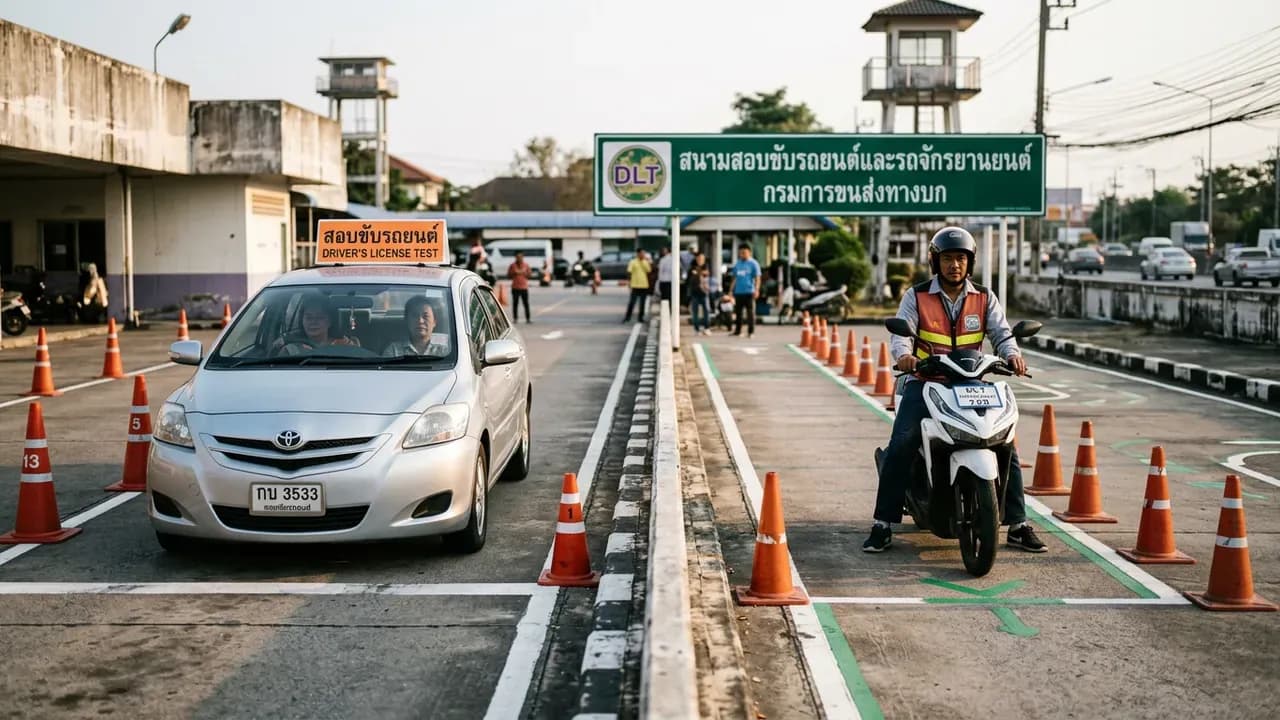
The physical fitness tests (colour-blindness, depth perception, peripheral vision, reaction time, brake reaction) are identical for both license types and only need to be done once if you apply for both on the same day. The written theory test is also the same test for both car and motorcycle licenses — it covers general traffic laws, road signs, and driving rules that apply to all vehicles. You only take it once even if applying for both licenses. If you are converting a foreign license, you skip both the written and practical tests for whichever category your foreign license covers. Where the tests differ is in the practical driving test (for new applicants only). The car practical test involves driving a car on a closed course: forward driving, reversing in a straight line, parallel parking or bay parking, stopping at a designated point, driving on a slope (hill start), and navigating an S-curve or similar manoeuvre. You must provide or arrange a car for this test — the DLT does not provide vehicles. The motorcycle practical test involves riding a motorcycle through a separate course: riding in a straight line slowly (balance test), riding over a narrow elevated plank, navigating a figure-eight or slalom between cones, and emergency braking. Again, you must provide or arrange a motorcycle. The motorcycle test is generally considered easier than the car test, but the balance and slow-riding elements catch some people off guard.
Common Misconceptions About Motorcycle Licensing
Misconception 1: 'A car license covers scooters under 125cc.' This is false in Thailand. No matter the engine size, any two-wheeled motor vehicle requires a motorcycle license. This includes 110cc scooters, 125cc automatics, and everything above. Misconception 2: 'Nobody checks for a motorcycle license.' While enforcement is inconsistent, police checkpoints targeting motorcycles are common, especially in Phuket, Pattaya, Chiang Mai, and near tourist areas. The fine is typically 500-1,000 THB, but the real cost is insurance invalidation if you have an accident. Misconception 3: 'My IDP covers motorcycles.' This depends on your home-country license. If your IDP reflects a car-only license from your home country, it does NOT cover motorcycles in Thailand. Check the vehicle categories listed on your IDP — it must explicitly include motorcycles. Misconception 4: 'Rental shops check your license, so if they rent to you it is fine.' Rental shops in Thailand frequently rent motorcycles to anyone without checking licenses. This does not make it legal, and it does not mean your insurance is valid. The rental shop's liability is separate from your legal obligation to hold the correct license. Misconception 5: 'If I have a Thai car license, I can ride a motorcycle.' No. The licenses are completely separate. You need both if you want to drive both vehicle types.
Which License Should You Get First?
If you plan to get both a car and motorcycle license, the most efficient approach is to apply for both at the same time during a single DLT visit. You share the medical certificate, residence certificate, photos, and physical tests across both applications, saving both money and time. However, if you can only get one now, consider your immediate needs. Get the car license first if: you own or will buy a car, you primarily use four-wheeled vehicles, you need a license for car rental, or your employer requires it. A car license is also the more broadly useful form of ID in Thailand. Get the motorcycle license first if: you primarily ride a scooter or motorcycle, you do not own or plan to use a car in Thailand, or you need to ride legally as soon as possible. Given that motorcycle accidents are the number one cause of injury and death among foreigners in Thailand, having a valid motorcycle license (and therefore valid insurance) is critically important for rider safety. Our recommendation for most expats: get both licenses in a single visit. The additional cost is minimal (50 THB more in DLT fees plus the cost of a motorcycle for the practical test if applicable), and having both licenses gives you maximum flexibility. If you use a service, ask about combined packages — most offer them, including TDL Service.
Not sure which option is right for you?
Our team provides free consultations to help you choose the best path for your situation.