Table of Contents
Overview: Thai Residence Certificate for Foreigners
If you plan to get a Thai driving license, buy a vehicle, or open a bank account, you will need a Thai Residence Certificate. Known officially as Form TM.16, this document is issued by the Thai Immigration Bureau as legal proof that you live at a specific address in Thailand.
The process is straightforward on paper, but small mistakes — wrong ink color, mismatched addresses — cause rejections every day. You need to visit the Immigration office that matches your registered address, bring the right documents, and pay a small fee. Processing takes anywhere from 1 to several business days depending on location.
This guide covers the full process: what the certificate is, all ten documented use cases, which Immigration offices to visit (with addresses and phone numbers), the complete document checklist, a step-by-step walkthrough, costs, processing times, common problems and how to avoid them, and answers to frequently asked questions.
Want us to handle it for you?
Our team obtains your residence certificate without you visiting Immigration. Same-day service available.
What Is a Thai Residence Certificate?
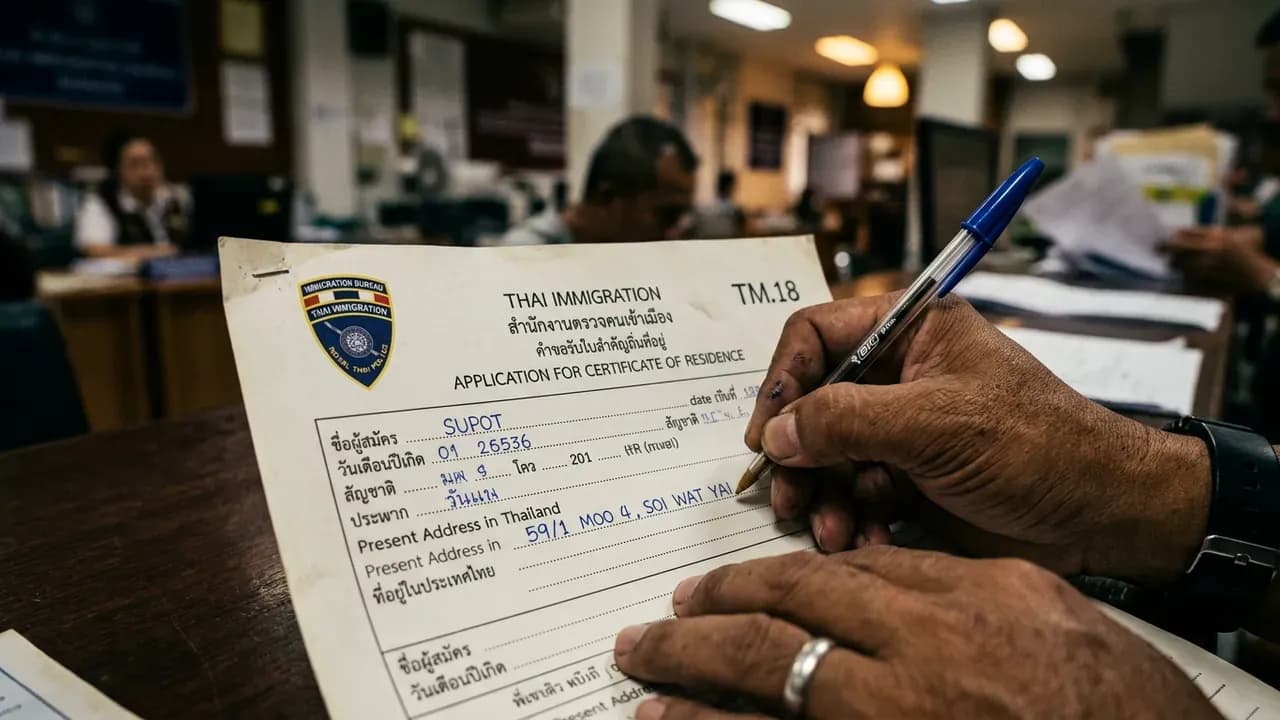
A Certificate of Residence, known in Thai as ใบรับรองถิ่นที่อยู่ (Bai Raprong Thin Thi Yu), is an official document issued by the Thai Immigration Bureau confirming a foreign national's current residential address within Thailand. The certificate itself is Form TM.16, while the application form you fill out is Form TM.18. It is a simple one-page document that states your name, nationality, passport number, and verified address.
It is important to understand that a residence certificate is NOT the same as Thai Permanent Residence. Permanent Residence is a separate immigration status that allows indefinite stay in Thailand and costs 191,400 THB to apply for. A residence certificate is simply proof of your current address — nothing more. You can apply for a new one each time you need it.
Who can apply? Foreign nationals on non-immigrant visas (Non-O, Non-B, Non-ED, Non-OA, LTR, Elite) can apply at any time. Tourist visa holders face inconsistent policies: Bangkok Chaeng Watthana generally does not issue certificates to tourist visa holders, while provincial offices in Pattaya, Chiang Mai, and elsewhere often do. Prerequisites include having a TM.30 filed in the system, at least one completed 90-day report (required in Bangkok), and at least 30 days remaining on your current visa or extension.
TM.16, TM.18 and the Letter You Actually Receive
Expats, agents and most Immigration counters call the proof-of-address letter 'the TM.16', and that is the term to use when you ask for it. Strictly speaking, though, the Immigration Bureau's own public-service handbook titled 'Application for Certificate of Residence (TM.16)' describes a different procedure: the certificate issued to foreigners who have been granted permanent residence by the Immigration Commission, applied for on form TM.18, with a fee of 191,400 THB (95,700 THB for spouses and children of Thai nationals) and a three-working-day service standard.
The letter the DLT, banks and district offices ask for is the ordinary Certificate of Residence (หนังสือรับรองถิ่นที่อยู่): a single page on Immigration letterhead confirming that, according to Immigration's records, you live at the address on your TM.30. It costs 200-500 THB, is valid for 30 days, and needs no immigration status beyond a valid stay — which is why tourist-visa holders can sometimes obtain one at provincial offices.
The practical consequence: if a search for 'Thailand residency' or 'residence permit' brought you here, the residence certificate gives no right to stay and is not a step toward permanent residence. It only proves where you live. When a DLT officer asks for 'the TM.16', this letter is what they mean.
Why You Need a Residence Certificate
The residence certificate is required for a surprisingly wide range of administrative and legal processes in Thailand.
- Thai driving license — The Department of Land Transport (DLT) requires a residence certificate from Immigration when applying for or renewing a Thai driving license. Accepted documents include the TM.16, Yellow House Book, or an Embassy Letter (Affidavit of Residence). Work permits are not accepted as proof of address.
- Vehicle registration, purchase, or sale — Required by DLT when registering a car or motorcycle in your name, or transferring ownership.
- Opening a Thai bank account — Some banks require a residence certificate as part of their Know Your Customer (KYC) process. Not all banks require it, but it is the most reliable proof of address.
- Work permit applications and renewals — Some employers or government agencies require it to validate a foreign employee's registered address.
- Marriage registration — May be required when registering a marriage at your local Amphur (district office).
- Yellow House Book application — Part of the documentation needed to obtain a Yellow House Registration Book (Tabien Baan).
- Property transactions — May be required for certain property ownership or transfer processes.
- Legal and civil affairs — Court proceedings, notarial services, or other legal processes may require proof of residence.
- Utility and internet contracts — Setting up utility accounts or internet service in your name.
- Visa extensions — Certain immigration processes for acquiring long-term visas or extensions may require it.
The most common use case by far is obtaining a Thai driving license. If that is your goal, plan to use the certificate within a few days of receiving it, as it is only valid for 30 days.
Are You Eligible? Check Your Visa Type First
Before anything else, confirm your visa type qualifies at the office you will actually use. This is the single most common reason applications are refused, and it is the one thing you cannot fix at the counter. Bangkok Chaeng Watthana is the strictest office in Thailand; several provincial offices are materially more flexible. Find your visa below.
| Your visa or status | Bangkok (Chaeng Watthana) | Provincial offices | Notes |
|---|---|---|---|
| Non-Immigrant B (business / employment) | Yes | Yes | Standard case. Bring your work permit if you have one — some officers ask. |
| Non-Immigrant O (family, retirement, volunteer) | Yes | Yes | Includes O-A and O-X long-stay retirement extensions. |
| Non-Immigrant ED (education) | Yes | Yes | Bring a current enrolment letter if your extension is recent. |
| Non-Immigrant M (media) | Yes | Yes | Standard case. |
| LTR (Long-Term Resident, 10-year) | Yes | Yes | Covers retirees, remote workers, wealthy global citizens and skilled professionals. |
| Thailand Privilege / Elite (all tiers) | Yes | Yes | Your member services contact can often file the TM.30 for you. |
| Tourist visa (TR / SETV / METV) | No | Often yes | Chaeng Watthana refuses tourist visas. Jomtien (Pattaya), Chiang Mai and Phuket commonly accept them with a valid TM.30. |
| Visa exemption (30-day stamp) | No | Varies | Least reliable case. Call the office before travelling, or use an embassy letter instead. |
Two prerequisites that apply to every visa type
- An active TM.30 for your current address, filed after your most recent entry into Thailand. Leaving and re-entering the country invalidates the previous one — this is the number-one rejection cause among our clients.
- At least one completed 90-day report (TM.47) if you are applying in Bangkok. Provincial offices apply this loosely or not at all, so if you have been in Thailand under 90 days, a provincial office is your realistic option.
If your visa type is refused at your local office, you have two fallbacks: apply at a provincial office if your TM.30 is registered there, or request an Affidavit of Residence from your embassy. The DLT accepts an embassy letter in place of the TM.16 — banks usually do too.
Where to Get a Residence Certificate
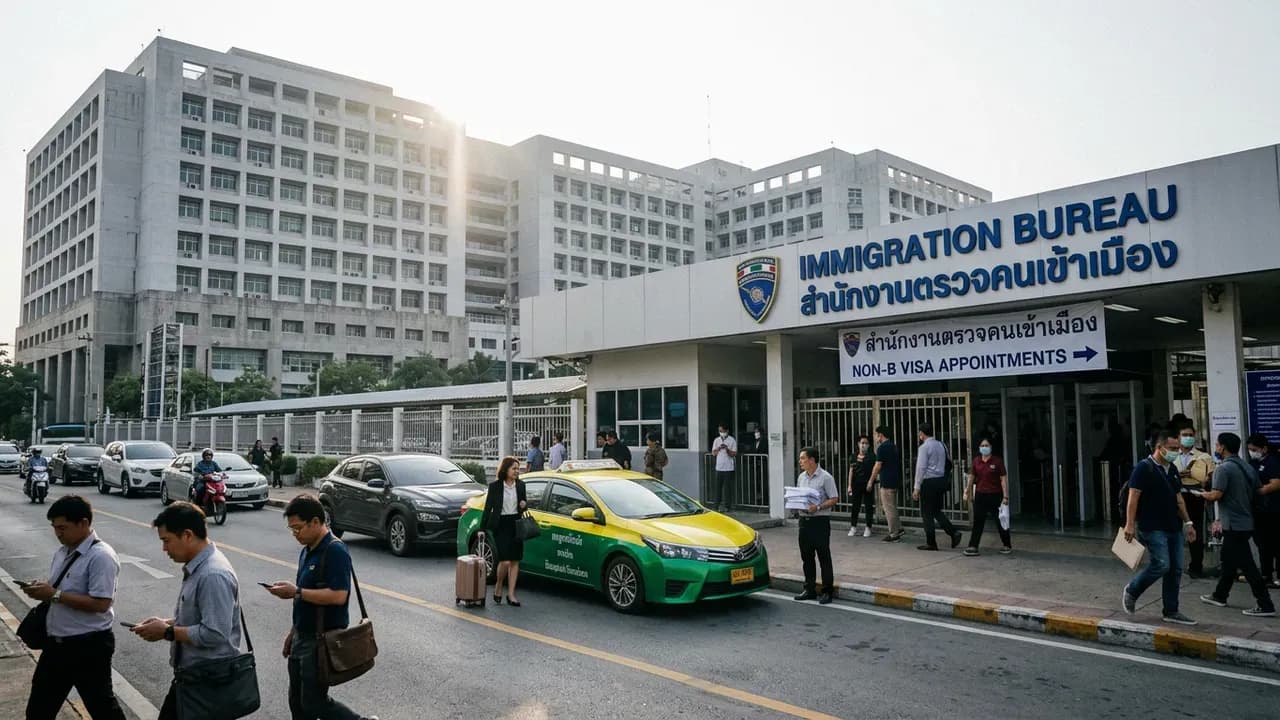
You must apply at the Immigration office that corresponds to your TM.30 filing location — that is, the province where you are registered as living. Here are the major offices:
Bangkok — Chaeng Watthana (Main Office)
Address: Immigration Division 1, Chalermprakiat Government Complex, Building B, Floor 2, 120 Moo 3, Chaengwattana Road, Soi 7, Thung Song Hong, Lak Si, Bangkok 10210
Phone: 0-2141-7869
Hours: Mon-Fri 8:30-16:30 (queue tickets stop at 15:30, lunch break 12:00-13:00)
Fee: 200 THB
Strictest office. Requires 90-day report. Generally does not issue to tourist visa holders. Certificates are purpose-specific (car and motorcycle may need separate certificates).
Chiang Mai
Address: 71 Moo 3, Airport Road, Suthep, Muang, Chiang Mai 50200 (next to Chiang Mai International Airport)
Phone: 053-369-666
Hours: Mon-Fri 8:00-12:00 for certificate applications
Fee: Standard ~50 THB (mail, ~1 month) / Rush 500 THB (next business day)
Apply between 8:00-10:00 AM for best results. Photo and copy services available behind the main building (photos 200 THB for six, copies 2 THB per page).
Phuket (Main Office)
Address: 482 Phuket Road, Talat Yai, Muang, Phuket 83000
Phone: 076 221 905 / Hotline: 1178
Hours: Mon-Fri 9:00-12:00 & 13:00-16:00
Fee: 200-500 THB
Room 101 for residence certificates. Processing typically takes 1-2 business days. Satellite offices in Patong (10:00-15:00) and Blue Tree (10:00-15:00).
Pattaya / Chonburi (Jomtien)
Address: Jomtien Immigration Office, Chonburi
Phone: 038-069-054
Hours: Mon-Fri 8:30-16:30
Fee: ~300 THB
Known to issue certificates to tourist visa holders. Same-day service possible through agents (submit by 11:00, pickup in afternoon).
Documents Required
Document requirements vary slightly between offices, but this checklist covers every major Immigration office:
- Application Form TM.18 — Download online or obtain at the Immigration office on arrival.
- Original passport plus photocopies of: bio-data page, current visa/extension stamp, most recent entry stamp, and TM.6 departure card or TDAC confirmation (since May 2025). Sign all copies in BLUE ink.
- TM.30 receipt (Address Notification Receipt) — Original plus a signed photocopy.
- 90-day report receipt (TM.47) — Receipt of your most recent 90-day notification. Required especially at Bangkok Chaeng Watthana.
- Proof of address — Lease agreement or rental contract, copy of landlord's ID card, copy of landlord's house registration book (Tabien Baan). Address must match your TM.30 exactly.
- Passport-size photos — Bangkok requires 3 photos (4x6 cm), other offices typically require 2. White background, straight-facing, taken within 6 months.
Additional Documents (If Applicable)
- Work permit — Original plus copies of first page and validity extension page.
- Marriage certificate — Original plus copy.
- Birth certificate or related documents — Original plus copy.
Critical Rules for Documents
- ALL photocopies must be signed by you in BLUE ink (not black). Black ink signatures are rejected at many offices, particularly Bangkok.
- Sign across the copied image itself, not on blank space.
- Your address must match EXACTLY across your lease, TM.30, and application form. Even small discrepancies cause rejection.
- Bring originals of everything for verification. Digital copies or printouts without wet signatures are not accepted.
Document Checklist: Originals, Copies and the Rules for Each

Print this and tick it off the night before. Every item comes from what the offices above actually ask for; the notes column is where applications fail.
| Item | Original | Signed copies | Notes |
|---|---|---|---|
| TM.18 application form | 1, completed in English block capitals | — | Fill it in at home. Download it from the links below or take one at the counter. |
| Passport | Yes | 1 set: bio page, current visa or extension stamp, latest entry stamp, TDAC confirmation | Sign each copy in blue ink, across the image. |
| TM.30 receipt | Yes | 1 | Must have been filed after your latest entry and match the address on the form exactly. |
| 90-day report receipt (TM.47) | Yes | 1 | Enforced at Bangkok Chaeng Watthana. Bring it anywhere if you have one. |
| Lease, rental contract or hotel booking | Yes | 1 | The address must match the TM.30 to the letter, including unit number. |
| Landlord's ID card and house book (Tabien Baan) | — | 1 copy of each, signed by the landlord | Asked for when you rent privately. Hotels rarely need this. |
| Passport photos, 4x6 cm, white background, under 6 months old | 2 (3 in Bangkok) | — | Say '4 by 6' at the photo shop. The default 3.5x4.5 size is refused. |
| Cash for the fee | 200-500 THB depending on the office | — | Cards, QR codes and PromptPay are not accepted at the counter. |
| Blue ballpoint pen | Yes | — | Black signatures are refused at Bangkok and many other offices. |
| Work permit, marriage certificate (if applicable) | Yes | 1 | Only if the officer asks or your stated purpose relates to it. |
Bring one spare set of every copy. Officers occasionally ask for more than the list, and the copy shop queue at Chaeng Watthana runs 20-30 minutes at peak.
Forms and city guides
Official PDFs, a field-by-field TM.18 walkthrough with a sample form, and the two office guides with directions, hours and queue tactics.
Step-by-Step Process
From preparation to collecting your certificate:
Step 1: Confirm Prerequisites
Before visiting Immigration, verify three things: (1) your TM.30 is current and registered in the system — if you left Thailand and re-entered, it must be updated after your return, (2) you have completed at least one 90-day report if applying in Bangkok, and (3) you have at least 30 days remaining on your visa or extension of stay.
Step 2: Gather and Prepare All Documents
Collect all items from the document checklist above. Make photocopies of every relevant passport page. Sign all copies in blue ink across the image. Fill out the TM.18 application form — you can download it online or get it at the office. Bring extra copies and photos just in case.
Step 3: Visit Your Local Immigration Office
Go to the Immigration office corresponding to your TM.30 registration location. You cannot apply at a random office. Arrive early — ideally by 8:00-8:30 AM at Bangkok Chaeng Watthana. Take a queue ticket at the information counter when you arrive.
Step 4: Document Verification
An officer at the information or document-check counter will review your documents for completeness. If anything is missing or addresses do not match, you will be sent away to correct the issue. This is the most common point of failure, so double-check everything before you go.
Step 5: Submit Application and Pay Fee
After passing the document check, submit your application to the processing counter. Pay the fee (200-500 THB depending on location). You will receive a receipt and a collection date. Some offices process same-day; others take 1-5 business days.
Step 6: Collect Your Certificate
Return on the specified date with your passport and receipt. Some offices mail the certificate; others require in-person pickup. In Phuket, processing typically takes 1-2 business days. In Chiang Mai, standard mail delivery takes about one month, but rush service (500 THB) gets it to you the next business day.
How Long It Actually Takes, Office by Office
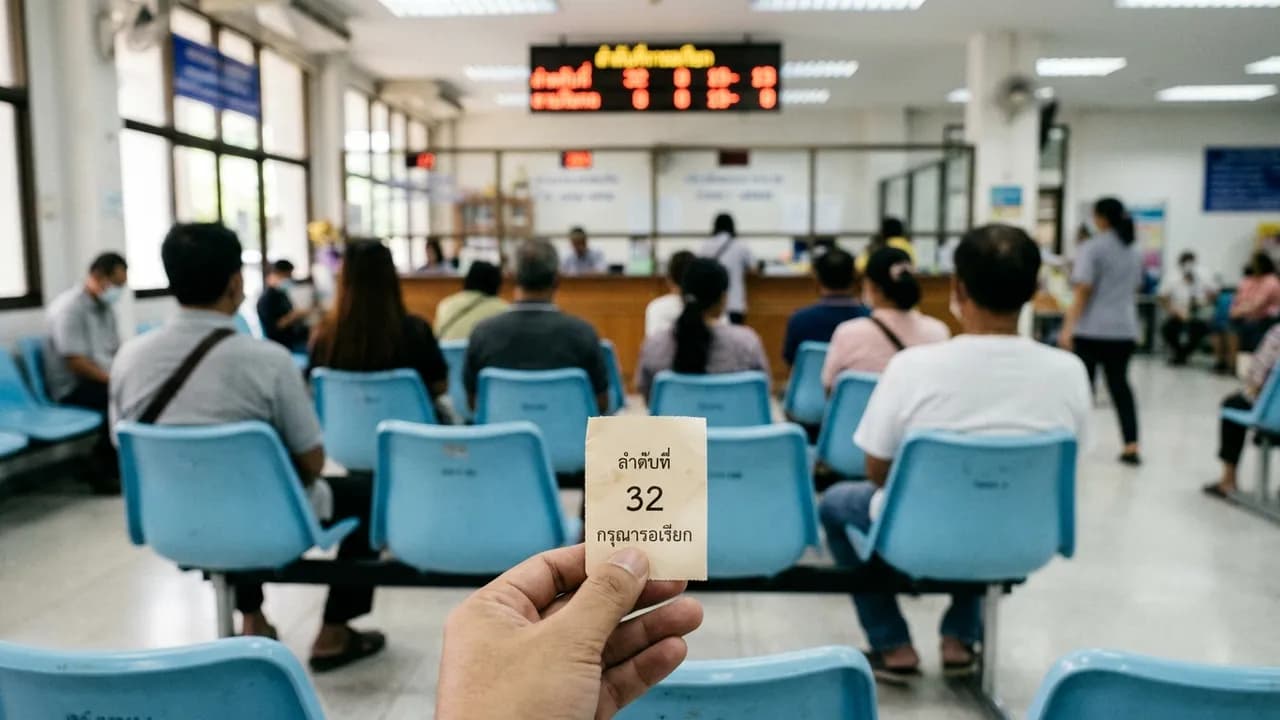
Two clocks run: the time you spend at the counter, and the time until you hold the certificate. They differ a lot by office, and both matter when a DLT appointment is already booked.
| Office | Time at the counter | Until you hold the certificate |
|---|---|---|
| Bangkok — Chaeng Watthana | Arrive 7:45-8:00; queue tickets from ~8:00; 1-3 hours of waiting plus about an hour of processing | 2-3 hours later the same day on quiet mid-week mornings; otherwise 1-5 working days (officially up to 15) |
| Pattaya — Jomtien | 1-2 hours; doors open 8:30 | Same day if you are early and complete; standard 1-2 working days |
| Chiang Mai — Airport Road | Applications 8:00-12:00, best 8:00-10:00 | About one month by mail (~50 THB), or the next working day with the 500 THB rush service |
| Phuket Town — Room 101 | 9:00-12:00 and 13:00-16:00 | 1-2 working days |
If your TM.30 was filed only this week, ask the information counter to confirm it shows in the system before you take a queue ticket — a filing that has not propagated is treated as no filing. Then work backwards from the day you need the certificate: it must be dated within 30 days when you hand it in, so collecting it 3-5 days before your DLT appointment is the sweet spot.
Costs and Fees
Fees are not standardized across Thailand and vary significantly by office.
| Location / Service | Cost |
|---|---|
| Bangkok (Chaeng Watthana) | 200 THB |
| Chiang Mai (standard, by mail) | ~50 THB |
| Chiang Mai (rush, next business day) | 500 THB |
| Pattaya / Chonburi (Jomtien) | ~300 THB |
| Other provincial offices | 200-500 THB |
| Expedited same-day (some offices) | Up to 1,500 THB |
| TDL Service (all-inclusive, we do everything) | 3,500 THB one document (TM.30 incl.) / 4,500 THB both car & motorcycle (TM.30 incl.) |
Note: Some sources report that the certificate should technically be free under Thai law. However, the vast majority of offices charge 200-500 THB as standard practice. Do not confuse these fees with Thai Permanent Residence application fees (191,400 THB), which is a completely different service.
Processing Time
Processing times vary significantly by location and workload.
| Location | Typical Processing Time |
|---|---|
| Bangkok (Chaeng Watthana) | 1-5 business days (officially up to 15) |
| Chiang Mai (standard) | ~1 month (by mail) |
| Chiang Mai (rush) | Next business day |
| Phuket | 1-2 business days |
| Pattaya / Chonburi | Same day to 1-2 business days |
| Other provincial offices | 1-5 business days |
If you need the certificate for a DLT appointment, plan your Immigration visit accordingly. The certificate is only valid for 30 days, so do not apply too early either. A good strategy is to get the residence certificate 3-5 days before your scheduled DLT visit.
Common Problems and How to Avoid Them
Immigration offices reject residence certificate applications more often than you might expect. These are the ones we see most often — and how to prevent them:
Missing or outdated TM.30
The TM.30 is the single most critical prerequisite. If you left Thailand and re-entered, your landlord must file an updated TM.30 after your return. A TM.30 filed while you are still outside Thailand is invalid. Verify it is in the system before applying.
Address mismatch between documents
Your TM.30 address, lease agreement address, and application form address must all be identical. Even minor discrepancies like different unit numbers or spelling variations cause rejection. Double-check everything matches before submitting.
Missing 90-day report (Bangkok)
Bangkok Chaeng Watthana requires at least one completed 90-day report. If you have not been in Thailand long enough, try a provincial office which may be more lenient, or obtain an embassy letter as an alternative.
Wrong ink color on photocopies
All photocopies must be signed in BLUE ink. Black ink signatures are rejected at Bangkok and many other offices. Bring your own blue pen.
Purpose-specific certificates (Bangkok)
In Bangkok, certificates may be issued for a specific purpose. A certificate for 'motorcycle license' will not work for 'car license.' State all purposes you need when applying, or request multiple certificates.
Tourist visa rejection (Bangkok)
Bangkok generally does not issue certificates to tourist visa holders. If you are on a tourist visa, apply at a provincial office like Pattaya or Chiang Mai, or get a proof-of-address letter from your embassy instead.
Insufficient visa validity
Some offices require at least 30 days remaining on your visa. Apply well before your visa is close to expiry.
Incomplete passport copies
Immigration wants copies of ALL relevant pages: bio-data page, visa page, entry stamp, extension stamps, and TM.6/TDAC confirmation. Copy every page that has any stamp or notation.
Tips and Tricks
These practical tips can save you hours of waiting and help you avoid rejection:
- Arrive early. At Bangkok Chaeng Watthana, aim for 8:00-8:30 AM. Avoid arriving after 11:00 AM as you may wait through the lunch break.
- Tuesday through Thursday tends to be less busy than Monday or Friday. Avoid going on the first working day after a long holiday.
- At Chaeng Watthana, take a queue ticket immediately. It has a QR code you can scan to monitor your position on your phone — you do not need to physically wait at the counter.
- Photo booths and copy shops are available inside Chaeng Watthana. You can get passport photos, photocopies, and other services on-site if you forget something.
- Fill out the TM.18 form before arriving. Download it online and complete it at home to save time at the office.
- Bring extra photocopies of everything. Officers occasionally ask for additional copies beyond what is listed.
- If you need the certificate for a driving license, time your visit so you go to DLT within a few days. The certificate expires after 30 days.
- Dress neatly. While there is no formal dress code, officers may treat well-presented applicants more favorably.
- Bring a book, phone charger, or something to pass the time. Wait times at Bangkok can be 1-3 hours.
- In Chiang Mai, apply between 8:00-10:00 AM for the best experience. Applications are accepted until noon but earlier is better.
Validity Period
The most commonly reported validity period for a Thai residence certificate is 30 days from the date of issue. This is confirmed by multiple Immigration offices and legal sources, and it is the practical validity for DLT and bank purposes. Some provincial offices have been reported to issue certificates valid for 6 or even 12 months, but this varies and should not be relied upon.
Plan to use the certificate within 30 days of receiving it. If you need it for a DLT appointment, schedule your Immigration visit accordingly. You can apply for a new certificate each time you need one — there is no limit on how many times you can request it.
What the Certificate Is Used For — and What Each Office Accepts
The certificate is the same one-page letter whoever asks for it, but the rules attached to it change with the purpose.
| Purpose | Who asks for it | What they accept | Rules to know |
|---|---|---|---|
| Thai driving licence (new, conversion, renewal) | DLT | Original Immigration letter, Yellow House Book, or an embassy affidavit of residence | Dated within 30 days. Work permits are not accepted. Bangkok issues per purpose, so car and motorcycle may need two letters. |
| Vehicle registration, purchase or transfer | DLT | Same as above | Original only, dated within 30 days. The DLT keeps it. |
| Opening a bank account | The bank branch | Immigration letter; some branches also take a work permit or other proof | Policy varies by branch. The Immigration letter is the one no branch refuses. |
| Marriage registration, Yellow House Book, property and legal matters | District office (Amphur), Land Office, courts, notaries | Immigration letter | Ask in advance whether they want a letter issued within 30 days. |
| Your embassy or consulate | — | Not required: the embassy is the alternative issuer | If Immigration refuses you, the embassy's affidavit of residence replaces the letter at the DLT. |
The DLT keeps the original, so a certificate used for a car licence cannot be reused for a motorcycle licence or a vehicle transfer. Ask for one per purpose when you apply.
Alternative Proof-of-Address Documents
The TM.16 from Immigration is the gold standard for proof of address, but other documents may be accepted depending on the situation:
| Document | Accepted by DLT? | Notes |
|---|---|---|
| TM.16 (Residence Certificate) | Yes — gold standard | Valid 30 days. Required for most DLT processes. |
| Yellow House Book (Tabien Baan) | Yes | More permanent, harder to obtain. Does not expire like TM.16. |
| Work Permit | No | Not accepted by DLT. The address may be the company's, not your residence, and may not be up to date. |
| Embassy Letter (Affidavit of Residence) | Yes | Official proof of your current address. Accepted by DLT. |
| TM.30 Receipt | No | Prerequisite for TM.16 only. Not proof of address on its own. |
If Immigration Refuses You: What to Do Next
Most refusals are one of six situations, and each has a specific fix. Arguing at the counter is not one of them.
No TM.30 on file
Nothing can be issued until it exists. Your landlord or hotel files it, online or at Immigration; if they will not, the filing can be done on your behalf — it is included in our service. Once filed, confirm it appears in the system before you queue again.
The TM.30 predates your last entry
Leaving and re-entering Thailand voids the previous notification. Have it re-filed after your return, then re-apply — the rest of your paperwork is unchanged.
Tourist visa or visa exemption refused at Chaeng Watthana
Bangkok will not change its mind. Either apply at the provincial office that covers your TM.30 address — Jomtien, Chiang Mai and Phuket commonly accept tourist visas — or obtain an Affidavit of Residence from your embassy, which the DLT accepts in place of the Immigration letter.
No 90-day report yet (Bangkok)
A 90-day report cannot be filed early. Provincial offices apply the rule loosely or not at all; otherwise the embassy affidavit is the route.
Address mismatch or missing copies
This is a paperwork rejection, not a refusal. Correct the document, sign the copies in blue ink and re-queue — at Jomtien and Phuket that can still be the same day.
Certificate issued for the wrong purpose (Bangkok)
A letter written for 'motorcycle licence' will be refused for a car licence. Re-apply stating every purpose on the TM.18, or request one certificate per purpose.
The embassy route, explained
Most embassies in Bangkok notarise a sworn statement of your address — called an affidavit or statutory declaration of residence — by appointment. Fees and availability differ by embassy, so check its notarial-services page. Two cautions: it records your own sworn statement rather than verifying the address, and some provincial DLT offices are reported to insist on the Immigration letter, so confirm with your DLT branch first.
Do It Yourself or Use Our Service? An Honest Comparison
Both routes end with the same letter. What differs is who carries the TM.30 problem, the queue and the risk of a second trip.
| Do it yourself | With TDL Service | |
|---|---|---|
| Government fee | 200-500 THB in cash, per certificate | Included |
| TM.30 filing | Your landlord's job — no TM.30, no certificate | Included: we file it if it is missing |
| Your time | Half a day to a full day at Immigration, plus a second trip if anything is rejected | None: you hand over your passport and documents, we return both with the certificate |
| Second certificate (car + motorcycle) | Pay the fee twice and state both purposes | 4,500 THB for both |
| Rejection risk | Yours to manage: TM.30, ink colour, address match, photo size | We run the document check before anything is submitted |
| Price | 200-500 THB plus photos and copies | 3,500 THB for one certificate, 4,500 THB for car + motorcycle — nothing else to pay |
If you live near your Immigration office, have a compliant TM.30 and a free morning, doing it yourself is the rational choice and this guide is everything you need. The service earns its price when a second trip would cost you a workday or a flight.
Let Us Handle It For You
If you would rather not spend a day at Immigration, we handle the entire residence certificate process for you. You provide your passport and supporting documents; we run the document check, file your TM.30 if it is missing, submit the application, pay the government fee, and collect the finished certificate. You skip the queues and you do not need to take time off work. Our team processes residence certificates every week and knows what each office asks for — which is what prevents the rejections that send most people home for a second visit.
The trade-offs are honest ones: it costs more than going yourself, and you hand over your original passport for the duration of the application. We return it together with the certificate. If you would rather do it alone, the guide above covers every requirement in full — we would rather you succeed on your own than turn up at Immigration unprepared.
Our all-inclusive price: 3,500 THB for one certificate (TM.30 filing included), or 4,500 THB for both the car and motorcycle certificates (TM.30 included). That covers the government fee and our service fee — there is nothing else to pay.
Get your answer now — chat with us
Message us what you need on WhatsApp or Messenger. A real person replies within 2 hours with your exact steps and price.