In This Article
Downloads & related guides
- Vehicle registration and road tax renewal — the full yearly renewal: Por Ror Bor, inspection, then tax
- Thailand road tax rates — what you pay once the inspection is done
When Is a Vehicle Inspection Required?
Private cars (sedans, pickups, SUVs, vans) need an inspection every year once they are more than 7 years past first registration. Motorcycles need one once they are more than 5 years past it. The DLT applies these thresholds nationwide, and the age counts from the first registration date in the blue or green book, not the model year. Below those ages you simply pay the annual road tax. Above them, the DLT won't take your tax payment, at a counter or online, until a passed inspection is on record. You can have a private car inspected up to 90 days before its tax expires. Vehicles for hire have their own schedules: the DLT allows them only 30 days ahead. Cars converted to LPG or CNG also need their gas system tested and certified by a licensed engineer, separately from the normal inspection.
Where to Get a Vehicle Inspection
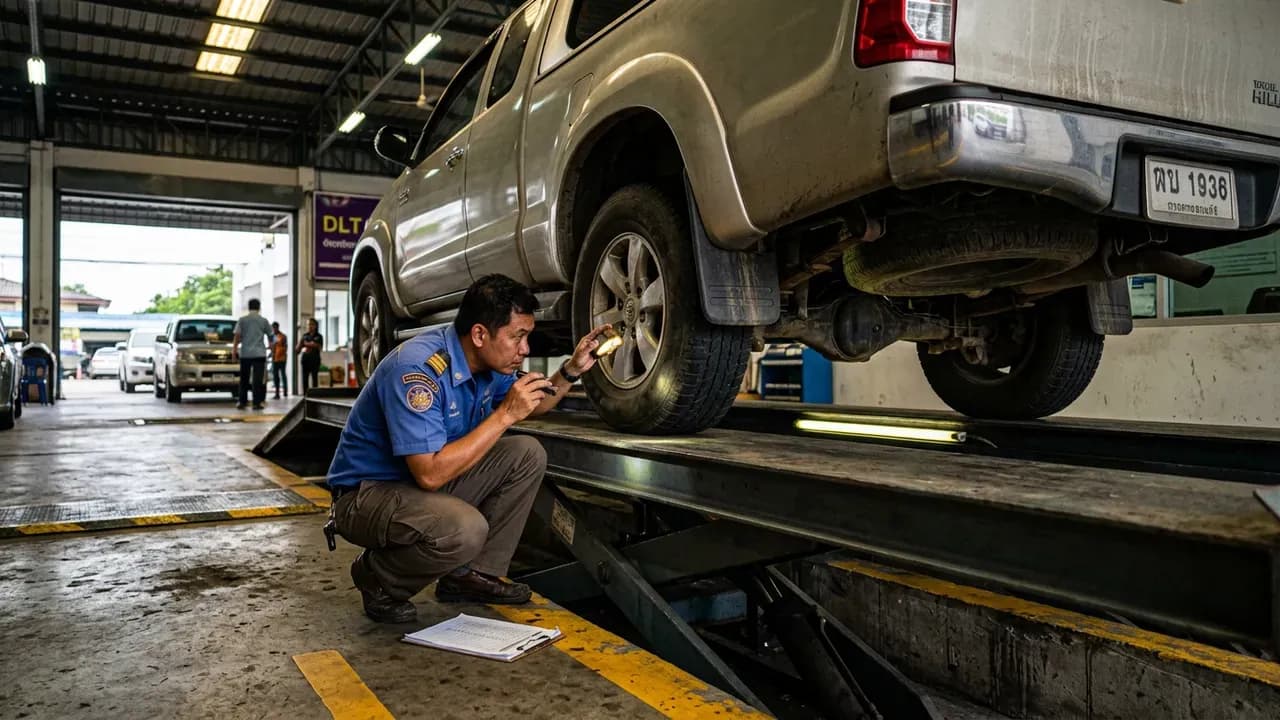
Most private cars and motorbikes are inspected at a private Tor Ror Or (ตรอ.) station, licensed by the DLT to inspect on its behalf to the same standard. They are everywhere: search Google Maps for 'ตรอ' or 'สถานตรวจสภาพรถ' (vehicle inspection station), or ask any mechanic. You don't need to go back to the province where the vehicle is registered. Many stations also sell Por Ror Bor and pay the road tax for you in the same visit, and a passed result goes straight into the DLT's system, so you can pay the tax online afterwards. DLT offices run their own inspection lanes, mainly for cases a private station can't take. The Nonthaburi DLT office's manual, for example, sends vehicles whose tax lapsed more than a year ago and vehicles over 2,200 kg to its own lane. Expect the DLT office too if the vehicle has been modified from its registration (engine swap, full colour change), its chassis or engine number is damaged or unreadable, its tax has lapsed for more than 3 years, or it was stolen and recovered. A certificate from a licensed private station is accepted by every DLT office.
What They Check During the Inspection
The inspection covers the paperwork and the hardware. Identity: the chassis number, engine number, plates, fuel type and engine type must match the registration book. Brakes: the car goes on rollers and braking force is measured on each side. Lights: headlight aim and brightness are measured, and every other light (tail, brake, indicators, reverse) must work. Emissions: CO and HC for petrol engines, smoke for diesels (more on that below). Noise: a car's exhaust must stay at or under 95 dB. Body and running gear: tyres, steering, suspension, seat belts, wipers, horn, fuel system, exhaust and the general condition of the body, including rust or modifications that make the vehicle unsafe.
Emissions Test: Part of the Same Inspection
For a private car or motorbike, the emissions check is part of the Tor Ror Or inspection, and the passed inspection is what the DLT looks for when you pay road tax. For petrol engines the station measures carbon monoxide (CO) and hydrocarbons (HC) at the tailpipe. For diesels it measures smoke: the filter-paper reading must not exceed 50% and opacity must not exceed 45%. A check-engine light, a failing catalytic converter or visible smoke are the usual reasons for an emissions fail, so get those fixed before you go.
Inspection Cost
At a private Tor Ror Or station a motorcycle inspection costs 60 THB. A car costs 200 THB if its unladen weight is up to 2,000 kg and 300 THB above that; the station displays its rates. Stations that also buy your Por Ror Bor and pay the tax for you may add a service charge for that. At a DLT office's own inspection lane, the fee for an annual-tax inspection is 10 THB for a motorcycle and 50 THB for a car. The fee is charged per attempt, pass or fail. If you fail at a private station and bring the vehicle back to the same station within 15 days, the retest costs half; after 15 days, or at a different station, you pay the full fee again. Road tax and Por Ror Bor are paid on top of the inspection.
How to Pass: Pre-Inspection Checklist
To avoid failing and having to return, run through this checklist before your inspection. Check all lights: headlights (both low and high beam), brake lights, tail lights, turn signals (front and rear), reverse lights, and license plate lights. Replace any burned-out bulbs. Test your brakes: ensure the foot brake stops the vehicle firmly and evenly. The handbrake should hold the vehicle on a slope. If brakes feel spongy or pull to one side, have them serviced. Inspect your tires: look for adequate tread depth, and check for cuts, bulges, or uneven wear. Replace worn tires before the inspection. Check your horn: it must produce a clear, audible sound. Test your windshield wipers: they must clear the windshield effectively. Wipers are cheap to replace. Address engine issues: if your check engine light is on or your exhaust is visibly smoky, get the engine serviced. Failed emissions are a common reason for inspection failure. Check your steering: if the steering wheel has excessive play or vibrates, have the steering system inspected. Ensure your mirrors are intact: both side mirrors and the rear-view mirror should be in place and functional. Fix any obvious structural damage: cracked windshields, hanging bumpers, or excessive rust.
What Happens If You Fail the Inspection
You are not fined for failing. The inspector tells you which items failed, the fee is still charged, and your documents are handed back so you can get the problem fixed. Bring the vehicle back to the same private station within 15 days and the retest costs half the fee; wait longer, or go to another station, and you pay in full. The usual failures are cheap to fix: blown bulbs (especially brake lights and indicators), worn tires, a horn that doesn't work, wipers that smear. Emissions over the limit, weak or uneven brakes and steering play cost more, because they mean real repair work. If the vehicle has serious structural problems such as a bent frame or heavy corrosion, get a quote before you sink money into it. A vehicle that can't pass can't renew its road tax, and shouldn't be on the road.
Motorcycle Inspection Requirements
A motorcycle needs an inspection every year once it is more than 5 years past first registration; under that, you just pay the 100 THB road tax and Por Ror Bor. The 5-year rule is the DLT's national rule for motorcycles, not a local variation. The check covers the same ground as a car's, adapted to two wheels: frame and engine numbers against the green book, front and rear brakes, lights (headlight, tail light, brake light, indicators), tires, horn, mirrors and exhaust. It costs 60 THB at a private Tor Ror Or station, or 10 THB in the cases where a DLT office inspects the bike itself. Common failure points for motorcycles are burned-out turn signal bulbs, worn tires, and non-functional horns. Before taking your motorcycle for inspection, replace any dead bulbs, ensure both brakes work properly, check tire condition, and confirm your horn is loud and clear. Most issues are inexpensive to fix at any motorcycle repair shop.
Make sure you are properly licensed
The most important step before driving in Thailand is having a valid license. We handle the entire process for you.