In This Guide
Why a Motorcycle License Matters in Pattaya
Pattaya is one of the most popular destinations in Thailand for renting scooters and motorcycles. Thousands of tourists and expats ride motorbikes daily through the city streets, along Beach Road, through Jomtien, and up into the hills of Pratumnak. However, Pattaya is also one of the strictest areas in Thailand for motorcycle license enforcement. The Pattaya police conduct regular checkpoints, especially along Beach Road, Second Road, Thappraya Road, and the roads around Jomtien. At these checkpoints, officers stop motorcyclists and check for a valid driving license. If you cannot produce a valid motorcycle license (Thai or International Driving Permit with motorcycle endorsement), you face an immediate fine and your bike may be impounded. Beyond police enforcement, there is a critical insurance issue. If you are involved in a motorcycle accident in Pattaya without a valid motorcycle license, your travel insurance and health insurance will almost certainly deny your claim. Pattaya has one of the highest motorcycle accident rates in Thailand, and hospital bills for serious injuries can easily reach 500,000-2,000,000 THB or more. Bangkok Hospital Pattaya, Memorial Hospital, and Pattaya International Hospital all report treating numerous unlicensed foreign riders each month — many of whom discover only after their accident that their insurance will not pay. A Thai motorcycle license costs just 105 THB and takes less than a day to obtain. The cost of not having one can be catastrophic.
Pattaya Police Crackdowns on Unlicensed Riders
Pattaya police have significantly increased enforcement against unlicensed motorcycle riders in recent years. Here is what you need to know about current enforcement. Checkpoint locations: Regular checkpoints are set up on Beach Road (near the Dolphin Roundabout and near Walking Street), Second Road (near Soi 6 and near Pattaya Klang), Thappraya Road (between Pattaya and Jomtien), Sukhumvit Road (near the Pattaya entrance points), and Jomtien Beach Road. Checkpoints are most common during the day between 10:00 AM and 4:00 PM, and again in the evening between 8:00 PM and midnight. Fines: The standard fine for riding a motorcycle without a valid license is 1,000 THB, payable at the police station. However, the fine can increase to 2,000 THB for repeat offenders. If you are caught without any license at all (not just a motorcycle license), the fine may be higher and your motorcycle can be impounded. If the motorcycle is impounded, retrieving it costs an additional fee and requires someone with a valid license to collect it. Important: A car license does not allow you to ride a motorcycle in Thailand. Your Thai driving license must specifically include a motorcycle endorsement, or you must have a separate motorcycle license. Similarly, an International Driving Permit only covers motorcycles if it includes the motorcycle category (Category A). Many foreigners have an IDP that only covers cars and mistakenly believe it covers motorcycles as well — it does not. The Pattaya police are well aware of this distinction and will check your license category. Helmet enforcement: Pattaya also enforces helmet laws. Riding without a helmet is a separate fine of 500 THB. If caught without both a license and a helmet, you face combined fines of 1,500-2,500 THB.
Getting a Motorcycle License at Pattaya DLT
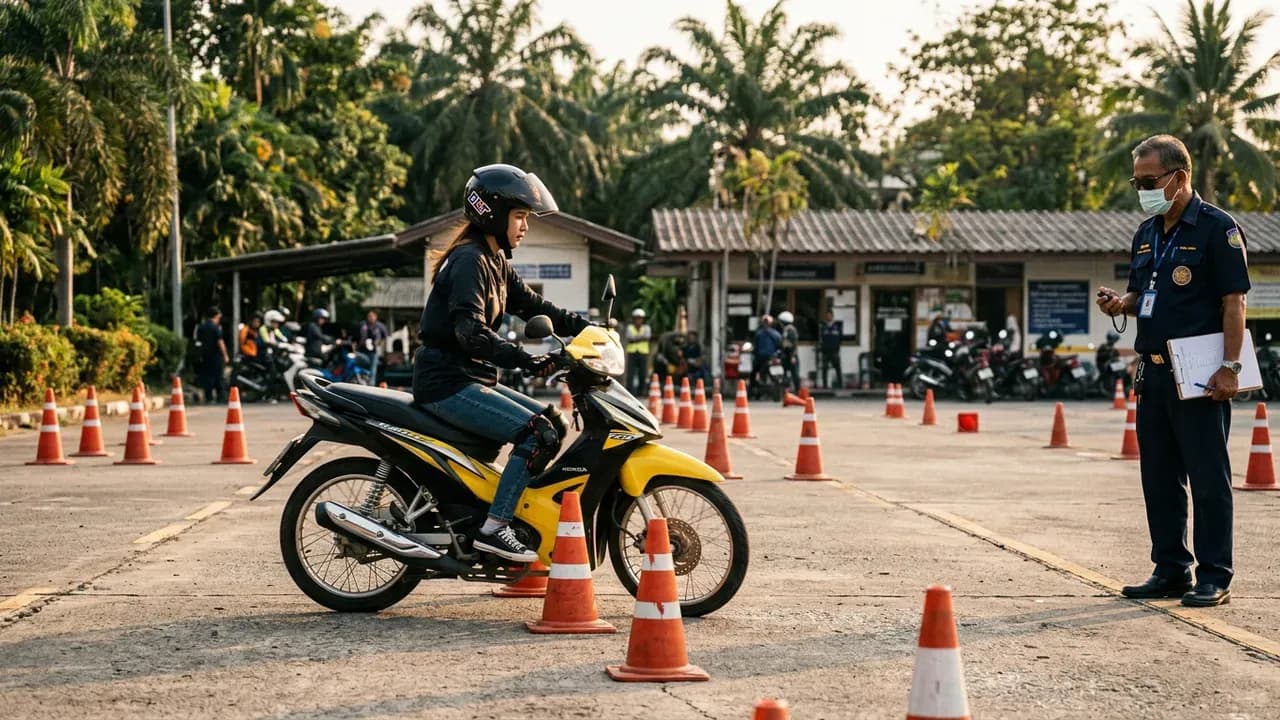
The process for getting a motorcycle license at the Pattaya DLT is similar to the car license process, with the addition of a motorcycle-specific practical test. Here is the complete process. Documents needed: Original passport with valid non-immigrant visa, residence certificate from Pattaya Immigration, medical certificate, passport photos (1 inch), and photocopies of all documents. If you are converting a foreign motorcycle license, you also need your foreign license plus embassy verification letter. Step 1: Arrive at the DLT by 8:00 AM and take a queue number for motorcycle license (specify this when taking your number). Step 2: Document verification at the foreign applicant counter. Step 3: Aptitude tests — identical to the car license tests (color blindness, depth perception, reaction time, peripheral vision). Step 4: Written theory test — 50 questions, 90% pass mark. The motorcycle written test is the same as the car test at most DLT offices, covering general traffic laws and road signs. Step 5: Practical motorcycle test. This is the key difference from the car license process. The Pattaya DLT motorcycle test course is located behind the main building. The test includes: riding in a straight line at low speed without putting your feet down, navigating a figure-8 pattern, riding over a narrow elevated platform (approximately 15 cm wide, 10 meters long), stopping at a designated point, and weaving through a set of cones. You must bring your own motorcycle for the test. If you do not have one, our service can provide a motorcycle for the test. Most rental shops will not allow you to use their bikes for a DLT test — you need to arrange this in advance. Step 6: If you pass all tests, pay the fee (105 THB for motorcycle license) and receive your license the same day. The motorcycle license is a separate card from your car license. If you want both car and motorcycle, you can apply for both on the same day and take both practical tests.
Motorcycle Practical Test Course at Pattaya DLT
The practical motorcycle test at the Pattaya DLT is designed to verify that you can safely control a motorcycle at low speeds and in tight spaces. Here is a detailed breakdown of each element. Element 1 — Straight line ride: You ride along a painted straight line (approximately 15 meters) at low speed. You must stay on the line without weaving and without putting your feet on the ground. This tests your balance and throttle control. Tips: Look ahead, not at the ground. Use gentle throttle and rear brake to control speed. Element 2 — Figure-8: You ride in a figure-8 pattern within a marked area. The space is not large, so you need good slow-speed turning skills. Tips: Turn your head to look where you want to go. Use the rear brake to keep speed low. Lean the bike, not your body. Element 3 — Elevated narrow platform: You ride over a raised platform that is approximately 15 cm wide and 10 meters long. This is often considered the hardest part of the test. Tips: Build momentum before getting on the platform. Look at the end of the platform, not at the front wheel. Keep a steady throttle. Element 4 — Stop-in-box: You accelerate to moderate speed and then brake to stop within a marked box. This tests your braking control. Tips: Use both front and rear brakes. Practice judging stopping distance beforehand. Element 5 — Cone weave: You weave through a series of cones set at regular intervals. Tips: Look two cones ahead, not at the cone you are passing. Use body lean and gentle steering. Common reasons for failing the practical test: putting feet down during the straight line or figure-8, falling off the elevated platform, stopping outside the marked box, and knocking over cones. If you fail, you can retake the practical test the next business day. Many people practice in the DLT parking lot before the test — the staff generally allow this early in the morning before the office opens.
Rental Scooters and License Requirements in Pattaya
Pattaya is one of the most popular places in Thailand for scooter rentals. Rental shops line Beach Road, Second Road, and Jomtien, offering everything from 110cc Honda Waves to 300cc Yamaha XMAX scooters. However, there are important license requirements you should understand before renting. Legal requirement: Thai law requires a valid motorcycle license (Thai license with motorcycle endorsement, or an International Driving Permit with Category A) to operate any motorcycle or scooter on public roads, regardless of engine size. There is no exception for small scooters — even a 110cc automatic scooter requires a motorcycle license. Rental shop reality: Most scooter rental shops in Pattaya do not check for a valid license. They will rent to anyone who leaves a passport or deposit. This does NOT mean it is legal to ride without a license. The rental shop is not responsible for your license status — you are. If you are caught at a checkpoint, the fine is your responsibility. Insurance implications: Most scooter rental agreements include basic insurance. However, this insurance typically states (in fine print) that the rider must have a valid license. If you are in an accident without a license, the rental insurance will not cover damage to the bike or third-party damage. You will be personally liable for all repair costs, which can be substantial — a damaged rental scooter can cost 10,000-50,000 THB in repairs. Your personal travel insurance will also likely deny medical claims if you were riding unlicensed. Our recommendation: Get a Thai motorcycle license before renting. If you plan to be in Pattaya for any length of time, the one day it takes to get a motorcycle license is a small investment compared to the potential consequences of riding without one. If you are on a short trip and have a motorcycle license from home, get an International Driving Permit with Category A before traveling to Thailand — this is accepted by Thai police and insurance companies.
Converting a Foreign Motorcycle License in Pattaya
If you already hold a motorcycle license from your home country, you can convert it to a Thai motorcycle license at the Pattaya DLT. The conversion process for a motorcycle license is identical to the car license conversion — you are exempt from the practical riding test. You only need to pass the aptitude tests and written theory test. This is a significant advantage, as the practical motorcycle test can be challenging for people who are not experienced riders. Documents needed are the same as for car license conversion: valid foreign motorcycle license, embassy verification letter, passport with non-immigrant visa, residence certificate, medical certificate, and photos. The embassy letter should confirm your motorcycle license category — if your foreign license covers both car and motorcycle, make sure the embassy letter mentions both categories. At the Pattaya DLT, you can convert both car and motorcycle licenses simultaneously. If you have a combined car-motorcycle license from your country, you will receive two separate Thai licenses (one for car, one for motorcycle). The total fee for both is 305 THB. The conversion gives you a 5-year motorcycle license. Processing time is the same as a car conversion — typically 2-4 hours at the Pattaya DLT.
Motorcycle Safety Tips for Pattaya
Pattaya's roads can be challenging for motorcycle riders, and the city sees a disproportionate number of motorcycle accidents involving foreigners. Here are essential safety tips. Always wear a helmet. This is both a legal requirement and a lifesaver. Buy your own quality helmet rather than relying on the cheap ones provided by rental shops — those often do not meet safety standards. Drive defensively. Pattaya traffic is unpredictable. Watch for vehicles pulling out of side roads (sois) without checking for traffic, songthaews stopping suddenly to pick up passengers, pedestrians crossing without looking, and other motorcyclists riding against traffic or on sidewalks. Be extra cautious on Beach Road and Second Road, which are one-way streets. Foreigners often get confused about the traffic flow. Beach Road flows south (from North Pattaya toward Walking Street), and Second Road flows north. Avoid riding at night if possible, especially after midnight when the risk of encountering drunk drivers increases significantly. The hill roads around Pratumnak and the area between Pattaya and Jomtien have steep inclines and sharp curves — ride these cautiously, especially in wet conditions. Never ride under the influence of alcohol. Thailand has strict DUI laws, and the penalties for motorcycle DUI include heavy fines, license suspension, and potential imprisonment. Pattaya police conduct DUI checkpoints, especially on weekend evenings. Always carry your license with you when riding. Leaving it at your hotel is not an acceptable excuse at a police checkpoint.
Need help with your Pattaya driving license?
Our team handles the entire process — documents, preparation, and DLT escort in Pattaya. 98% first-attempt pass rate.