In This Article
What Is an International Driving Permit (IDP)?
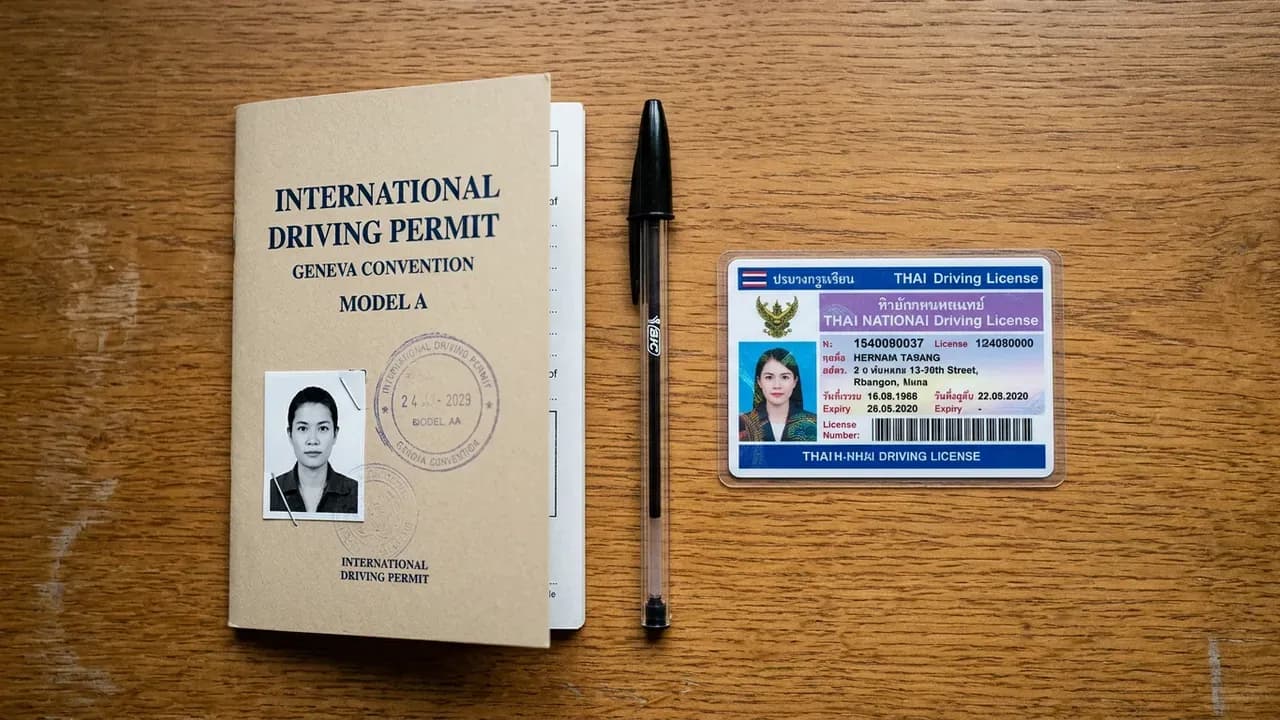
An International Driving Permit is a standardised translation document issued under the 1949 or 1968 Geneva/Vienna Conventions on Road Traffic. It translates your home-country driving license into multiple languages so that foreign authorities and police officers can read it. An IDP is NOT a standalone license — it is only valid when carried together with the original license it translates. You cannot obtain an IDP in Thailand; you must apply for one in your home country before travelling, usually through your national automobile association (e.g., AAA in the US, AA in the UK, NRMA in Australia). Most IDPs are valid for one year from the date of issue. Thailand is a signatory to the 1949 Convention, which means IDPs issued under the 1949 Convention are officially recognised. However, some countries now only issue 1968 Convention IDPs, and technically Thailand has not ratified the 1968 Convention — this creates a legal grey area that can cause problems during police stops or insurance claims. The cost of an IDP varies by country but is typically between 15 and 50 USD. It is a paper booklet with a passport-style photo and does not require any testing or medical examination to obtain.
What Is a Thai Driving License?
A Thai driving license is a full, government-issued license from the Department of Land Transport (DLT) that legally authorises you to drive on Thai roads. For foreigners, the initial license is a two-year temporary license. After those two years, you can renew it into a five-year license without retaking any tests. The Thai license is a credit-card-sized plastic card with your photo, license number, and vehicle categories. Obtaining one requires a medical certificate, a written theory test (available in English), a practical driving test (for new applicants), and several supporting documents including a residence certificate from Immigration. If you already hold a valid license from your home country, you may be able to convert it — skipping the practical driving test — depending on whether Thailand has a reciprocal agreement with your country. The two-year license costs 205 THB for a car license and 105 THB for a motorcycle license in government fees alone, though total costs including medical certificates, photos, and the residence certificate are higher. A Thai driving license is recognised throughout Thailand without question and also serves as valid photo ID for many domestic purposes.
Legal Validity: IDP vs Thai License in Thailand
Under Thai law (the Land Traffic Act B.E. 2522), anyone driving a motor vehicle on Thai roads must hold a valid Thai driving license or a valid international driving permit together with their original foreign license. An IDP issued under the 1949 Geneva Convention is legally accepted for the duration of your stay as a tourist, provided it has not expired and you carry your original license alongside it. However, there are important caveats. First, if you are a resident of Thailand — meaning you hold a non-immigrant visa, work permit, or have been living in the country for an extended period — the legal expectation shifts. Police and courts may argue that long-term residents should obtain a Thai license rather than relying on a temporary IDP. Second, the distinction between 1949 and 1968 Convention IDPs matters. Some countries (notably Germany and others in the EU) issue only 1968 Convention IDPs. While many Thai police officers accept any IDP in practice, technically the 1968 IDP is not covered by Thailand's treaty obligations. Third, an expired IDP has zero legal standing — you are driving illegally. A Thai driving license eliminates all ambiguity: it is valid for as long as it is current, and there is no debate about which convention applies or whether you qualify as a tourist or resident.
Insurance Implications: Why This Matters Most
This is arguably the most important factor in the IDP vs Thai license decision. Thai compulsory motor insurance (Por Ror Bor) provides minimal coverage and pays out regardless of license status. However, voluntary first-class insurance policies — the ones that actually cover significant damage, theft, and third-party liability — almost always require the driver to hold a valid license recognised in Thailand at the time of the accident. If you are driving on an expired IDP, a 1968 Convention IDP, or no IDP at all, your insurance company has grounds to deny your claim. This is not theoretical; it happens regularly. Insurers investigate claims and will check license validity. An invalid or incorrect IDP can void your entire policy when you need it most. Similarly, if you rent a car or motorcycle and the rental agreement specifies a Thai license or valid IDP, and you cannot produce one after an accident, both the rental company's insurance and your personal travel insurance may refuse coverage. A Thai driving license removes this risk entirely. It is unambiguously valid, and no insurer can question it. For anyone with a vehicle, particularly a car with first-class insurance, obtaining a Thai license is essentially a financial safety net. The cost of getting the license is trivial compared to the potential cost of a denied insurance claim.
Police Stops and Rental Companies
In day-to-day driving, police checkpoints are common in Thailand, especially in tourist areas like Phuket, Pattaya, and Chiang Mai. Officers will ask to see your license. If you present a Thai driving license, the interaction is typically fast and straightforward — they see a familiar card, confirm it is valid, and wave you on. Presenting an IDP is a different experience. Many police officers are not familiar with IDPs, especially in rural areas. The IDP is a paper booklet that looks nothing like a license, and officers may struggle to verify it. This confusion sometimes leads to on-the-spot fines (typically 500-1,000 THB) even when your IDP is perfectly valid. While these fines can be contested, the hassle is real. Regarding rental companies: major car rental agencies (Budget, Hertz, Thai Rent A Car) generally accept a valid IDP plus your original license. However, motorcycle rental shops in tourist areas are far less consistent. Many will rent you a scooter without checking any license at all, but if an accident occurs, the absence of a valid license becomes a serious legal and financial problem. Some premium car rental agencies actually prefer or require a Thai driving license for long-term rentals. Having a Thai license simplifies every interaction with both police and rental companies, eliminating uncertainty and potential fines.
When Is an IDP Enough vs When You Need a Thai License
An IDP is sufficient if you are visiting Thailand as a short-term tourist (under 90 days), your IDP is issued under the 1949 Convention, your IDP has not expired, you carry your original license alongside it, and you do not own a vehicle in Thailand. In this scenario, the IDP covers you legally, insurance policies for rental vehicles will generally honour it, and the cost and effort of getting a Thai license is not justified. You should get a Thai license if any of the following apply: you live in Thailand on a non-immigrant visa, you own or lease a vehicle, you plan to stay longer than your IDP's one-year validity, your country only issues 1968 Convention IDPs (e.g., Germany, Japan under certain conditions), you want hassle-free police interactions, or you want absolute certainty regarding insurance coverage. The bottom line: the IDP is a temporary travel document, while the Thai license is a proper driving credential. If Thailand is your home — even part-time — the Thai license is the correct choice. The effort to obtain one is a one-time investment that pays off in legal clarity, insurance security, and daily convenience for years.
Not sure which option is right for you?
Our team provides free consultations to help you choose the best path for your situation.