In This Article
Test Overview and 2026 Rules
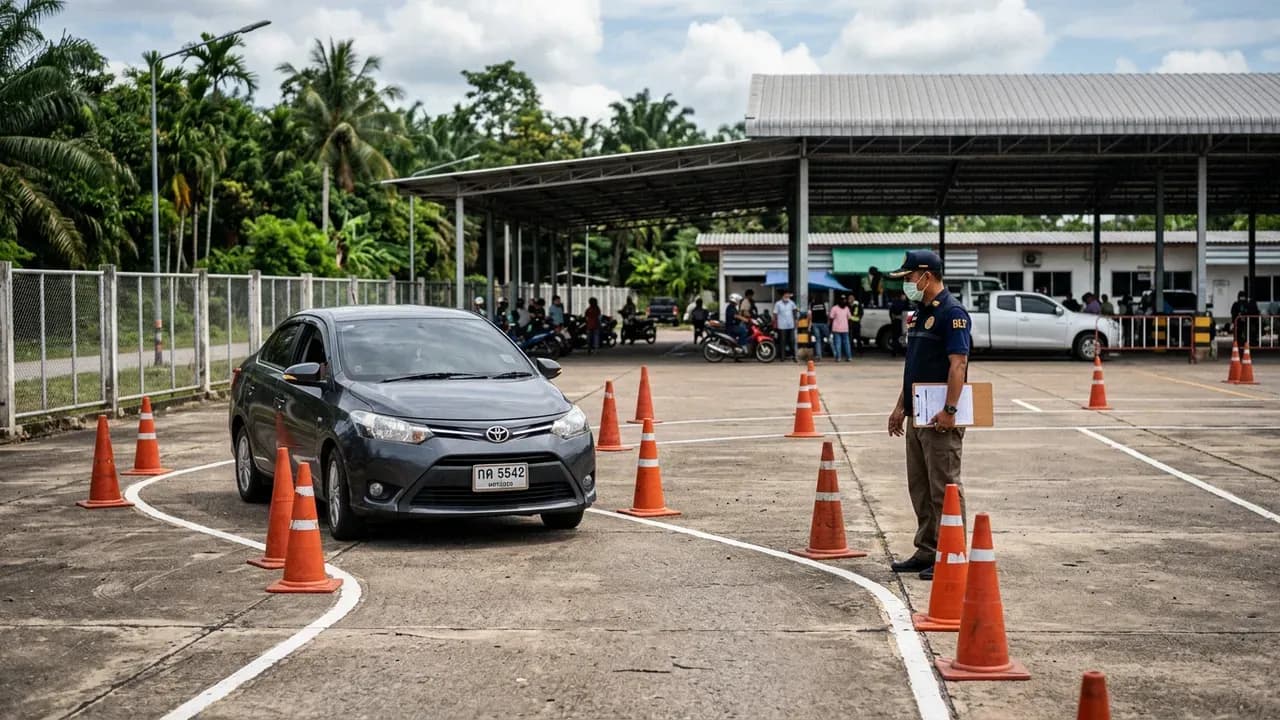
The practical driving test is conducted on a closed course at the DLT office. You do not drive on public roads at any point during the test. The course is a standardized layout with marked lanes, cones, and inclines designed to test basic vehicle control skills. The entire test takes approximately 15 to 20 minutes per person, though wait times can add hours to your visit. You can use your own vehicle, provided it has valid registration and insurance, or you can use a vehicle provided by the DLT. Each maneuver is scored on a pass/fail basis. You must pass all five maneuvers to pass the test overall. If you fail any single maneuver, you fail the entire test and must reschedule. The 2026 rules maintain the general exemption for foreign license conversion applicants, meaning that if you hold a valid driving license from another country and are converting it to a Thai license, you typically do not need to take the practical test. However, there is an important caveat: some DLT offices, particularly in Bangkok, have begun requiring practical tests for conversion applicants on a case-by-case basis. This appears to be at the discretion of individual offices rather than a nationwide policy change. If you are converting a foreign license, call your local DLT office ahead of time to confirm whether the practical test will be required. For all new license applicants who have never held a driving license in any country, the practical test is mandatory.
Maneuver 1: Forward Driving and Precision Stop
The first maneuver tests your ability to drive forward in a straight line and stop precisely within a marked zone. You drive approximately 100 meters along a straight lane bordered by lines or low cones. The lane is wider than a standard road lane, so staying within it is not the challenge. The challenge comes at the end, where you must bring the vehicle to a complete stop with the front bumper inside a marked zone, typically indicated by two painted lines about 1 meter apart. If you stop too early or overshoot the zone, you fail this maneuver. The key is smooth, controlled driving at a slow speed. Do not accelerate to high speed and then brake hard at the end. Instead, approach the stop zone at roughly 10 to 15 km/h and begin braking gradually about 5 meters before the first line. Use the line markings on the road and your front bumper as reference points. If your vehicle has a long hood, practice judging where the bumper is relative to your seating position. Many modern cars have short front overhangs, which makes this easier. Keep both hands on the steering wheel throughout and look straight ahead. After stopping, wait for the officer's signal before proceeding. This is generally considered the easiest of the five maneuvers, and very few people fail on this one alone.
Maneuver 2: Parallel Parking
Parallel parking is the maneuver that fails the most people. The test requires you to parallel park your vehicle into a space marked by cones, then exit the space. The parking space is approximately 1.5 times the length of your vehicle, which is tighter than what most people are accustomed to. There is a critical rule that surprises many test-takers: you must complete the entire parallel parking maneuver within 7 gear changes. A gear change means any shift between drive, reverse, and back to drive. This means you cannot keep adjusting your position back and forth indefinitely. In a typical successful parallel park, you use about 3 to 5 gear changes. The 7-gear limit is generous enough for a competent driver but will catch anyone who keeps overshooting and correcting. To execute the maneuver, pull alongside the front cone until your rear bumper is roughly level with it. Turn your steering wheel fully toward the curb and reverse slowly until your vehicle is at approximately a 45-degree angle. Then straighten the wheel and continue reversing until you are close to the rear cone. Finally, turn the wheel away from the curb and reverse to straighten the vehicle within the space. You must not hit any cones and you must end up within 25 cm of the curb line. After parking, you must pull out of the space cleanly without hitting cones. Practice this maneuver extensively before the test. If you are using an unfamiliar vehicle, the dimensions will feel different and your reference points will be off.
Maneuver 3: Reversing in a Straight Line
This maneuver tests your ability to reverse your vehicle in a straight line without drifting left or right. You will reverse along a lane marked with boundary lines or cones for approximately 10 to 15 meters. If any part of your vehicle crosses the lane markers, you fail. The lane is not much wider than your vehicle, so there is minimal margin for error. The most common mistake is oversteering. When you notice the car drifting, the instinct is to make a large correction, which often sends you too far in the other direction. Instead, make very small, gentle adjustments to the steering wheel. The key technique is to use your side mirrors as your primary reference. Adjust both side mirrors slightly downward before starting so you can see the lane markings alongside your rear wheels. Alternate your gaze between the left mirror, the right mirror, and the rear window. Some instructors recommend keeping one hand at the 12 o'clock position on the steering wheel during reversing, as this gives you a physical reference for when the wheels are straight. If the steering wheel is centered with your hand at the top, the wheels are pointing straight. Go as slowly as possible. There is no time limit on this maneuver, and creeping backward at idle speed gives you the most time to make micro-corrections. Rushing is the enemy of straight reversing. Practice this in an empty parking lot with improvised lane markers until you can do it confidently.
Maneuver 4: Three-Point Turn
The three-point turn, sometimes called a U-turn or K-turn, tests your ability to reverse the direction of your vehicle in a confined space. The area is a dead-end lane that is too narrow to make a U-turn in a single sweep. You must turn the vehicle 180 degrees using a sequence of forward and reverse movements. The typical execution is: (1) turn the steering wheel fully to the left and drive forward until your front bumper approaches the far boundary, (2) stop, shift to reverse, turn the wheel fully to the right, and reverse until your rear bumper approaches the opposite boundary, (3) shift to drive, straighten the wheel, and drive forward in the new direction. That is three points of movement, hence the name. You must complete this without hitting any boundary markers or cones and without needing more than the three movements. An extra back-and-forth adjustment will typically result in a fail, though enforcement varies by office. The confined space means you need to use the full lock of your steering wheel at each point. Turn the wheel all the way before you start moving each time. A common mistake is not turning the wheel enough, which results in a wider arc that does not fit within the space. Another common error is misjudging the rear of the vehicle during the reverse phase. Use your mirrors and turn your head to check both sides. Go slowly and deliberately. Speed is your enemy in a tight maneuver like this.
Maneuver 5: Slope Stop and Start
The final maneuver tests your ability to stop on an incline and restart without rolling backward. You drive up a slope, stop when signaled or at a marked point, engage the handbrake, and then release the brake and pull away smoothly. The vehicle must not roll backward more than a specified distance, typically around 20 to 30 cm. Any rollback beyond that, or stalling the engine, results in a fail. For manual transmission vehicles, this is the most technically demanding maneuver. The technique is to hold the handbrake while you find the clutch biting point, then release the handbrake gradually as you apply gas. The biting point is the position where you feel the engine start to engage with the wheels and the car begins to strain against the handbrake. Once you feel that, smoothly release the handbrake while maintaining or slightly increasing your gas pedal pressure. The car should pull forward without any rollback. Practice this on any hill or parking garage ramp until the coordination becomes automatic. For automatic transmission vehicles, this maneuver is significantly easier. Simply hold the brake pedal firmly on the slope, then transition smoothly from brake to gas. Most modern automatics have a hill-start assist feature that prevents rollback for a few seconds after you release the brake, which makes this nearly foolproof. If your automatic vehicle has hill-start assist, confirm it is enabled before the test. Even with an automatic, avoid releasing the brake abruptly, as the car may still roll slightly on a steep incline before the transmission engages.
Common Fail Points and Statistics
Based on DLT data and driving instructor experience, parallel parking is the most common reason for failing the practical test, accounting for roughly 35 to 40% of failures. The combination of tight space, the 7-gear-change limit, and the 25 cm curb proximity requirement makes it the most technically demanding maneuver for most drivers. The slope stop and start is the second most common failure point, particularly for manual transmission drivers, causing about 25% of failures. Stalling on the slope or rolling back beyond the limit are the typical reasons. The three-point turn causes about 20% of failures, usually because the driver does not use full steering lock and runs out of space. Reversing in a straight line accounts for about 15% of failures, mostly from overcorrecting. The forward driving and precision stop causes the fewest failures at around 5%, but people do occasionally overshoot the stop zone due to nervousness or approaching too fast. One important pattern: most failures happen because people rush. Every maneuver on the DLT course can be done at very slow speed, and there are no time penalties. Going slow gives you more time to think, more time to correct, and smaller consequences for small errors. Another common pattern is unfamiliarity with the test vehicle. If you are using the DLT vehicle rather than your own, you are driving a car you have never sat in before, with different dimensions, mirror positions, and pedal feel. Take a moment to adjust everything before you start.
Preparation Tips and Test Day Strategy
If possible, practice at the actual DLT course before your test day. Some DLT offices allow applicants to walk the course and observe other test-takers before their turn. Watching two or three people complete the course gives you a clear sense of the layout, the distances involved, and the common mistakes to avoid. If you cannot access the course ahead of time, practice each maneuver in an empty parking lot using cones, water bottles, or any markers you can find. Set up a parallel parking space that is 1.5 times your vehicle length and practice until you can park within it consistently in under 5 gear changes. Find a slight slope for hill start practice. Mark out a lane with boundaries for straight-line reversing. On test day, arrive at the DLT office by 8:00 AM. The practical test typically takes place after the aptitude tests and written test, so you may not reach the course until late morning. Bring water and snacks, as the process can take several hours. Wear comfortable shoes with thin soles so you can feel the pedals properly. Avoid sandals or flip-flops. If using your own vehicle, ensure it has passed its inspection, has valid insurance, and all lights, signals, indicators, and brakes are working. A DLT officer may do a quick vehicle check before allowing you on the course. Adjust your seat, mirrors, and steering wheel position before you start. Tell the officer if you need a moment to get comfortable. During the test, follow the officer's instructions exactly. If you do not understand something, ask for clarification. Move slowly through every maneuver. Breathe. Stay calm even if you make a small error. Many small errors are recoverable if you do not panic and overcorrect.
Need help with this?
Our team handles the entire process — documents, preparation, and DLT escort. 98% first-attempt pass rate.