In This Article
2026 Status: Do Conversion Applicants Take the Written Test?
This is the question where guides contradict each other most, so here is the verified status as of August 2026. For first-time applicants the written test has always been mandatory — that is not new. For foreign-license conversions, it depends on the DLT office: a valid foreign license waives the written test at many offices, while others have started requiring it. What is driving the confusion is a DLT draft regulation — put to public hearing in June and July 2025 — that would make the written test mandatory for all conversion applicants nationwide and stop International Driving Permits being used as the basis for obtaining a Thai license. As of August 2026 that draft has NOT been published in the Royal Gazette, so it is not law: guides presenting it as an enacted 2025 rule are ahead of the facts, and guides saying conversions never involve a written test are behind them. The practical reality is per-office variation. If your office does require it, you sit the same 50-question computer-based exam as new applicants, with the same 90% passing threshold — Thai-specific penalties and sign meanings trip up even experienced drivers, so study beforehand. We track the draft regulation and will update this page the day it is enacted; if you book with us, we confirm the current requirement at your specific DLT office before your visit.
Test Format and Structure
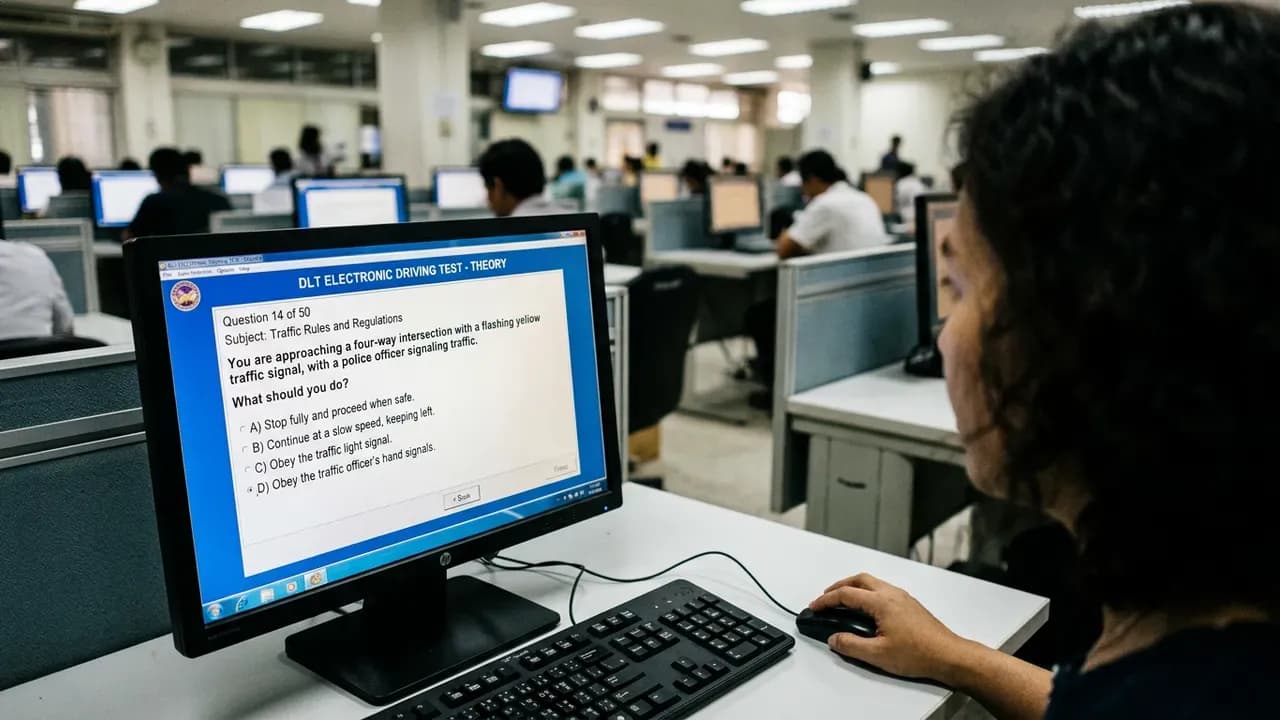
The DLT written test consists of 50 multiple-choice questions randomly drawn from a pool of approximately 350 questions. Each question has four answer choices, and you must select one. The passing score is 45 out of 50, which is a 90% threshold. This is notably high compared to driving theory tests in many other countries, where 70-80% is common. The old Thai passing score was 75%, but the DLT raised it to 90% back in 2014 to improve road safety outcomes — despite what some guides imply, that is not a recent change. The test is entirely computer-based, taken on terminals at the DLT office. You receive 60 minutes to complete all 50 questions, though most people finish in 20 to 30 minutes. The questions are randomized, so no two test-takers receive the same set in the same order. Once you submit your answers, the system scores your test immediately and displays your result on screen. You can see which questions you got wrong, though the correct answers are not always shown. The test interface is relatively simple: you click on your chosen answer and move to the next question. You can go back and change answers before submitting. There is no penalty for guessing, so never leave a question blank. If you are unsure, eliminate the obviously wrong choices and make your best guess from the remaining options.
Available Languages
The written test is available in Thai and English at every DLT office, and in up to 12 languages at major offices: Chinese, Japanese, Korean, German, French, Russian, Swedish, Dutch, Portuguese, and Spanish among them. You select your preferred language when you register for the test at the DLT office. All major DLT offices in Bangkok, Chiang Mai, Phuket, Pattaya, and other tourist-heavy areas offer the English version. Smaller provincial offices may have fewer language options, so if you need a less common language, call ahead or visit a larger office. One important caveat about the English version: the translations are not always perfect. Some questions contain awkward phrasing, grammatical errors, or ambiguous wording that can make the intended meaning unclear. This is a well-known issue that the DLT has been gradually improving, but it has not been fully resolved. If a question seems confusing, try to identify the core concept being tested rather than getting hung up on the exact wording. Practicing with online mock tests that use the actual DLT question bank is the best way to familiarize yourself with the translation style. If English is not your first language and your native language is available, consider taking the test in your native language instead, as the translations may be more natural. You cannot switch languages mid-test, so choose carefully at registration.
Question Categories Breakdown
The 50 questions are drawn from five main categories, each with a roughly predictable weighting. Traffic signs and signals make up approximately 30% of the test, or about 15 questions. These include identifying warning signs, regulatory signs, and informational signs, as well as understanding traffic light sequences and flashing signals. Traffic laws and right-of-way rules account for about 20%, covering intersection rules, who yields to whom, overtaking regulations, and lane usage laws. Speed limits and road markings make up roughly 16% of the test, including questions about speed limits in different zones like school zones, urban areas, and highways, as well as the meaning of various road markings and lane dividers. Driving safety and vehicle maintenance cover about 14%, with questions on safe following distances, driving in rain or fog, tire maintenance, brake checks, and what to do in emergency situations like a tire blowout. Finally, Thai traffic law penalties account for approximately 20%, testing your knowledge of fines, license suspension rules, point systems, and penalties for specific offenses like drunk driving, running red lights, and driving without a valid license. The penalty category is where most foreign applicants struggle, because these are Thailand-specific and cannot be guessed from general driving knowledge. Memorizing the key fine amounts and suspension periods is essential.
How to Study Effectively
The most effective study approach combines online practice tests with targeted review of weak areas. Start with the DLT official question bank, which is publicly available and contains the pool of questions your test will draw from. Websites like thaidrivingtest.com and driving-exam-thailand.com offer free practice tests using questions from this pool. Take a full 50-question practice test first without studying to establish your baseline score. Most people score between 30 and 40 on their first attempt, which is below the 45-question passing threshold. After your baseline test, review every question you got wrong and identify which categories need the most work. If you are strong on traffic signs but weak on Thai penalties, focus your study time accordingly. A good study timeline is 3 to 5 days of 30 to 60 minutes per day. Day one, take the baseline test and review results. Days two and three, study your weak categories using the question bank. Day four, take two or three full practice tests and aim for 47 or above consistently. Day five, do a final review of any remaining trouble spots. Pay special attention to questions about Thai-specific rules that differ from your home country. Thailand drives on the left side of the road, overtaking is done on the right, and many intersection priority rules differ from Western conventions. Questions about blood alcohol limits, penalty amounts in Thai baht, and specific fine schedules are common stumbling points. Flashcards for traffic signs are also helpful since some Thai signs look similar to international ones but have different meanings.
Common Trick Questions and Pitfalls
Several question types consistently trip up foreign test-takers. First, questions about maximum speed limits in different zones: the default urban speed limit in Thailand is 80 km/h unless otherwise posted, which surprises many people accustomed to lower urban limits. School zone limits, highway limits, and limits for different vehicle types each have specific numbers you need to memorize. Second, questions about blood alcohol concentration thresholds. Thailand's legal limit is 0.05% BAC for regular drivers, but there are stricter limits for commercial vehicle operators and new drivers. Third, right-of-way at roundabouts and uncontrolled intersections follows specific Thai rules that may differ from what you are used to. Vehicles already in the roundabout have priority, and at unmarked intersections, the vehicle arriving first generally has right-of-way. Fourth, watch for questions about what to do when an emergency vehicle approaches. Thai law requires you to pull to the left, not the right as in right-hand-drive countries. Fifth, penalty questions often have very specific baht amounts and jail terms. For example, the fine for running a red light, the penalty for driving without a license, and the suspension period for accumulating too many points all have exact figures that appear in test questions. Do not try to guess these; memorize the key ones. Sixth, some questions about traffic signs show signs that look nearly identical but have different meanings. The warning sign for a curve versus a winding road, or the different types of no-passing signs, require careful attention to visual details.
What to Expect on Test Day
The computer test room at most DLT offices opens between 8:00 and 11:00 AM. Arrive early, ideally by 8:00 AM, because the testing room has a limited number of terminals and operates on a first-come, first-served basis. Some busy offices in Bangkok can have queues of 50 or more people. Bring your queue number from registration, your passport, and your application documents. You will be directed to the testing room after completing the aptitude tests. Before sitting down at the terminal, a DLT officer will verify your identity and assign you a station. The test interface will display in your selected language. You may receive brief instructions from the officer, usually in Thai, but the on-screen instructions are in your chosen language. Read each question carefully before answering. Do not rush just because you see others finishing quickly. Use the full time if you need it, and review your answers before submitting. Some terminals have a review screen that lets you see all your answers at a glance and flag questions you want to revisit. Once you submit, your score appears immediately. If you pass, you proceed to the next step in the license process, which is typically the practical driving test or photo and license issuance for conversion applicants. If you fail, you will be told your score and given information about retaking the test. Keep your composure either way, as the DLT staff deal with hundreds of applicants daily and the process moves quickly.
Retake Policy and What to Do If You Fail
If you score below 45 out of 50, you fail and must retake the test. The retake policy varies by DLT office. Many offices, especially larger ones in Bangkok, allow same-day retakes if there are available terminal slots later in the day. In this case, there is no additional fee for the retake. If same-day retake is not available, you can return the next business day. Some smaller offices only run the test room on certain days of the week, so check the schedule before planning your return. There is no limit on the number of retake attempts. However, each visit to the DLT office means another half-day commitment, so it is worth studying thoroughly before your first attempt. If you fail, take note of which questions you got wrong and which categories they fell into. Focus your study on those areas before retaking. The question pool is large enough that you will get a different set of questions each time, but the categories and difficulty level remain the same. Some people fail by just one or two questions, which is frustrating but common given the 90% threshold. If you scored 43 or 44, a quick review session and one more practice test is usually enough to pass on the second attempt. If you scored below 40, invest more time in studying the question bank systematically before returning.
Need help with this?
Our team handles the entire process — documents, preparation, and DLT escort. 98% first-attempt pass rate.