In This Article
When Is a Vehicle Inspection Required?
In Thailand, vehicle inspections are required for cars (sedans, SUVs, vans) that are more than 7 years old from the date of first registration. This means if your car was first registered in 2019 or earlier, it needs an inspection before you can renew your annual road tax in 2026. For motorcycles, the inspection requirement applies to vehicles over 5 years old, though enforcement varies and some offices apply the 7-year rule for motorcycles as well. Commercial vehicles (trucks, buses, vehicles for hire) have stricter inspection schedules and may require inspection regardless of age. Vehicles that have been modified — such as engine swaps, body modifications, or LPG/CNG conversions — may also require inspection regardless of age. New vehicles (under the age threshold) are exempt from inspection and can renew road tax without one. The inspection must be completed before the road tax renewal date. You cannot renew your road tax without a valid inspection certificate if your vehicle is over the required age. The inspection certificate is valid only for the current renewal period.
Where to Get a Vehicle Inspection
Vehicle inspections in Thailand can be done at two types of facilities. DLT Inspection Stations: these are operated directly by the Department of Land Transport and are located at or near DLT offices. They are government-run, generally cheaper, but can have longer wait times. You do not need an appointment at most DLT stations — simply drive in and join the queue. Authorized Private Inspection Stations (TRO Stations): these are privately operated but authorized and regulated by the DLT. They are sometimes called 'ตรอ' (Tor Ror Or) stations. Private stations are often more convenient — shorter wait times, longer operating hours, and some operate on weekends. They may charge slightly more than DLT stations but typically cost 200 to 400 THB. To find a private inspection station, search Google Maps for 'ตรอ' or 'สถานตรวจสภาพรถ' (vehicle inspection station) near your location. Many car repair shops and service centers are also authorized inspection points. Both government and private stations use the same inspection criteria and issue the same valid inspection certificate. The certificate from either type is accepted by any DLT office for road tax renewal.
What They Check During the Inspection
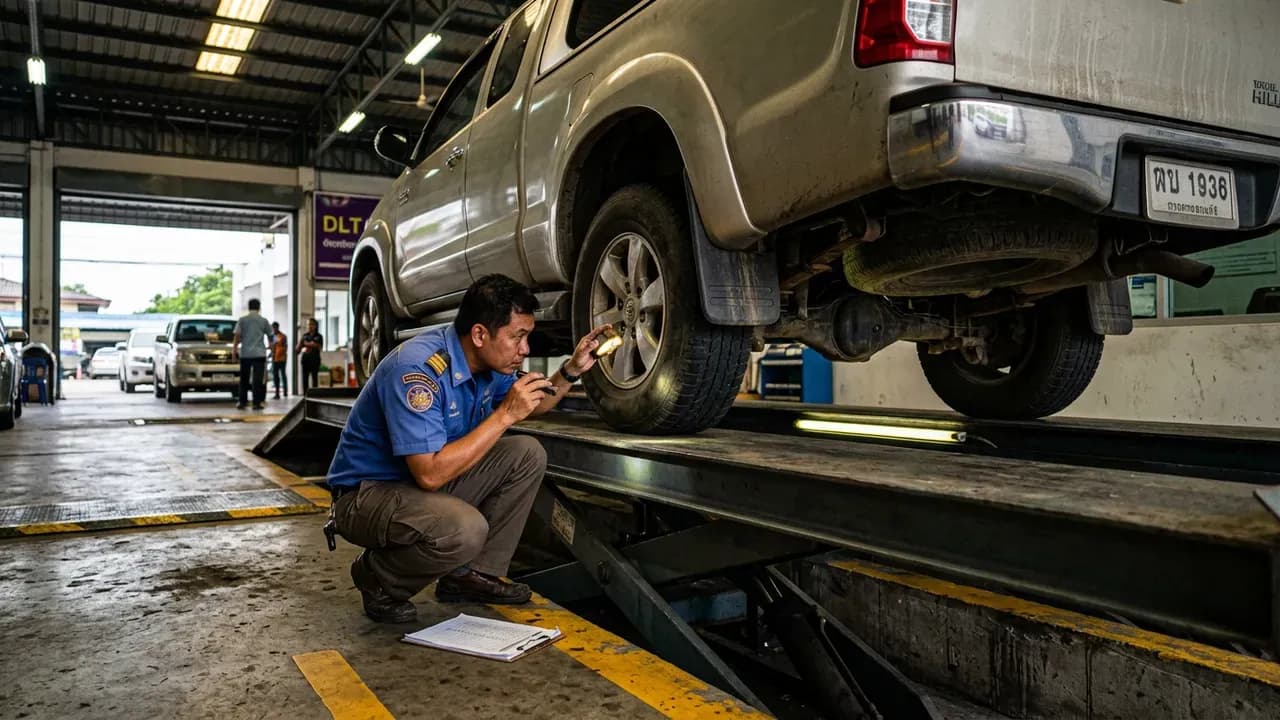
The vehicle inspection covers several key areas designed to ensure the vehicle is safe and roadworthy. Brakes: both the service brake (foot brake) and parking brake (handbrake) are tested. The vehicle is placed on rollers and brake force is measured. Both sides must produce adequate and balanced braking force. Lights: all lights are checked — headlights (low and high beam), tail lights, brake lights, turn signals, and reverse lights. Headlight alignment is also tested to ensure proper aim. Emissions: exhaust emissions are measured. For gasoline vehicles, carbon monoxide (CO) and hydrocarbon (HC) levels must be within limits. For diesel vehicles, smoke opacity is measured. Vehicles with catalytic converter problems or engine issues often fail this test. Tires: tread depth must meet minimum requirements (at least 1.6 mm), and tires must be free of visible damage, bulges, or excessive wear. Steering: the steering system is checked for excessive play or looseness. Suspension: shock absorbers and suspension components are inspected for wear or damage. Horn: must be functional. Windshield wipers: must work properly. Overall structure: checked for excessive rust, damage, or modifications that affect safety.
Inspection Cost
Vehicle inspection costs in Thailand are regulated and relatively affordable. At DLT inspection stations, the fee is typically 200 THB for motorcycles and 200 to 400 THB for cars, depending on the vehicle type and size. At authorized private inspection stations (TRO), fees are slightly higher — typically 150 to 250 THB for motorcycles and 250 to 450 THB for cars. Some private stations may charge up to 500 THB for larger vehicles like vans or trucks. The inspection fee is separate from the road tax fee — you pay for inspection first, receive the certificate, then use it when paying road tax. If your vehicle fails the inspection, you will need to fix the issues and return for a re-inspection. Most stations charge the full fee again for re-inspection, though some offer a reduced rate if you return within a specified period (usually 15 to 30 days). The total cost of inspection is minimal compared to the potential cost of driving an unsafe vehicle, and it is far less than the late penalty and hassle of letting your registration expire.
How to Pass: Pre-Inspection Checklist
To avoid failing and having to return, run through this checklist before your inspection. Check all lights: headlights (both low and high beam), brake lights, tail lights, turn signals (front and rear), reverse lights, and license plate lights. Replace any burned-out bulbs. Test your brakes: ensure the foot brake stops the vehicle firmly and evenly. The handbrake should hold the vehicle on a slope. If brakes feel spongy or pull to one side, have them serviced. Inspect your tires: look for adequate tread depth (at least 1.6 mm — the legal minimum), and check for cuts, bulges, or uneven wear. Replace worn tires before the inspection. Check your horn: it must produce a clear, audible sound. Test your windshield wipers: they must clear the windshield effectively. Wipers are cheap to replace. Address engine issues: if your check engine light is on or your exhaust is visibly smoky, get the engine serviced. Failed emissions are a common reason for inspection failure. Check your steering: if the steering wheel has excessive play or vibrates, have the steering system inspected. Ensure your mirrors are intact: both side mirrors and the rear-view mirror should be in place and functional. Fix any obvious structural damage: cracked windshields, hanging bumpers, or excessive rust.
What Happens If You Fail the Inspection
If your vehicle fails the inspection, the inspector will provide a report detailing which items failed and why. You are not fined for failing — the inspection is a pass or fail assessment. You then have a period (usually 15 to 30 days, depending on the station) to fix the failed items and return for re-inspection. Only the failed items are re-tested, not the entire vehicle, at most stations. If you do not return within the specified period, you may need to undergo the full inspection again. Common failure items and their typical repair costs: burned-out bulbs (20 to 100 THB per bulb), brake pad replacement (500 to 2,000 THB for all four), tire replacement (1,500 to 3,000 THB per tire for common sizes), emissions failure (may require catalytic converter repair or engine tune-up, 1,000 to 10,000+ THB), steering play (tie rod replacement, 500 to 2,000 THB), and worn windshield wipers (100 to 300 THB). If your vehicle has serious structural issues — such as a bent frame or severe corrosion — repair costs can be significant, and it may be more economical to replace the vehicle. Vehicles that cannot pass inspection cannot legally renew their road tax and should not be driven on public roads.
Motorcycle Inspection Requirements
Motorcycles in Thailand are subject to inspection requirements, though enforcement has historically been less strict than for cars. As of 2026, motorcycles over 5 years old officially require an inspection before road tax renewal, though some DLT offices and private stations apply a 7-year threshold. The motorcycle inspection checks many of the same items as car inspections but adapted for two-wheelers: brakes (front and rear), lights (headlight, tail light, brake light, turn signals), tires (tread depth and condition), horn, mirrors, and emissions. The practical test is simpler than for cars — there is no roller-based brake test at most stations. Instead, an inspector visually checks the motorcycle and may ride it briefly or use a simplified testing rig. The inspection fee for motorcycles is typically 150 to 250 THB at private stations and around 200 THB at DLT stations. Common failure points for motorcycles are burned-out turn signal bulbs, worn tires, and non-functional horns. Before taking your motorcycle for inspection, replace any dead bulbs, ensure both brakes work properly, check tire condition, and confirm your horn is loud and clear. Most issues are inexpensive to fix at any motorcycle repair shop.
Make sure you are properly licensed
The most important step before driving in Thailand is having a valid license. We handle the entire process for you.