In This Article
Overview of Residence Certificate Requirements
A Thai residence certificate — formally known as Form TM.16 — is an official document issued by the Immigration Bureau confirming that a foreign national resides at a verified address in Thailand. It is the gold-standard proof-of-address document accepted by the Department of Land Transport (DLT), Thai banks, and virtually every government agency in the country. Before you visit Immigration, you must satisfy a specific set of eligibility criteria and prepare a defined list of documents. Missing even a single item means being turned away and losing half a day. This guide covers every requirement in detail so you can prepare everything for a single, successful visit. The core requirements fall into seven categories: <strong>(1)</strong> a qualifying visa type, <strong>(2)</strong> a registered TM.30 notification, <strong>(3)</strong> at least one completed 90-day report (required in Bangkok and many other offices), <strong>(4)</strong> a valid passport with sufficient remaining validity, <strong>(5)</strong> passport-sized photographs meeting Thai specifications, <strong>(6)</strong> supporting address documentation such as a lease agreement, and <strong>(7)</strong> the completed TM.18 application form plus the 200 THB government fee. Each requirement is explained in full below, along with insider tips from our team who process residence certificates for clients every week.
Visa Type Requirements
Your visa type is the single most important eligibility factor. The Bangkok Immigration office at Chaeng Watthana — the strictest office in Thailand — generally requires a <strong>non-immigrant visa</strong> or an extension of stay based on a non-immigrant visa. Accepted categories include: <ul><li><strong>Non-Immigrant B</strong> — business or employment</li><li><strong>Non-Immigrant O</strong> — family, retirement, or volunteer</li><li><strong>Non-Immigrant OA / OX</strong> — long-stay retirement visas</li><li><strong>Non-Immigrant ED</strong> — education</li><li><strong>Non-Immigrant M</strong> — media and journalism</li><li><strong>LTR (Long-Term Resident) Visa</strong> — the newer 10-year visa for retirees, digital nomads, wealthy global citizens, and highly skilled professionals</li><li><strong>Thailand Elite Visa</strong> — all tiers</li></ul> <div style="background:#fff3cd;border-left:4px solid #ffc107;padding:12px 16px;margin:16px 0;border-radius:4px;"><strong>Tourist visa holders:</strong> Bangkok Chaeng Watthana does <em>not</em> issue residence certificates to tourist visa holders or visa-exempt entries (30-day stamps). However, some provincial offices — notably Pattaya (Jomtien), Chiang Mai, and Phuket — will issue certificates to tourist visa holders as long as you have a valid TM.30 and proof of address. If you hold a tourist visa and live in Bangkok, your best options are: (a) use a provincial office if your TM.30 is registered outside Bangkok, or (b) obtain a proof-of-address letter from your embassy instead.</div> Your visa must be currently valid on the day you apply. Expired visas, overstay situations, or visas with fewer than 15 days remaining may result in denial. If your visa or extension is about to expire, extend it first, then apply for the residence certificate. <br/><br/><strong>Related:</strong> Planning to get a Thai driving license? Read our <a href="/thai-driving-license">complete Thai driving license guide</a> which covers the full process from start to finish.
TM.30 Notification Prerequisite
The TM.30 (Notification of Residence for Foreigners) is the foundation of the residence certificate. Without a confirmed TM.30 on file, Immigration cannot verify where you live and will refuse your application on the spot. <h4>What is a TM.30?</h4> The TM.30 is a form that your landlord, hotel, or accommodation provider is legally required to file with Immigration within 24 hours of your moving in (or checking in). It registers your presence at a specific address. When you apply for a residence certificate, the officer checks the Immigration database to confirm your TM.30 is active for the address you claim. <h4>How to confirm your TM.30 is filed</h4> <ol><li>Ask your landlord directly — they should have a receipt or online confirmation</li><li>Check online at the Immigration Bureau TM.30 portal: <strong>tm30.immigration.go.th</strong></li><li>Visit your local Immigration office and ask them to look up your record</li></ol> <h4>Common TM.30 problems</h4> <div style="background:#f8d7da;border-left:4px solid #dc3545;padding:12px 16px;margin:16px 0;border-radius:4px;"><strong>Critical:</strong> If you left Thailand and re-entered, your landlord must file a <em>new</em> TM.30 after your return. A TM.30 filed before your departure is invalidated when you leave the country. This is the number-one reason for residence certificate rejections among our clients.</div> If your landlord has not filed the TM.30, they can do so online (processed within 24 hours) or in person at the Immigration office. Some offices allow same-day filing, but this adds significant time and is not guaranteed. We strongly recommend having the TM.30 filed at least 3 business days before your Immigration visit. <br/><br/><strong>Important distinction:</strong> A TM.30 receipt is <em>not</em> the same as a residence certificate. The TM.30 is a prerequisite for the certificate, but it is not accepted by the DLT or banks as proof of address on its own. You need the actual TM.16 certificate.
90-Day Report Requirement
Bangkok Chaeng Watthana Immigration requires that you have completed at least one 90-day report (Form TM.47) before you can apply for a residence certificate. This is a strict requirement — if you arrived in Thailand less than 90 days ago and have not yet done your first report, Bangkok will reject your application. <h4>What is the 90-day report?</h4> Every foreigner staying in Thailand longer than 90 consecutive days must notify Immigration of their address every 90 days. This is separate from the TM.30 (which is filed by your landlord). The 90-day report is your personal obligation and can be done: <ul><li>In person at the Immigration office</li><li>Online through the Immigration Bureau website</li><li>By registered mail</li></ul> <h4>What if I have not completed a 90-day report yet?</h4> <div style="background:#d1ecf1;border-left:4px solid #17a2b8;padding:12px 16px;margin:16px 0;border-radius:4px;"><strong>Tip:</strong> If you have been in Thailand for less than 90 days, try a provincial office. Offices in Chiang Mai, Pattaya, Phuket, and most other provinces are generally more lenient about this requirement. Some do not require a 90-day report at all. Alternatively, obtain an embassy letter as a proof-of-address substitute — this works for bank accounts but not for DLT driving license applications.</div> Keep your 90-day report receipt (the TM.47 acknowledgment slip) with your documents. The officer will ask to see it.
Passport Requirements
You must bring your <strong>original passport</strong> to the Immigration office. Digital copies, photocopies of your passport, or photos on your phone are not accepted as substitutes for the physical document. <h4>What the officer checks</h4> <ul><li><strong>Biographical data page</strong> — your photo, name, nationality, date of birth, passport number</li><li><strong>Current visa or extension of stay stamp</strong> — must be valid on the day of application</li><li><strong>Most recent entry stamp</strong> — confirms you are legally present in Thailand</li><li><strong>TM.6 departure card</strong> or <strong>TDAC (Thailand Digital Arrival Card)</strong> confirmation — since May 2025, many arrivals use the digital system instead of the paper TM.6. Print your TDAC confirmation to be safe</li></ul> <h4>Photocopies required</h4> You must provide <strong>signed photocopies</strong> of each of the above pages. Each copy must be signed by you in <strong>blue ink</strong> across the copied image — not on a blank area of the page. This is a security measure to prevent document misuse. <div style="background:#fff3cd;border-left:4px solid #ffc107;padding:12px 16px;margin:16px 0;border-radius:4px;"><strong>Why blue ink?</strong> Black ink signatures can be confused with printed text or photocopied signatures. Blue ink clearly shows the signature is original. Bangkok Chaeng Watthana is especially strict about this — black ink signatures are rejected. Bring your own blue ballpoint pen.</div> <h4>Passport validity</h4> Your passport should have at least 6 months remaining validity. While Immigration technically only needs your passport to be currently valid, a passport nearing expiration can raise questions and some officers may hesitate to issue the certificate. If you have recently renewed your passport, bring both old and new passports so the officer can trace your visa history.
Photo Specifications
You need <strong>two to three passport-sized photographs</strong> for the residence certificate application. Bangkok requires 3 photos; most other offices require 2. Bring extras just in case. <h4>Photo specifications</h4> <table><thead><tr><th>Specification</th><th>Requirement</th></tr></thead><tbody><tr><td>Size</td><td><strong>4 x 6 cm</strong> (larger than standard Western passport photos)</td></tr><tr><td>Background</td><td>Plain white</td></tr><tr><td>Recency</td><td>Taken within the last 6 months</td></tr><tr><td>Expression</td><td>Neutral, front-facing, eyes open</td></tr><tr><td>Accessories</td><td>No sunglasses, no hats (religious headwear permitted)</td></tr></tbody></table> <h4>Where to get photos taken</h4> <ul><li><strong>Near Immigration offices</strong> — photo shops are always nearby, but expect to pay 150-200 THB for a set of 6</li><li><strong>Shopping malls</strong> — photo booths and shops, typically 100-150 THB</li><li><strong>BTS/MRT stations</strong> — automated photo booths for ~100 THB</li><li><strong>Inside Chaeng Watthana</strong> — there is a photo booth on the ground floor of Building B</li></ul> <div style="background:#d1ecf1;border-left:4px solid #17a2b8;padding:12px 16px;margin:16px 0;border-radius:4px;"><strong>Common mistake:</strong> The default photo size at many Thai shops is <strong>3.5 x 4.5 cm</strong> (international passport format). You need the larger <strong>4 x 6 cm</strong> size. Always specify "see-by-hok" (4x6) when ordering.</div>
Proof of Address Documents
Beyond the TM.30, Immigration offices request supplementary proof of your residential address. The most commonly accepted documents are: <ol><li><strong>Rental or lease agreement</strong> — a copy of your signed lease contract. This is the most important supporting document. The address must match your TM.30 exactly.</li><li><strong>Landlord documentation</strong> — a copy of your landlord's Thai national ID card, plus a copy of the house registration book (Tabien Baan) for the property. These establish that your landlord actually owns or has authority over the property.</li><li><strong>Utility bills</strong> — a recent electricity, water, or internet bill (within the last 3 months) showing the address. If bills are in your landlord's name, bring the bill alongside the landlord's ID to establish the connection.</li></ol> <h4>Address matching is critical</h4> <div style="background:#f8d7da;border-left:4px solid #dc3545;padding:12px 16px;margin:16px 0;border-radius:4px;"><strong>Rejection alert:</strong> Your address must be <em>identical</em> across your TM.30, lease agreement, and TM.18 application form. Even minor discrepancies — different room numbers, different building name spellings, or different transliterations of the street name — cause rejection. Before your visit, compare all three documents side by side and ensure they match character for character.</div> If you own property in Thailand, bring a copy of the title deed (Chanote) instead of a lease. If you live with a Thai spouse or family member, bring their house registration book showing the address and a copy of your marriage certificate or family documentation. <br/><br/><strong>Related:</strong> Need a medical certificate too? Our <a href="/medical-certificate">medical certificate guide</a> covers what you need for DLT applications.
Government Fee: 200 THB
The government fee for a residence certificate at most Immigration offices is <strong>200 THB</strong>, payable in cash only. Some offices charge up to 500 THB, and expedited services at certain provincial offices may cost up to 1,000 THB. Credit cards, QR code payments, and bank transfers are not accepted. <h4>Fee comparison by location</h4> <table><thead><tr><th>Immigration Office</th><th>Standard Fee</th><th>Rush/Expedited Fee</th></tr></thead><tbody><tr><td>Bangkok (Chaeng Watthana)</td><td>200 THB</td><td>N/A (no rush service)</td></tr><tr><td>Chiang Mai</td><td>~50 THB (standard, by mail)</td><td>500 THB (next business day)</td></tr><tr><td>Phuket</td><td>200-500 THB</td><td>Same-day available</td></tr><tr><td>Pattaya / Chonburi (Jomtien)</td><td>~300 THB</td><td>Same-day possible through agents</td></tr><tr><td>Other provincial offices</td><td>200-500 THB</td><td>Varies</td></tr></tbody></table> <div style="background:#d1ecf1;border-left:4px solid #17a2b8;padding:12px 16px;margin:16px 0;border-radius:4px;"><strong>Note:</strong> Some legal sources state the residence certificate should technically be free under Thai law. In practice, the vast majority of offices charge a fee as standard procedure. Do not confuse the residence certificate fee with the Thai Permanent Residence application fee (191,400 THB), which is an entirely different service.</div> You pay after the officer reviews and accepts your application — never before the document check is complete. You will receive an official receipt. Budget an extra 100-200 THB for photocopies and photos if you have not prepared them in advance.
Complete Requirements Checklist
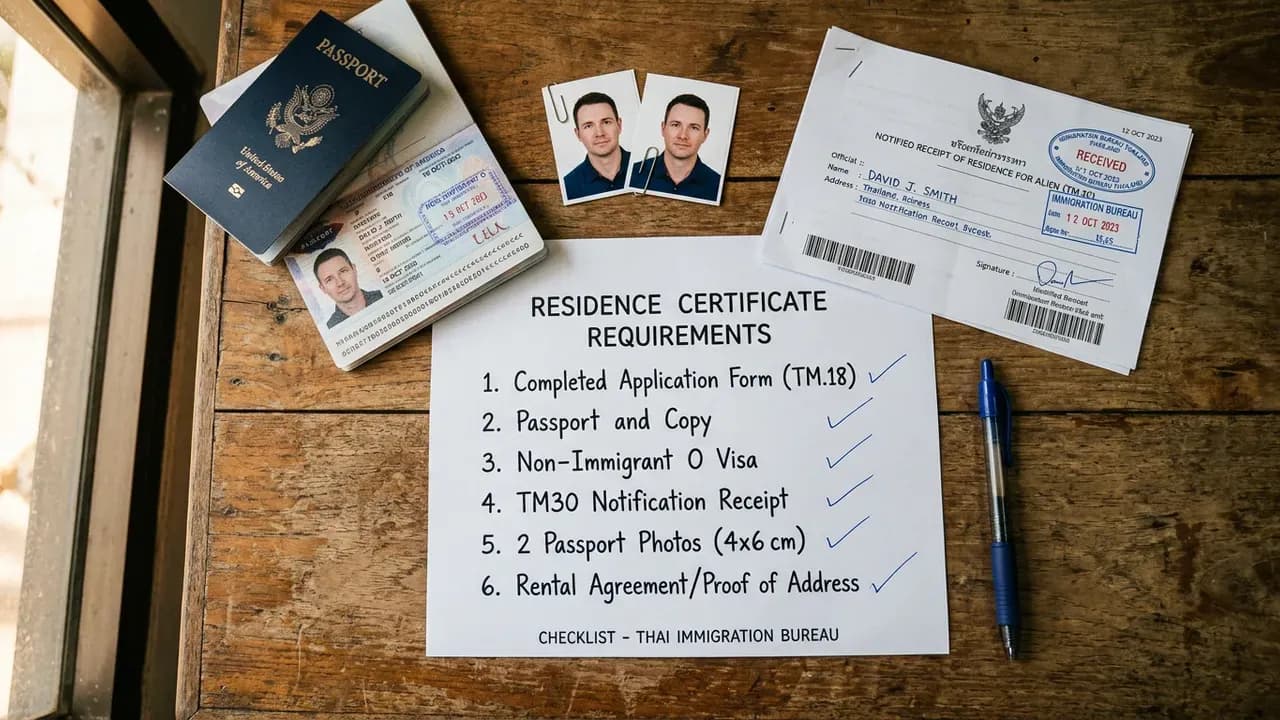
Here is the complete checklist of everything you need before visiting the Immigration office: <table><thead><tr><th>#</th><th>Requirement</th><th>Details</th></tr></thead><tbody><tr><td>1</td><td>Qualifying visa</td><td>Non-Immigrant B, O, OA, OX, ED, M, LTR, or Elite. Not tourist visa (Bangkok).</td></tr><tr><td>2</td><td>Active TM.30</td><td>Filed after your most recent entry into Thailand. Confirmed in Immigration system.</td></tr><tr><td>3</td><td>90-day report</td><td>At least one completed. Bring TM.47 receipt. (Required at Bangkok; varies elsewhere.)</td></tr><tr><td>4</td><td>Original passport</td><td>Valid, with current visa/extension. Plus signed photocopies of bio page, visa, entry stamp, TM.6/TDAC.</td></tr><tr><td>5</td><td>Photos</td><td>2-3 photos, 4x6 cm, white background, taken within 6 months.</td></tr><tr><td>6</td><td>Proof of address</td><td>Lease agreement + landlord ID + house book. Or title deed if owner. Address must match TM.30.</td></tr><tr><td>7</td><td>TM.18 form</td><td>Completed application form. Download online or get at office.</td></tr><tr><td>8</td><td>Fee</td><td>200-500 THB in cash.</td></tr></tbody></table> <div style="background:#d4edda;border-left:4px solid #28a745;padding:12px 16px;margin:16px 0;border-radius:4px;"><strong>Pro tip from our team:</strong> Organize your documents in the order listed above. This matches the sequence most officers follow when reviewing applications, and a well-organized stack creates a positive first impression. Paper-clip each section together rather than using staples, as officers need to separate and photocopy individual pages.</div>
Need help with your residence certificate?
Our team handles the entire process — document preparation, Immigration visit, and certificate collection.