In This Article
You Technically Need an IDP Alongside Your Foreign License
Under Thai law and the 1949 Geneva Convention on Road Traffic, foreign visitors should carry an International Driving Permit alongside their original home-country license when driving in Thailand. The IDP serves as an official translation of your license into multiple languages, including Thai, and is recognized by Thai authorities as a valid temporary driving authorization. Your foreign license alone, without an IDP, is not officially sufficient under Thai law, even if it is in English. The legal basis is that Thailand recognizes the IDP system established by the Geneva Convention, which requires the IDP to be presented together with the original domestic license. Neither document is valid on its own — the IDP without the original license is meaningless, and the original license without an IDP lacks official recognition in Thailand. This is the strict legal position, though enforcement on the ground is more nuanced.
Many People Drive on Foreign Licenses Alone
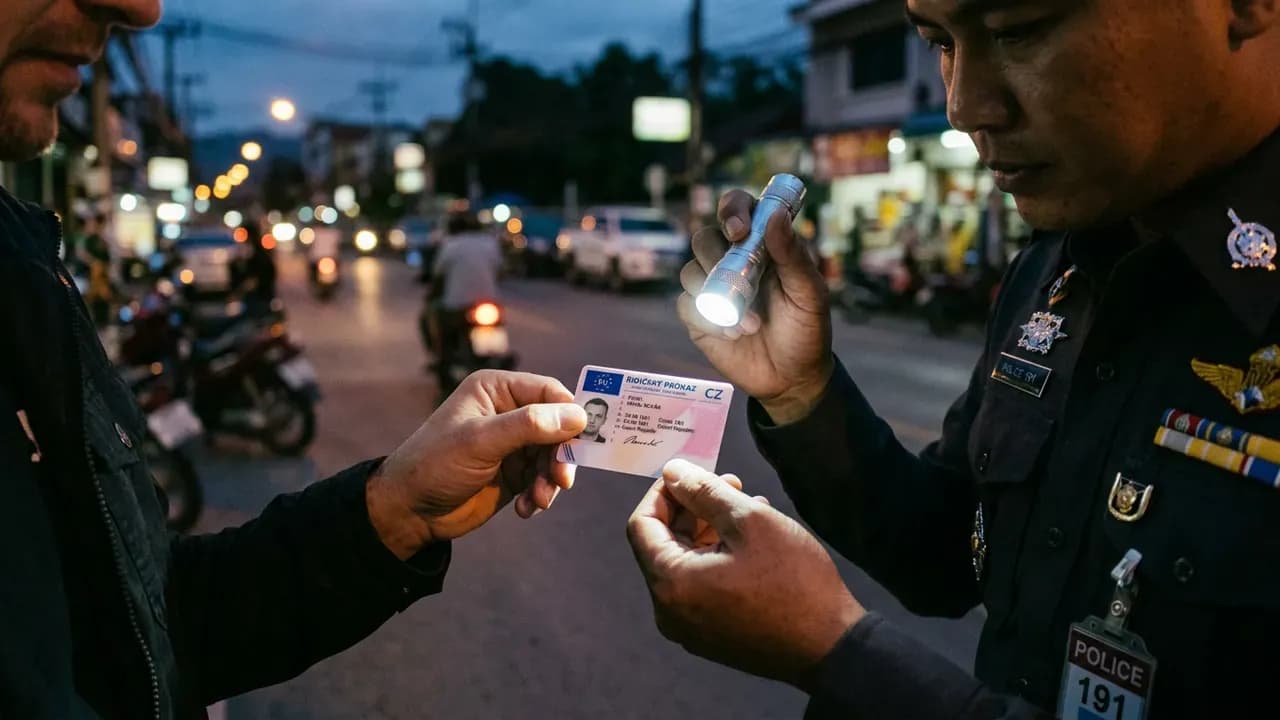
Despite the legal requirement for an IDP, the practical reality is that many foreigners drive in Thailand using only their foreign driving license. In some situations, police officers at checkpoints will accept a foreign license — particularly English-language licenses from countries like the US, UK, Australia, and Canada — without asking for an IDP. However, this is inconsistent and depends heavily on the individual officer, the location, and the circumstances. In major tourist areas like Phuket and Koh Samui, police are more likely to insist on proper documentation and fine those without it. In rural areas or less touristy provinces, officers may be more lenient. The key risk of relying on your foreign license alone is not just the potential fine (500-2,000 THB) but the insurance implications. Just because a police officer lets you go does not mean your insurance company will honor a claim if you are driving without the legally required documentation.
Police Enforcement Varies by Area
Police enforcement regarding foreign driving licenses varies dramatically across Thailand. In Bangkok, police checkpoints are common but tend to focus on Thai drivers; foreigners are occasionally checked but less frequently targeted. In Phuket, enforcement against foreign drivers and riders is aggressive, with daily checkpoints in popular areas like Patong, Kata, and Kamala. Koh Samui and Koh Phangan have regular checkpoints, especially during Full Moon Party periods. Chiang Mai checkpoints are common around the Old City and on the road to Doi Suthep. Pattaya enforcement is moderate but increasing. In rural and provincial areas, checkpoints exist but foreigners are rarely the primary target. The general trend across Thailand is toward stricter enforcement, driven by the government's road safety campaigns and the high number of tourist injuries and fatalities in motorcycle accidents. Areas that were previously relaxed about licensing are tightening up year by year.
Insurance May Not Cover You Without Proper Documentation
This is the critical issue that many foreign drivers overlook. Even if police never stop you and you never receive a fine, driving without proper licensing documentation puts your insurance coverage at serious risk. Thai motor insurance policies (both compulsory PRB and voluntary coverage) typically require the driver to hold a valid license recognized under Thai law. If you are in an accident and file a claim, the insurance company may investigate your documentation. If they determine you were driving with only a foreign license and no IDP, they may deny your claim entirely. Travel insurance works similarly — most policies exclude coverage for incidents where the insured was operating a vehicle in violation of local law. The financial exposure is enormous: a serious accident can result in vehicle damage costs of 100,000-500,000 THB, medical bills exceeding 1,000,000 THB, and third-party liability claims that could reach several million baht. Proper licensing documentation is your financial safety net.
Best Practice: Get an IDP or Convert to Thai License
For short-term visitors (under 90 days), the recommended approach is to obtain an IDP from your home country before traveling to Thailand. IDPs are inexpensive (typically 15-30 USD), widely available from national automobile associations, and valid for 1 year. Make sure your IDP includes all the vehicle categories you plan to drive — Category B for cars and Category A for motorcycles/scooters. For long-term residents (those on non-immigrant visas, work permits, or retirement visas), converting to a Thai driving license is strongly recommended. A Thai license is unambiguous — there is no question about its validity at police checkpoints or with insurance companies. The conversion process is simpler than a new application if you already hold a valid foreign license: you may be exempt from the written and practical tests, depending on your country of origin and the specific DLT office. The cost is minimal (205-505 THB) and the license is valid for 2-5 years.
How Long Can You Use an IDP in Thailand?
An International Driving Permit is valid in Thailand for the duration of each entry, up to a maximum of 90 days per entry. The IDP itself has a validity period of 1 year from the date of issue, but Thai authorities treat it as a temporary document tied to your immigration status. If you leave Thailand and re-enter, the 90-day clock resets. However, if you are a long-term resident staying in Thailand continuously, relying on an IDP indefinitely is not advisable — it is designed as a temporary solution for travelers, not a permanent driving authorization. The Department of Land Transport has indicated that long-term residents should obtain a Thai driving license rather than perpetually relying on an IDP. In practice, there is no formal mechanism to track how long you have been using an IDP, but if you are on a yearly retirement visa and have been in Thailand for years, having a Thai license is both more practical and more legally defensible.
Need help with this?
Our team handles the entire process — documents, preparation, and DLT escort. 98% first-attempt pass rate.