In This Article
Legal Requirements for Foreigners to Drive
Yes, foreigners can legally drive in Thailand, but only with the proper documentation. There are two legal options. Option one: a valid Thai driving license. This is the best option for long-term residents. You can obtain one by converting your foreign license or taking the full test at a DLT office. A Thai license is valid for two years (temporary) then five years (permanent). Option two: an International Driving Permit (IDP) paired with your valid home country license. The IDP must be issued in your home country before you travel to Thailand. It must follow the 1949 Geneva Convention format — Thailand does not recognize the 1968 Vienna Convention IDP format. The IDP is valid for one year from the date of issue. What is NOT legal: driving with only your foreign license and no IDP. Despite widespread practice, this is technically illegal and can result in fines, insurance complications, and legal issues in case of an accident. Your home country license alone — whether from the US, UK, Australia, or anywhere else — does not legally authorize you to drive in Thailand.
Practical Realities of Driving in Thailand
The legal requirements are clear, but the practical reality of driving in Thailand is more nuanced. Many foreigners drive motorcycles and cars daily, some without proper documentation. Rental companies frequently rent vehicles with no license check beyond a passport scan. However, the consequences of driving without proper documentation become severe only when something goes wrong — an accident, a police checkpoint, or an insurance claim. Thai driving culture is different from Western countries. Traffic flow is more organic and less rule-bound. Motorcycles weave between lanes. U-turns happen in unexpected places. Speed limits are loosely enforced on highways but more strictly in cities. Pedestrians do not have right of way in practice. Horn use is communicative rather than aggressive. Traffic in Bangkok is among the worst in the world, with average speeds during rush hour dropping to 10 to 15 kilometers per hour. Outside of major cities, roads are generally good quality but two-lane highways with fast-moving traffic can be dangerous, especially at night when unlit vehicles, animals, and pedestrians are common hazards.
Left-Hand Traffic and Road Conditions
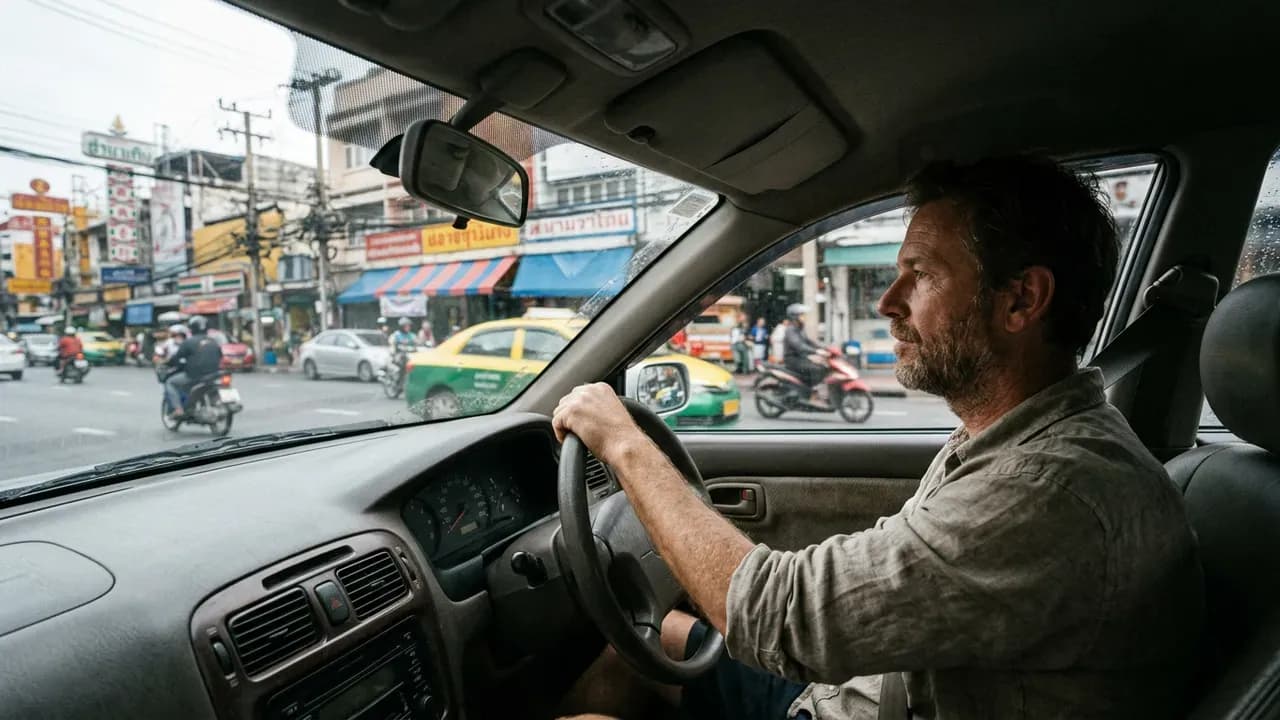
Thailand drives on the left side of the road, with the steering wheel on the right side of the vehicle. This is the same as the UK, Japan, Australia, and Singapore, but opposite to the US, Canada, and most of Europe. If you are accustomed to driving on the right, the most dangerous moments are: turning at intersections (you instinctively look the wrong way), entering roundabouts (you must go clockwise), overtaking (you pass on the right side), and merging onto highways. After two to three days of careful driving, most people adjust. Road conditions vary significantly. Major highways and expressways are excellent — well-maintained, clearly marked, and comparable to Western standards. Provincial roads are generally good but may lack shoulders or have uneven surfaces. Rural roads can be narrow, poorly lit, and shared with agricultural vehicles, animals, and pedestrians. During the rainy season (June to October), flooding is common in certain areas, and road surfaces become slippery. Potholes appear suddenly after heavy rain. Mountain roads in the north (Chiang Mai, Chiang Rai, Mae Hong Son) are winding and steep.
Police Checkpoints: What They Check
Police checkpoints are common throughout Thailand, particularly on major roads, near tourist areas, and during holiday periods. Knowing what to expect reduces anxiety. At a checkpoint, an officer will wave you over or signal for you to stop. They will typically ask for your driving license — a Thai license, or an IDP with your home country license. They may also ask for vehicle registration (the green book or a copy) and proof of insurance. For motorcyclists, they will check whether you are wearing a helmet, as it is legally required. Common reasons foreigners are stopped: no helmet (motorcycle), no license or expired license, running a red light, or random document checks. If you have all your documents in order and are driving legally, the checkpoint is quick — usually under two minutes. If you do not have a valid license, the fine is typically 500 to 1,000 THB, paid at the police station or sometimes on the spot with a receipt. In some tourist areas, checkpoints specifically target motorcyclists without licenses. Having a Thai driving license eliminates virtually all checkpoint stress.
Insurance Requirements and Implications
Insurance is a critical consideration for foreign drivers in Thailand. There are two types of vehicle insurance: compulsory and voluntary. Compulsory insurance (Por Ror Bor) is required by law for all vehicles. It covers medical expenses for third-party injuries up to 80,000 THB per person and death up to 500,000 THB. It does not cover your own injuries or any property damage. Voluntary insurance comes in several classes. Class 1 covers everything — your vehicle, other vehicles, property, medical, and fire and theft. Class 2 covers third-party vehicle and property damage, fire, and theft. Class 3 covers only third-party damage. Class 2+ and 3+ are intermediate options. Here is the critical point: if you are in an accident while driving without a valid license (no Thai license and no IDP), your insurance company may deny your claim. This applies to both compulsory and voluntary insurance. You would be personally liable for all costs — vehicle repair, medical bills, and compensation to the other party. Medical and evacuation costs after a serious accident can easily exceed 1,000,000 THB. Your travel insurance may also have exclusions for unlicensed driving. Always drive with valid documentation.
Renting vs Owning as a Foreigner
As a foreigner in Thailand, you can either rent or own a vehicle, and each approach has different implications. Renting: widely available for both cars and motorcycles throughout Thailand. Car rental starts at about 800 to 1,500 THB per day for economy cars, or 15,000 to 25,000 THB per month for long-term rentals. Motorcycle rental is 150 to 300 THB per day or 2,500 to 5,000 THB per month. Rental companies handle registration, insurance, and maintenance. The downside is cost over time and the risk of disputes over damage. Always photograph the vehicle thoroughly before renting and confirm what insurance is included. Owning: foreigners can legally own vehicles in Thailand. You can buy new or used cars and motorcycles, and the vehicle is registered in your name with a green book. Ownership is straightforward but selling later requires a DLT transfer process. For motorcycles, ownership is extremely affordable — a used Honda Click costs 25,000 to 35,000 THB. For cars, consider that financing options for foreigners are limited. Long-term residents (one year or more) generally benefit from owning over renting. Short-term visitors should rent. In both cases, you need a valid driving license — Thai license or IDP.
Make sure you are properly licensed
The most important step before driving in Thailand is having a valid license. We handle the entire process for you.