In This Article
License Requirements for Motorcycles and Scooters
Every motorized two-wheeler in Thailand requires a motorcycle license to ride legally — and that includes the small 110cc scooters that rental shops hand out to tourists without a second thought. There is no exception for engine size, automatic transmission, or electric scooters. If it has a motor and two wheels, you need a motorcycle license. For short stays under three months, you can ride with your home country motorcycle license paired with a valid International Driving Permit (IDP) that includes a motorcycle endorsement. For stays longer than three months, you need to obtain a Thai motorcycle driving license from the Department of Land Transport (DLT). The temporary Thai motorcycle license costs 105 THB and is valid for two years. A five-year license costs 255 THB. Both require passing a written test (90% score on 50 questions), aptitude tests, and a practical riding exam for new applicants. If you are converting a foreign motorcycle license, the practical test is waived.
A Car License Does NOT Cover Motorcycles
This is the single most common and most costly misconception among foreigners in Thailand. Your car driving license — whether Thai, foreign, or international — does not authorize you to ride any motorcycle or scooter. A car license and a motorcycle license are entirely separate documents with separate tests and separate endorsements. An IDP based on a car-only license from your home country does not cover motorcycles either. If your home country license only shows car categories (such as Category B in European licenses), your IDP inherits those same limitations. To ride legally, you need either a dedicated motorcycle license from your home country reflected on your IDP, or a Thai motorcycle license obtained at a DLT office. Many tourists assume that because rental shops do not ask for a motorcycle license, one is not required. This is incorrect. Rental shops face minimal enforcement and are motivated by profit, not your legal protection. The responsibility for having a valid license falls entirely on the rider.
Penalties for Riding Without a License
Riding a motorcycle in Thailand without a valid license carries an on-the-spot fine of 500 to 2,000 THB. While that may sound minor, the real financial risk is far greater. If you are involved in an accident while riding without a valid motorcycle license, your vehicle insurance is voided entirely. Your travel insurance will almost certainly reject any medical claims. Hospital bills for serious motorcycle injuries in Thailand routinely reach 500,000 to several million THB, and hospitals are legally permitted to hold your passport until the bill is paid. Beyond fines and insurance, riding without a license can lead to vehicle impoundment by police. If the accident causes injury or death to another person, you face potential criminal charges under Thai law, and lacking a valid license significantly worsens your legal position. Thai courts view unlicensed riding as negligence, which can increase both criminal penalties and civil liability for damages.
Helmet Laws — Updated June 2025
Thailand's helmet laws were significantly tightened in June 2025. Both the rider and all passengers must wear a helmet at all times while on a motorcycle, with no exceptions for short distances or slow speeds. The fine for not wearing a helmet was quadrupled from 500 THB to 2,000 THB per person. This means a rider caught without a helmet who also has a helmetless passenger faces a combined 4,000 THB fine. Police no longer issue warnings — fines are applied on the spot. Despite these laws, enforcement remains inconsistent outside of major cities and checkpoint areas. However, the safety argument for helmets is overwhelming. In 2024, 84% of injured motorcycle riders in Thailand were not wearing helmets. A proper full-face helmet is one of the single most effective things you can do to protect yourself. Cheap helmets are available at every 7-Eleven and Big C store for 300 to 500 THB, though investing 1,500 to 3,000 THB in a proper DOT or ECE-certified helmet is strongly recommended.
Where Motorcycles Can and Cannot Ride
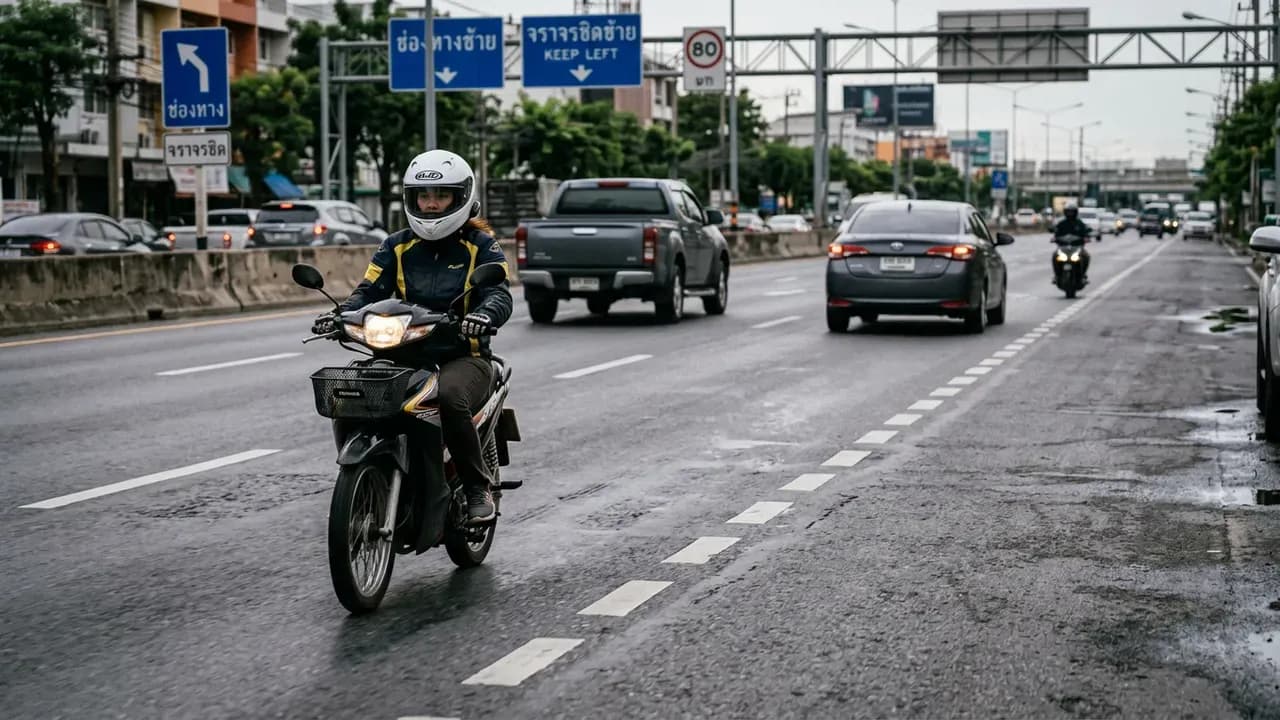
Motorcycles are prohibited from all expressways and motorways in Thailand. This includes the elevated tollways in Bangkok (such as the Sirat Expressway and Chalerm Maha Nakhon Expressway) and the inter-city motorways connecting major cities. The fine for riding a motorcycle on an expressway is up to 1,000 THB, and you will be directed to exit immediately. On regular roads, motorcycles should ride in the leftmost lane on multi-lane roads. In practice, Thai motorcycle riders weave through traffic and ride between lanes, but this is technically not permitted and significantly increases accident risk. On single-lane roads, motorcycles follow the same rules as other vehicles. Motorcycles are allowed on all regular highways, urban streets, and rural roads throughout the country. In some cities, there are designated motorcycle lanes marked with motorcycle symbols on the road surface — use these where available.
Speed Limits for Motorcycles
Motorcycle speed limits in Thailand are the same as those for other vehicles on most roads. In urban areas and cities, the speed limit is 50 to 60 km/h unless otherwise posted. On rural highways and inter-city roads, the limit is 80 to 90 km/h for motorcycles. Since motorcycles are prohibited from expressways and motorways, the higher speed limits of 110 to 120 km/h on those roads do not apply. Speed enforcement is increasing in Thailand, particularly on major highways and in tourist areas. Fixed speed cameras are becoming more common, and police regularly set up radar checkpoints. Fines for speeding start at 500 THB and can reach 1,000 THB. More importantly, excessive speed is the leading contributing factor in fatal motorcycle accidents. Most scooters (110-125cc) have a practical top speed of 90 to 100 km/h, which means riding at the highway speed limit already pushes these bikes near their limits.
Passenger Rules
Thai law allows a maximum of one passenger on a motorcycle, for a total of two people on the bike. Carrying more than one passenger is illegal and carries a fine, though enforcement is admittedly lax in many areas — you will regularly see Thai families of three or four on a single scooter. All passengers must wear helmets under the updated June 2025 regulations. Children under two years old should not ride on motorcycles at all according to Thai safety guidelines, though there is no specific law setting a minimum age for motorcycle passengers. For passengers, sitting sideways (side-saddle) is common in Thailand but is dangerous and not recommended. Passengers should sit astride the bike facing forward, with feet on the passenger pegs. Proper footwear is important for passengers as well — flip-flops and sandals offer zero protection in even a minor fall.
Insurance Requirements and What Happens Without a License
Every registered motorcycle in Thailand must carry compulsory insurance known as Por Ror Bor, which costs approximately 300 to 430 THB per year. This insurance covers third-party bodily injury only — it does not cover your own injuries or property damage. Voluntary insurance (Class 1, 2, or 3) provides additional coverage but is not legally required. Here is the critical point that many riders miss: both compulsory and voluntary motorcycle insurance policies contain clauses that void coverage if the rider does not hold a valid motorcycle license at the time of an incident. This means that if you crash while riding without a license, your insurance company will deny the claim. You become personally liable for all medical bills, vehicle repairs, and compensation to any injured parties. Your travel insurance from your home country will similarly reject motorcycle accident claims if you were riding without the proper license. This single fact — that insurance is voided without a license — represents the greatest financial risk of unlicensed riding, far exceeding any police fine.
Recent Crackdowns on Tourists (2025-2026)
Thai authorities have dramatically escalated enforcement against unlicensed foreign riders, beginning in Phuket and expanding nationwide. In Phuket alone, 20,901 foreign nationals were arrested for riding without a valid license during the 2025 crackdown period. An additional 4,437 arrests targeted rental operators who provided motorcycles to unlicensed riders, and 1,737 motorcycles were seized from rental businesses. The Thai government has drafted amendments to the Land Transport Act that would impose fines of 10,000 to 100,000 THB on rental operators who provide vehicles to unlicensed drivers — legislation expected to pass in 2026. These crackdowns are now expanding beyond Phuket to Pattaya, Koh Samui, and Chiang Mai, all popular tourist destinations with high rates of unlicensed riding. Police checkpoints specifically targeting foreign riders are now a regular occurrence in these areas. Officers check for a valid motorcycle license (Thai license or IDP with motorcycle endorsement), helmet compliance, and vehicle registration. The days of casually renting a scooter and riding around without documentation are ending rapidly.
Thailand Motorcycle Safety Statistics
Thailand has the highest per capita motorcycle death rate in the world, and the numbers are staggering. In 2024, more than 14,000 people died in motorcycle crashes across the country — that translates to roughly 36 deaths per day. Approximately 80% of all road fatalities in Thailand involve motorcycles. Among injured riders, 84% were not wearing helmets at the time of the crash. These are not abstract statistics. As a motorcycle rider in Thailand, you face a level of road risk that is dramatically higher than in most Western countries. Contributing factors include inconsistent road quality, poorly lit rural roads, stray animals, vehicles making unexpected turns, and a general driving culture that is less predictable than what many foreigners are accustomed to. Alcohol is a major factor — a significant proportion of fatal motorcycle accidents involve riders who have been drinking. Foreign tourists are overrepresented in motorcycle accident statistics relative to their numbers on the road, largely due to unfamiliarity with left-hand traffic, local driving patterns, and the tendency to ride without proper training or licensing.
Renting a Motorcycle vs Owning
Rental costs for a standard 125cc scooter range from 150 to 300 THB per day, with monthly rates dropping to 2,500 to 4,000 THB. Larger bikes (300cc and above) rent for 500 to 1,500 THB per day. For stays of several months or longer, buying a used scooter often makes more financial sense — a used Honda Wave costs 15,000 to 25,000 THB and can be resold for a similar price when you leave. When renting, never hand over your passport as a deposit. Offer a photocopy of your passport instead, or leave a cash deposit. If the rental shop insists on holding your original passport, walk away and find another shop. Always photograph the bike thoroughly before riding away, documenting every scratch and dent. Get a written rental agreement that specifies the daily rate, deposit amount, and the bike's existing condition. Confirm whether the rental includes insurance and what the deductible is. Many rental shops include only compulsory insurance, leaving you liable for damage to the bike itself.
Essential Safety Tips for Riding in Thailand
Always wear a full-face helmet — not the thin plastic novelty helmets sold at some shops. Wear closed-toe shoes, long pants, and a jacket or long-sleeved shirt. Ride on the left side of the road and stay in the leftmost lane on multi-lane roads. Drive defensively and assume that other road users will make unexpected moves — because they will. Avoid riding at night whenever possible, as road hazards are harder to see and drunk driving rates increase significantly after dark. Watch for sand, gravel, and oil patches on the road surface, especially on curves and at intersections. Never drink and ride — Thailand's legal blood alcohol limit is 0.05% (0.02% for riders under 20), and alcohol is a factor in a large proportion of fatal motorcycle crashes. Keep your speed moderate, particularly on unfamiliar roads. Be constantly aware that Thailand drives on the left — this is especially dangerous at intersections where your instinct may be to look the wrong way. Get proper insurance before riding. Carry your license and IDP at all times. Avoid riding in heavy rain when visibility and road grip are severely compromised. Watch for stray dogs, which are common on Thai roads and can cause serious accidents. Use your mirrors and signal before changing lanes or turning.
Make sure you are properly licensed
The most important step before driving in Thailand is having a valid license. We handle the entire process for you.