In This Article
What Is a Residence Certificate?
A residence certificate (also called a certificate of residence or letter of residence) is an official document issued by Thai Immigration confirming that you reside at a specific address in Thailand. The Department of Land Transport (DLT) requires this document as proof of your Thai address when applying for or renewing a driving license. It is a separate document from your TM30 notification — though the TM30 is needed as a prerequisite to obtain it. The residence certificate is valid for a limited period (usually 30 days from issuance), so you should obtain it close to your planned DLT visit.
Who Needs a Residence Certificate?
All foreigners applying for a Thai driving license need a residence certificate, whether you are applying for a new license, converting a foreign license, or renewing an existing Thai license. The only exception is if you hold a Thai work permit — some DLT offices accept the work permit as proof of address instead. However, even with a work permit, many DLT offices still request a residence certificate, so it is safer to obtain one regardless. If you are on any type of non-immigrant visa (B, O, OA, OX, ED), you will need this document.
Prerequisites — What You Need Before Applying
Before you can obtain a residence certificate, you need: (1) A valid passport with a non-immigrant visa and current entry stamp. (2) A TM30 notification on file — this is a report filed by your landlord or hotel confirming your place of stay. If your TM30 is not on file, Immigration will not issue the residence certificate. Check your TM30 status using the Immigration online system or by calling the Immigration hotline at 1178. (3) A TM28/TM47 (90-day report) if applicable — if you have been in Thailand for more than 90 days, your 90-day report should be current. (4) A completed TM18 form (application for residence certificate) — available at the Immigration office.
Documents to Bring
Bring the following to the Immigration office: Original passport (they will photocopy the photo page, visa page, most recent entry stamp, and TDAC arrival confirmation — the digital card that replaced the paper TM6 in May 2025). Two passport-size photos (4x6 cm). TM30 receipt or confirmation number. Proof of address (lease agreement, utility bill, or hotel booking confirmation). TM18 application form (completed). The application fee is 200-500 THB depending on the office. Some offices may also request a copy of your landlord's ID card and house registration book (tabien baan). If you use our service, we prepare all documents for you and handle the TM30 filing if needed.
Where to Apply
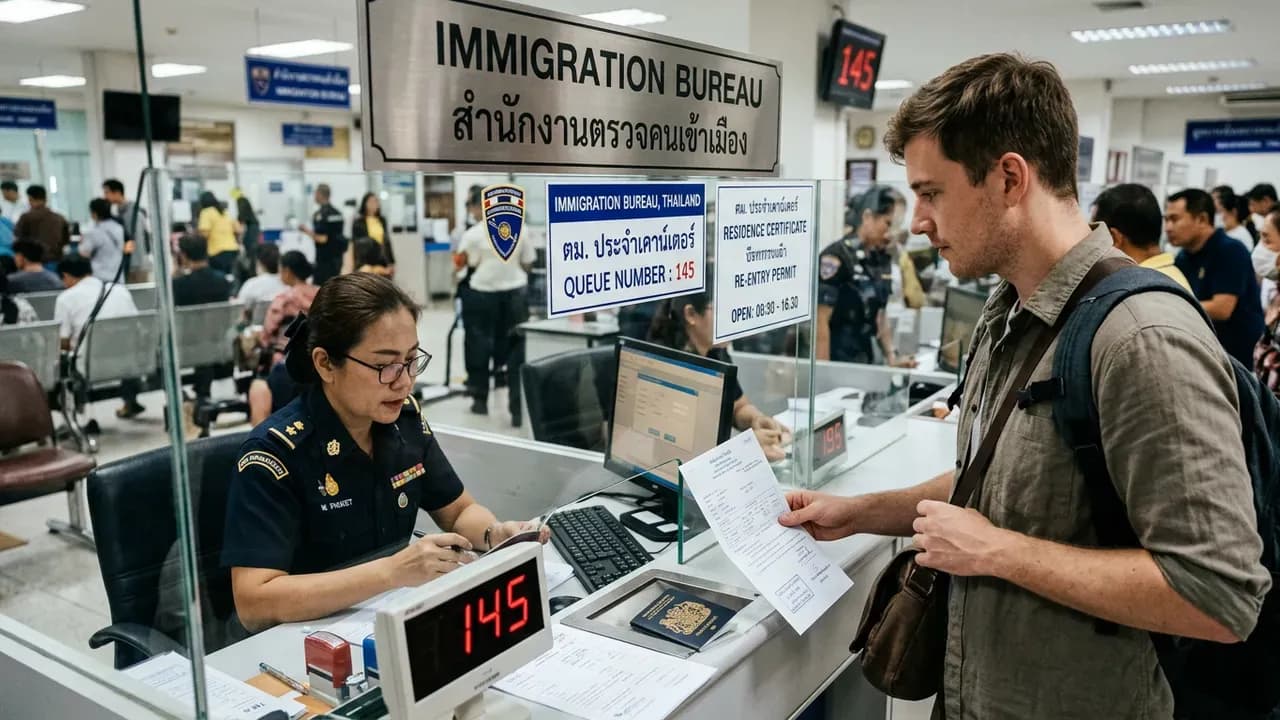
You must apply at the Immigration office that has jurisdiction over your place of residence. In Bangkok, the main office is at the Chaeng Watthana Government Complex (Building B, Floor 2). For foreigners living in Chiang Mai, Phuket, Pattaya, Koh Samui, or other provinces, apply at your local Immigration office. Some offices handle the process faster than others. Bangkok's Chaeng Watthana office is the busiest but has a streamlined system. Arrive early — the office opens at 8:30 AM and queues can be long, especially on Mondays. Most provincial offices are less crowded and sometimes more flexible with requirements.
The Application Process
Step 1: Arrive at the Immigration office and go to the residence certificate section (separate from visa extensions). Step 2: Submit your completed TM18 form, passport, photos, and supporting documents. Step 3: The officer will verify your TM30 status in their system. If your TM30 is not on file, you will be asked to have your landlord file it first. Step 4: Pay the fee (200-500 THB depending on the office). Step 5: Wait for processing — this typically takes 1-3 hours at busy offices, sometimes same-day at smaller offices. Some offices may ask you to return the next business day. Step 6: Collect your residence certificate. Check all details (name spelling, address, passport number) before leaving.
Common Problems and How to Avoid Them
The most common issue is a missing or outdated TM30. If your TM30 is not on file, Immigration cannot issue the residence certificate. Solution: have your landlord file a TM30 online (via the Immigration website) or in person before you apply — our TM30 service handles this for you. Another common problem is address mismatches — the address on your TM30, lease agreement, and residence certificate request must all match. If you have moved recently, update your TM30 first. Some offices are strict about photo specifications — bring recent photos that meet Thai government standards (no glasses, white background, formal attire).
Validity Period and Timing Tips
The residence certificate is typically valid for 30 days from the date of issuance. Plan accordingly — obtain it within 1-2 weeks of your planned DLT visit to ensure it is still valid. If your residence certificate expires before you make it to the DLT, you will need to obtain a new one. For this reason, we recommend scheduling your DLT appointment first, then getting your residence certificate about 1 week before. If you are using our full service package, we coordinate the timing of all documents so nothing expires before your DLT visit.
Make sure you are properly licensed
The most important step before driving in Thailand is having a valid license. We handle the entire process for you.