In This Article
Current Legal Status of Electric Bikes and Scooters
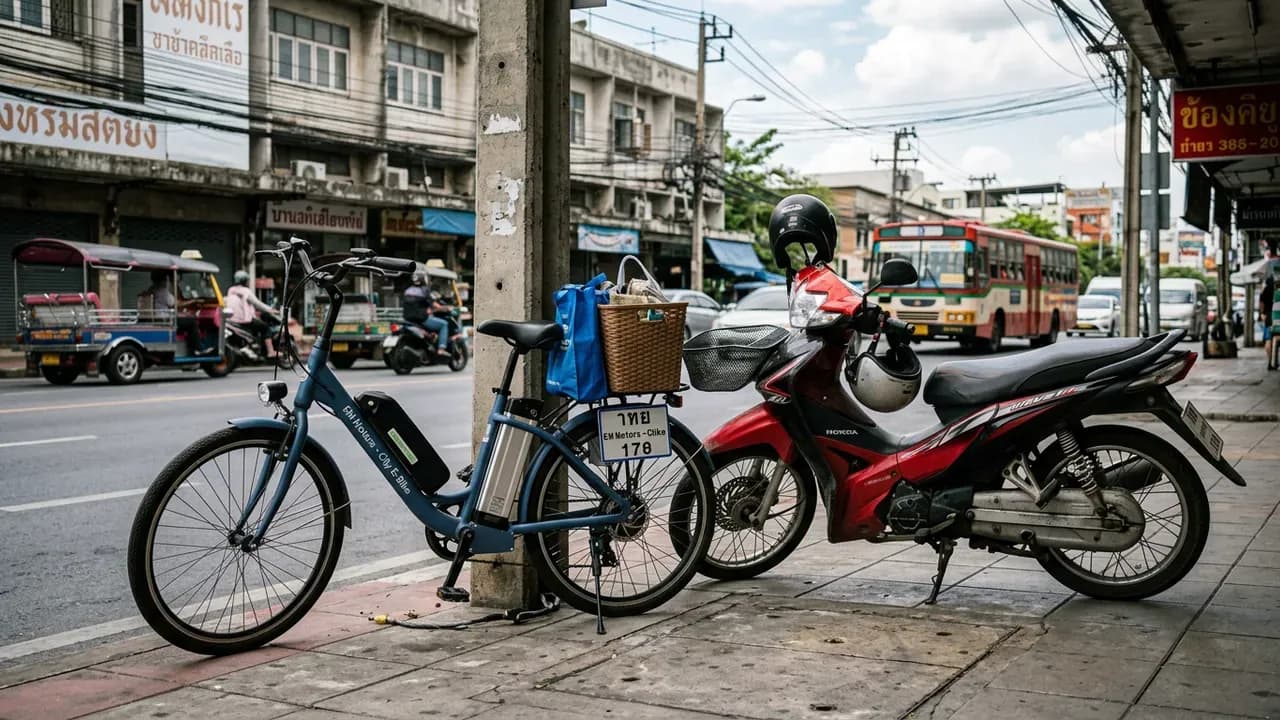
Electric bikes and scooters in Thailand occupy an evolving legal landscape. As of 2026, electric motorcycles and scooters that meet the definition of a motor vehicle under the Land Transport Act must be registered and the rider must hold a valid motorcycle license — the same requirements as gasoline-powered motorcycles. The key distinction is power output. Low-power electric bicycles (pedal-assist e-bikes with motors under 250 watts and maximum speed of 25 km/h) are generally treated as bicycles and do not require registration or a license. However, the more powerful electric scooters that dominate the Thai market — including popular models from Ninebot, NIU, Deco, and MINE Mobility — have motors well above 250 watts and top speeds exceeding 45 km/h. These absolutely require registration and a license. The Thai government has been actively promoting electric vehicle adoption through tax incentives and subsidies since 2022, and the regulatory framework continues to develop. Some grey-market imported electric scooters may not have Thai type approval, making them impossible to register legally.
Registration Requirements for Electric Vehicles
Electric motorcycles and scooters that qualify as motor vehicles must be registered at the DLT, just like their gasoline counterparts. To register an electric motorcycle, you need proof of purchase (receipt or invoice from the dealer), the vehicle manufacturer's certificate of origin, proof of import (if applicable), compulsory insurance (Por Ror Bor), and your identification documents (passport for foreigners, plus a residence certificate). The DLT assigns a license plate number and issues a green book (vehicle registration book) for the electric vehicle. If you buy from an authorized Thai dealer, the dealer typically handles the registration process. The challenge arises with imported or grey-market electric scooters that lack Thai type approval — these cannot be legally registered, and riding an unregistered vehicle on public roads is illegal with fines up to 10,000 THB. Before purchasing, confirm that the model has DLT type approval for registration in Thailand. Thai-manufactured and officially imported brands like MINE Mobility, NIU, Deco, and Honda Electric are generally easy to register.
License Requirements: Same as Regular Motorcycles
The license requirement for electric motorcycles and scooters is straightforward: you need the same motorcycle driving license as you would for a gasoline motorcycle. There is no separate 'electric vehicle' license category in Thailand. A Thai motorcycle license (ใบอนุญาตขับรถจักรยานยนต์) covers both gasoline and electric motorcycles. For foreigners, this means you either need a Thai motorcycle license obtained at a DLT office, or an International Driving Permit (IDP) that includes motorcycle authorization (Category A). The process for getting a Thai motorcycle license is identical regardless of whether you plan to ride electric or gasoline — you take the same written test (covering traffic rules and signs), the same color blind test, the same reaction test, and the same practical riding test. The practical test is typically done on a gasoline motorcycle provided by the DLT. Once you have the license, it covers all motorcycle types. If you already have a Thai car license, you still need a separate motorcycle license — a car license does not cover motorcycles (whether electric or gasoline) in Thailand.
Popular Electric Scooters and Bikes in Thailand
Thailand's electric two-wheeler market has grown rapidly. MINE Mobility is a Thai manufacturer producing the MINE SPA1 and MINE ONE, with prices starting around 35,000 to 60,000 THB. They have a dealer network and service centers in major cities. NIU has established a strong presence with models like the NIU NQi and MQi series, priced from 50,000 to 120,000 THB, known for good build quality and smart connectivity features. Deco offers budget-friendly options starting around 20,000 to 40,000 THB, popular with delivery riders and short-distance commuters. Honda has entered the electric segment with the Honda EM1 e: scooter, priced around 55,000 THB, benefiting from Honda's vast service network in Thailand. Yamaha has the NEO series of electric scooters. For higher-end options, Gogoro and Super SOCO are available through authorized dealers. When choosing an electric scooter, consider range (typically 50 to 100 km per charge), charging time (3 to 6 hours for a full charge), availability of service centers and spare parts in your area, and whether the model has DLT type approval for registration. Battery replacement costs (typically 15,000 to 40,000 THB) should be factored into total ownership costs.
Charging Infrastructure in Thailand
Charging infrastructure for electric two-wheelers in Thailand is different from that for electric cars. Most electric scooters and motorcycles use removable batteries that you charge at home using a standard household outlet (220V). A full charge typically takes 3 to 6 hours and costs approximately 5 to 15 THB in electricity — far cheaper than gasoline. Some brands like Gogoro use battery swapping stations where you exchange a depleted battery for a fully charged one in seconds, though the swapping network is still limited to Bangkok. For electric motorcycles with fixed (non-removable) batteries, you simply plug into any household outlet. No special charging station is needed for most electric scooters. For electric cars, Thailand has been rapidly expanding its charging network. Major providers include EA Anywhere (by Energy Absolute), PEA VOLTA (by the Provincial Electricity Authority), SHARGE, and PTT EV Station. Charging stations are increasingly common at shopping malls, gas stations, and parking garages in Bangkok and major cities. However, coverage in rural areas remains sparse. The Thai government targets 12,000 public charging stations nationwide by 2030.
Insurance for Electric Vehicles
Insurance for electric motorcycles and scooters follows the same structure as gasoline vehicles. Compulsory insurance (Por Ror Bor) is required for all registered vehicles, including electric ones. The cost is similar to gasoline motorcycles — approximately 300 to 430 THB per year. Voluntary insurance is available from major Thai insurers including Viriyah, Bangkok Insurance, Thai Srimuang, and Dhipaya. However, not all insurers have electric vehicle-specific policies yet, and premiums may vary as insurers are still building risk data for electric vehicles. Some important considerations for insuring electric vehicles: battery damage can be extremely expensive to repair, so comprehensive (Class 1) coverage is recommended. Confirm whether the policy covers battery damage from flooding — a real risk during Thailand's rainy season. Check whether the policy covers fire damage from battery malfunction, as lithium-ion battery fires, while rare, are a known risk. Some EV manufacturers include a battery warranty (typically 2 to 3 years) which provides some protection. When insuring an electric vehicle, provide the insurer with the vehicle's registration details, including the fact that it is electric, to ensure proper coverage.
Make sure you are properly licensed
The most important step before driving in Thailand is having a valid license. We handle the entire process for you.