In This Article
Categories of Thai Road Signs
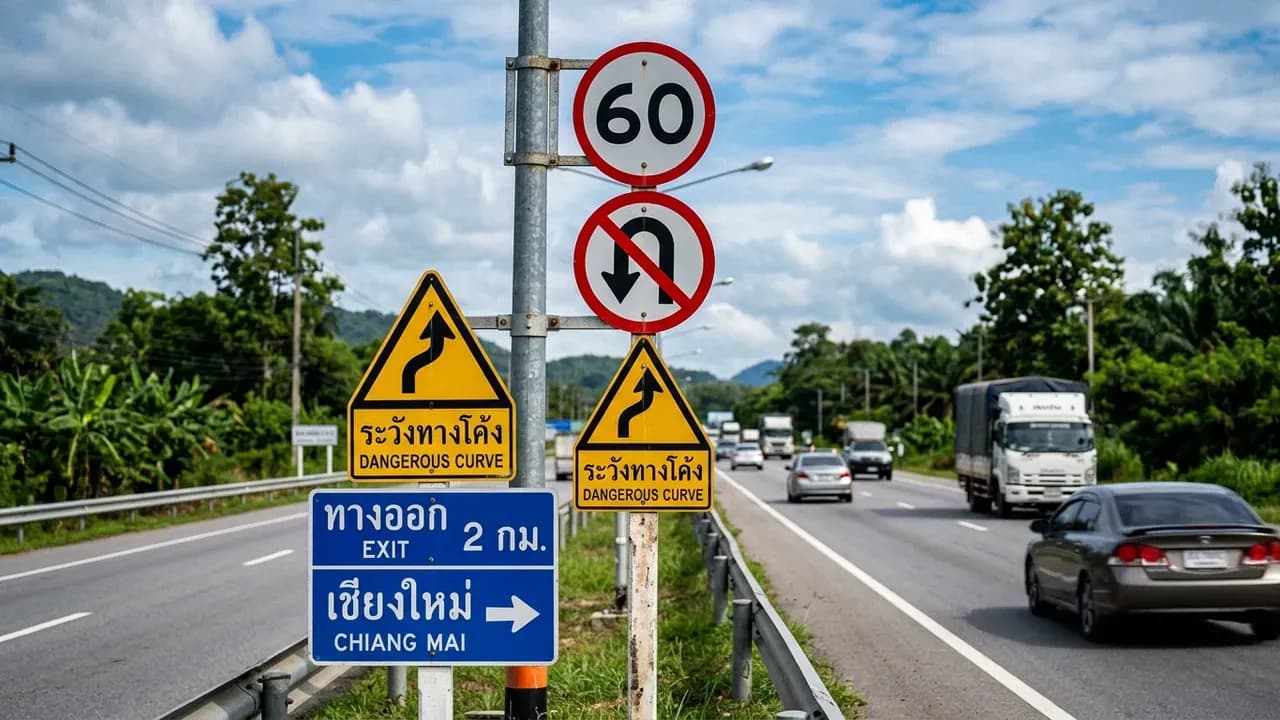
Thai road signs fall into three main categories: Regulatory signs (red circles) — these indicate mandatory instructions like stop, no entry, and speed limits. Warning signs (yellow diamonds or triangles) — these alert you to hazards ahead like curves, school zones, and construction. Information signs (blue or green rectangles) — these provide directions, distances, and facility information. Most signs use international symbols that are recognizable worldwide.
Key Regulatory Signs
The most important regulatory signs to know: Stop sign (hexagonal, red) — same as international standard. No entry — red circle with white horizontal bar. No U-turn — red circle with U-turn symbol crossed out. Speed limit — red circle with number inside. No overtaking — red circle with two cars. One-way — blue rectangle with white arrow. These signs are legally binding, and violations carry fines.
Common Warning Signs
Warning signs you will frequently encounter: Sharp curve ahead (left or right). Intersection ahead (various configurations). Pedestrian crossing. School zone. Construction zone. Slippery road (especially relevant during the rainy season). Animal crossing (elephants in some rural areas). Railway crossing. These yellow diamond or triangle signs indicate you should reduce speed and proceed with caution.
Thai-Specific Signs and Quirks
Some signs are more common in Thailand than elsewhere: U-turn permitted signs are very frequent on divided highways. Temple zone signs indicate reduced speed near Buddhist temples. National park signs. Highway distance markers in kilometers. Signs in Thai script — major highways have bilingual signs (Thai and English), but smaller roads may be Thai only. Learning basic Thai numerals helps with reading speed limit signs on rural roads.
Make sure you are properly licensed
The most important step before driving in Thailand is having a valid license. We handle the entire process for you.