In This Article
Overview of Driving Age Rules in Thailand
Thailand's driving age requirements are governed by two primary pieces of legislation: the Motor Vehicle Act B.E. 2522 (1979) and the Land Transport Act B.E. 2522 (1979), both administered and enforced by the Department of Land Transport (DLT). These laws establish clear minimum age thresholds for every category of vehicle operated on Thai roads, from small motorcycles to hazardous materials tankers. Unlike many Western countries such as the United States, United Kingdom, or Australia, Thailand does not operate a graduated licensing system with learner permits, provisional licenses, or mandatory supervised driving hours. Instead, the system is straightforward: once you reach the minimum age for your chosen vehicle category, you can apply for and receive a full temporary license, subject to passing the required tests. There are no intermediate steps, no logbook requirements, and no mandatory waiting periods between stages. The age requirements apply equally and without exception to Thai nationals and foreign residents. A foreigner living in Thailand on a non-immigrant visa faces the exact same age thresholds as a Thai citizen born and raised in the country. There is no special provision, exemption, or alternative pathway based on nationality, prior driving experience, or licenses held in other jurisdictions. The DLT verifies every applicant's age during the application process using the date of birth recorded in their passport (for foreigners) or Thai national ID card (for Thai citizens). If you do not meet the minimum age on the day you visit the DLT, your application will be refused on the spot, regardless of how close you are to the required birthday. Understanding these age requirements before you begin the application process is essential. Arriving at the DLT underage wastes an entire day of queuing and processing, and the DLT does not offer any form of pre-registration or reservation for applicants approaching the minimum age. You must meet the age requirement on the day of your application — not the day after, not next week. Plan your visit accordingly.
Minimum Driving Age by Vehicle Type: Complete Breakdown
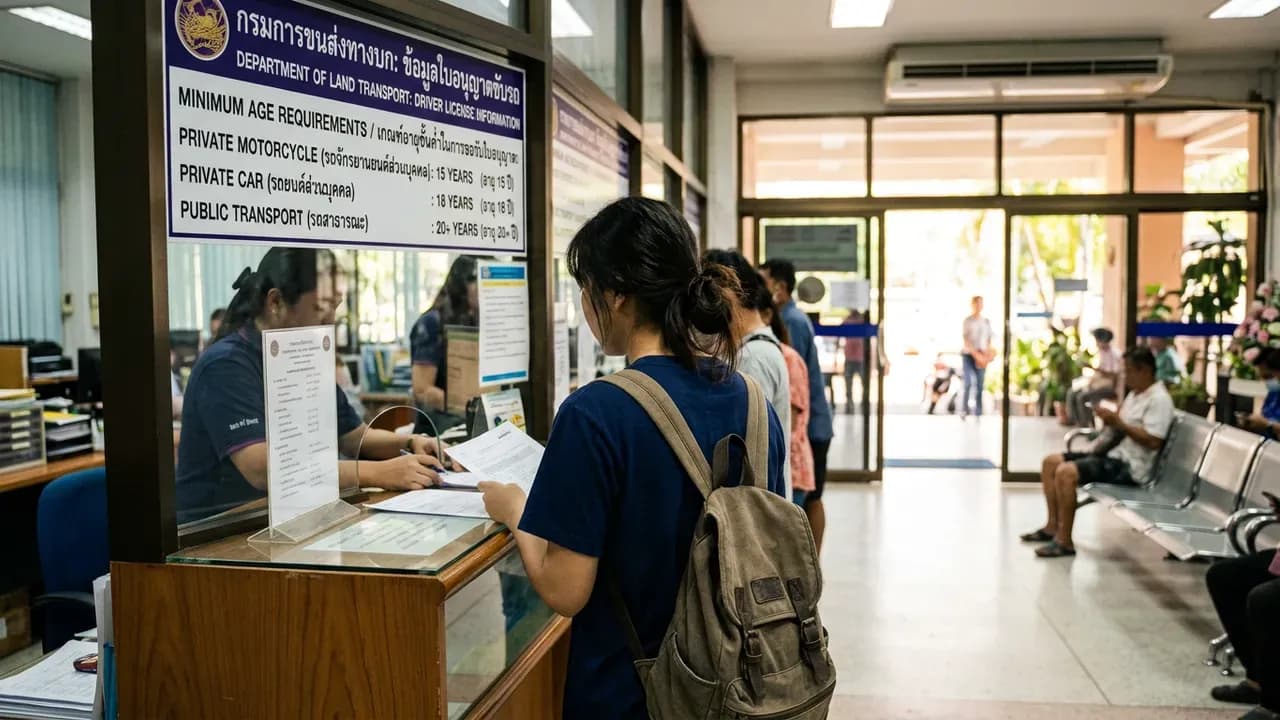
Thailand assigns different minimum age requirements to different vehicle categories, reflecting the complexity, size, and risk level associated with each type of vehicle. Here is the complete breakdown of every license category and its corresponding minimum age. Private car license (personal use): The minimum age is 18 years old. This covers standard passenger cars, SUVs, pickup trucks, and vans used for personal transportation. This is the most commonly sought license by both Thai nationals and foreign residents. Motorcycle license (under 110cc, probationary): The minimum age is 15 years old. This probationary license is restricted to motorcycles and scooters with engine displacement under 110cc. Riders with this license cannot legally operate larger motorcycles. This category is particularly relevant for Thai teenagers and is the lowest driving age available in the country. Motorcycle license (full, all engine sizes): The minimum age is 18 years old. This license covers motorcycles of any engine size, including large touring bikes, sport bikes, and big adventure motorcycles above 400cc. If you are a foreigner looking to ride anything larger than a small scooter, this is the license you need. Three-wheeled vehicle license (tuk-tuk): The minimum age is 18 years old for private three-wheelers. However, operating a tuk-tuk as a public transport vehicle — carrying passengers for hire — requires a public vehicle driving license with a minimum age of 22. Taxi license (public car): The minimum age is 22 years old. This applies to metered taxis, limousine services, ride-hailing drivers (Grab, Bolt), and any other public passenger car service. In addition to the age requirement, taxi license applicants must have held a personal car license for at least one year before applying. Bus license (public passenger bus): The minimum age is 22 years old. This covers city buses, intercity coaches, minibuses used for public transport, and tour buses. Bus drivers must also hold a personal car license for a minimum period before upgrading to a commercial bus license. Commercial truck license (Class 1 and Class 2): The minimum age is 22 years old. Class 1 covers trucks with a gross vehicle weight exceeding 2,200 kg, while Class 2 covers articulated vehicles and truck-trailer combinations. These licenses are required for logistics, freight, and construction vehicle operators. Hazardous materials transport license (Class 4): The minimum age is 25 years old. This is the highest age requirement in Thailand's licensing system. It applies to drivers transporting flammable liquids, chemicals, explosives, radioactive materials, or other dangerous goods. Applicants must also pass additional specialized training and certification beyond the standard driving tests. Special-purpose vehicle license (tractors, agricultural machinery): The minimum age is 18 years old. This covers farm tractors, road rollers, forklifts used on public roads, and other special-purpose vehicles. These age thresholds are absolute and non-negotiable. The DLT will not issue a license to anyone below the required age for their vehicle category, regardless of driving experience, training certificates, or qualifications obtained in other countries. A 17-year-old with five years of karting experience and an international racing license still cannot get a Thai car license until their 18th birthday.
Motorcycle License Age Requirements: The 15 vs 18 Split Explained
The motorcycle license age requirement in Thailand deserves special attention because it is the most commonly misunderstood aspect of Thai driving age rules, especially among tourists and expat families. Thailand uses a split system based on engine displacement. At age 15, a Thai resident can obtain a probationary motorcycle license that restricts the rider to motorcycles with engines smaller than 110cc. This covers most of the small scooters commonly seen on Thai roads — the Honda Wave, Honda Click 110, Yamaha Fino, and similar models that dominate urban and rural transportation in Thailand. The probationary license for 15- to 17-year-olds comes with important restrictions beyond the engine size limit. The license is valid for two years (or until the holder turns 18, at which point they can upgrade). Riders under 18 with this probationary license are not permitted to carry passengers on the motorcycle. They are also subject to the stricter blood alcohol limit of 0.02% BAC that applies to all drivers under 20. Violation of the engine size restriction — for example, a 16-year-old riding a 125cc motorcycle — is treated as driving without a valid license, since the probationary license does not authorize that engine category. At age 18, the rider can apply for a full motorcycle license that covers all engine sizes with no restrictions. This is essential for anyone planning to ride popular mid-size motorcycles like the Honda PCX 160, Yamaha NMAX 155, or any of the big bikes (300cc and above) that are increasingly popular among both Thai riders and foreign residents. For foreigners, the practical implication is straightforward: if you want to ride any motorcycle or scooter in Thailand, you need to be at least 18 years old for a full motorcycle license that covers the 110cc-and-above bikes that most rental shops offer. The 15-year-old probationary license is primarily relevant for Thai teenagers, not for visiting tourists or expat residents. Most scooters available for rent in tourist areas — such as the Honda Click 125 or Honda PCX 160 — exceed the 110cc limit, meaning a probationary license would not legally cover them. Parents considering whether their teenager can legally ride a sccoter in Thailand should note that the 15-year-old minimum only applies if the teenager holds a Thai driving license. A foreign teenager visiting on a tourist visa cannot apply for a Thai license. Their options are limited to holding an International Driving Permit from their home country that includes motorcycle authorization — and even then, Thailand's minimum age of 18 for motorcycles over 110cc would apply regardless of what their home country permits.
Commercial and Public Vehicle License Age Requirements
Thailand's commercial and public vehicle licensing system imposes significantly higher age requirements than personal vehicle licenses, reflecting the greater responsibility involved in transporting passengers or operating heavy vehicles on public roads. These requirements are enforced under the Land Transport Act and apply to anyone seeking to drive professionally in Thailand, whether Thai or foreign. Public motorcycle license (motorcycle taxi): The minimum age is 20 years old. Motorcycle taxi drivers — the riders wearing colored vests who provide passenger transport at designated motorcycle taxi stands throughout Bangkok and other Thai cities — must hold this specialized public motorcycle license. The applicant must have held a personal motorcycle license for at least one year before applying. Public car and three-wheel vehicle license (taxi, tuk-tuk, Grab): The minimum age is 22 years old. This covers all forms of public passenger car transport including metered taxis, tuk-tuks operating as public transport, hotel shuttle drivers, and ride-hailing services like Grab and Bolt. Applicants must also have held a personal car license for at least one year. The one-year prior license requirement means that even if you turn 22, you cannot immediately apply for a taxi license unless you obtained your personal car license at 21 or earlier. Public bus license: The minimum age is 22 years old. This covers any bus used for public passenger transport, from small minibuses (rot tu) to large intercity coaches. Bus companies operating routes registered with the DLT require their drivers to hold this specific license category. Commercial truck license (Class 1): The minimum age is 22 years old. This is required for drivers operating trucks with a gross vehicle weight exceeding 2,200 kilograms. Most commercial delivery trucks, construction vehicles, and freight haulers fall into this category. Commercial truck license (Class 2): The minimum age is 22 years old. This covers articulated vehicles, truck-trailer combinations, and other large transport vehicles. It requires additional practical testing beyond the Class 1 license. Hazardous materials license (Class 4): The minimum age is 25 years old — the highest in the Thai system. This specialized license is required for transporting dangerous goods including petroleum products, industrial chemicals, compressed gases, and other hazardous materials. Beyond the age requirement, Class 4 applicants must complete a certified hazmat training course and pass additional written examinations specific to dangerous goods handling and emergency response procedures. For foreign nationals working in Thailand's logistics, transportation, or tourism industries, these commercial license age requirements are particularly important. A young expat hired as a tour guide who needs to drive a minibus must be at least 22 and must have held a personal license for at least one year. These requirements cannot be waived based on experience or licenses held in other countries.
How Age Affects Temporary vs Permanent License Eligibility
Thailand issues two main categories of personal driving licenses: a temporary 2-year license and a permanent 5-year license. Your age determines when you can access each tier, and understanding this progression helps you plan your driving timeline in Thailand. Temporary license (2-year validity): Every first-time applicant in Thailand receives a temporary license, regardless of age or experience. For cars, the temporary license is available from age 18. For motorcycles under 110cc, the probationary temporary license can be obtained at age 15 — but it carries the engine size restriction described above. For motorcycles of all sizes, the full temporary license requires age 18. The temporary license is valid only within Thailand and is not recognized under ASEAN mutual recognition arrangements. Permanent license (5-year validity): To upgrade from a temporary to a permanent 5-year license, you must have held the temporary license for its full 2-year term and then apply for renewal. The renewal process involves passing the aptitude tests again but does not require retaking the written or practical driving tests. This means the earliest possible age for a permanent car license is 20 (obtain temporary at 18, upgrade at 20). For a full motorcycle license covering all engine sizes, the earliest permanent license age is also 20. The permanent license is recognized in all ASEAN member countries (Brunei, Cambodia, Indonesia, Laos, Malaysia, Myanmar, Philippines, Singapore, Vietnam) under the ASEAN Mutual Recognition Arrangement on Driving Licences. Foreign license conversion and age: Foreigners converting a valid foreign license to a Thai license receive a 5-year license directly, bypassing the 2-year temporary stage. However, the same minimum age requirements still apply. A foreigner must be at least 18 to convert a car license and at least 18 to convert a full motorcycle license, regardless of the age at which their home country license was issued. The conversion shortcut saves time but does not override age thresholds. Online renewal changes for 2026: Starting March 4, 2026, drivers under 55 years old are eligible to renew their driving licenses online through the DLT e-Service platform. This digital renewal option is a significant convenience improvement, though it applies only to renewals — first-time applications and license conversions still require an in-person visit to the DLT office.
Age Rules for Foreigners: Same Requirements, No Exceptions
One of the most frequently asked questions from expats, tourists, and foreign families in Thailand is whether foreigners face different age requirements than Thai nationals. The answer is unambiguous: no. Foreign nationals are subject to exactly the same age requirements as Thai citizens, with no exceptions, no special provisions, and no diplomatic considerations. A 17-year-old American who has been driving legally in the United States since age 16 cannot obtain a Thai car license until turning 18. A 16-year-old British teenager who holds a full UK motorcycle license cannot ride in Thailand until meeting the Thai minimum of 18 for motorcycles over 110cc (or 15 for the under-110cc probationary license, which would require obtaining a Thai license — not possible on a tourist visa). A 21-year-old Australian who wants to drive a taxi in Bangkok must wait until age 22, even if they have been a licensed taxi driver in Sydney since age 20. The only differences between the foreigner and Thai national experience relate to documentation requirements, not age. Foreigners must provide a passport with a valid non-immigrant visa (tourist visas are not accepted), a certificate of residence issued by Thai Immigration, and a medical certificate from a Thai clinic. Thai nationals provide their national ID card instead. But these are procedural differences in paperwork — the age requirement itself is identical for both groups. International Driving Permit holders are also bound by Thailand's age requirements. If you enter Thailand at age 17 with a valid IDP that includes car authorization from your home country, you still cannot legally drive a car in Thailand. Thai police may not always check your age at a checkpoint, but if you are involved in an accident while underage, the legal and insurance consequences are severe regardless of what documents you carry. For expat families relocating to Thailand with teenage children, this is a critical planning consideration. A teenager who was already driving independently in their home country may suddenly find themselves unable to drive legally in Thailand. This is particularly frustrating in areas outside Bangkok where public transportation is limited and driving is the primary mode of getting around. The practical solution for families is to plan around the age thresholds and ensure that teenage children understand the legal and financial risks of driving underage in Thailand.
Maximum Driving Age and Senior Driver Requirements
Thailand does not impose a maximum driving age. There is no birthday at which you automatically lose the right to drive. In principle, a person can continue driving for as long as they remain physically and mentally capable — and the DLT has mechanisms in place to verify this on an ongoing basis. However, senior drivers face progressively more requirements as they age, and understanding these is important for both retired expats and long-term residents planning their mobility in later years. Drivers aged 70 and older must renew their driving license annually instead of the standard five-year cycle. Each annual renewal requires the driver to visit a DLT office in person and pass the full set of aptitude tests: color blindness recognition, peripheral vision test, depth perception assessment, and brake reaction time measurement. If the driver passes all four tests, the license is renewed for one more year without any restrictions on the type of vehicle they can drive or the hours they can be on the road. There is no limit to how many consecutive annual renewals a person can complete. Drivers aged 55 and older whose licenses have lapsed — meaning the license expired and was not renewed within the allowed grace period — face additional requirements when reapplying. They must complete the full aptitude test battery at the DLT, and some offices may require them to retake the written theory test as well. This is more demanding than the process for younger applicants with lapsed licenses, reflecting the DLT's increased caution around senior driver competency. The aptitude tests themselves are designed to catch age-related declines that could impair driving safety. The color blindness test ensures the driver can distinguish traffic light colors (red, yellow, green). The peripheral vision test checks whether the driver can detect movement at the edges of their visual field — a capability that often narrows with age. The depth perception test verifies the driver's ability to judge distances accurately, which is critical for merging, parking, and maintaining safe following distances. The brake reaction time test measures how quickly the driver can move their foot from the accelerator to the brake pedal, with a maximum acceptable reaction time threshold. For expat retirees — many of whom moved to Thailand specifically because of the lower cost of living and pleasant climate — these annual renewals are a manageable requirement. The tests take approximately 15-20 minutes at the DLT and do not involve any driving. Many retirees in their 70s and 80s continue driving without difficulty, particularly in areas like Chiang Mai, Hua Hin, and Pattaya where driving conditions are relatively calm compared to central Bangkok. If a senior driver fails one or more of the aptitude tests, the license is not renewed. The driver may try again after addressing the issue — for example, updating their eyeglasses prescription — but the DLT will not issue the renewal until all tests are passed. There is no appeals process for failed aptitude tests; the results are objective and recorded electronically.
IDP and International License Holders: Age Still Applies
Many tourists and short-term visitors assume that because they hold a valid International Driving Permit from their home country, they can drive in Thailand at whatever age their home country permits. This is incorrect. Thailand's minimum age requirements override whatever age is printed on your IDP or home country license. An IDP is a translation document, not an independent driving authorization. It translates the privileges of your existing home country license into a format recognized internationally. But Thailand, as the host country, retains the right to set its own minimum age requirements. Under the 1949 Geneva Convention on Road Traffic (to which Thailand is a signatory), each contracting state applies its own domestic regulations regarding who may drive on its roads. The practical implications are as follows. Regardless of the age at which your home country issued your domestic license, you must be at least 18 to drive a car in Thailand — whether on a Thai license or an IDP. For motorcycles over 110cc, the minimum is also 18. For motorcycles under 110cc, the Thai minimum of 15 applies, but since most foreign teenagers visit Thailand on tourist visas and cannot obtain a Thai license, this is rarely relevant in practice. The IDP must include the correct vehicle categories that correspond to what you intend to drive in Thailand. Category A covers motorcycles, Category B covers cars. If your home country license and IDP only include Category B (cars), you cannot legally ride a motorcycle or scooter in Thailand, regardless of your age. This is a critical point for tourists who rent scooters — riding a scooter in Thailand without motorcycle authorization on your license or IDP is driving without a valid license, even if you are over 18. Thailand officially recognizes IDPs issued under the 1949 Geneva Convention. It is not formally a signatory to the 1968 Vienna Convention, though in practice many DLT offices and police officers accept Vienna Convention IDPs as well. For maximum certainty, obtain a Geneva Convention IDP before traveling to Thailand. For visitors staying up to 90 days, an IDP is a practical and convenient alternative to obtaining a Thai license. For stays longer than 90 days — particularly for those on non-immigrant visas — converting to a Thai driving license is strongly recommended. A Thai license eliminates any ambiguity about your legal right to drive, ensures full insurance coverage, and is instantly recognized at every police checkpoint without confusion. Our guide to International Driving Permit validity in Thailand covers the IDP topic in full detail.
Penalties for Underage and Unlicensed Driving in Thailand
Driving without a valid license in Thailand — including driving below the minimum legal age — is a criminal offense under Thai traffic law. The consequences extend far beyond a simple traffic ticket, and anyone considering driving underage (or allowing a minor to drive) should understand the full scope of potential penalties. Financial penalties: Driving without a valid license carries a fine of up to 10,000 THB under the Motor Vehicle Act. This applies to all cases of unlicensed driving, whether the driver is underage, has an expired license, or simply never obtained one. Separately, failing to carry your license while driving (even if you hold a valid one) incurs a fine of up to 2,000 THB. These fines are typically collected on the spot or at the local police station. Vehicle insurance voided: This is arguably the most devastating consequence. All motor vehicle insurance in Thailand — both the compulsory Por Ror Bor (PRB) insurance and any voluntary comprehensive or third-party coverage — contains clauses that void coverage if the driver was not legally authorized to operate the vehicle. An underage driver, by definition, does not hold a valid license for the vehicle they are operating. This means that if an underage driver is involved in an accident, the insurance company will deny any and all claims. The vehicle owner (not just the driver) may also find their policy canceled entirely. Personal liability: With insurance voided, the underage driver and/or their parents or guardians become personally liable for all costs arising from an accident. In Thailand, these costs can be enormous. Vehicle repair or replacement costs commonly reach 100,000 to 500,000 THB for moderate accidents. Medical bills at private hospitals can exceed 1,000,000 THB for serious injuries. Third-party claims — if the underage driver injures or kills another person — can result in civil liability of several million baht. Without insurance, these costs fall entirely on the driver and their family. Criminal liability for parents and guardians: Thai law holds parents and legal guardians responsible when they knowingly allow minors to drive. If a parent rents a motorcycle for their underage child or hands them car keys knowing they are not licensed, the parent can face criminal charges in addition to the child's traffic offense. This is not a theoretical risk — it is actively enforced, particularly in cases involving serious accidents. Stricter rules for young drivers under 20: Even for licensed young drivers, Thailand applies a stricter blood alcohol concentration limit. Drivers under 20 face a legal BAC limit of 0.02% — effectively zero tolerance — compared to the 0.05% limit for drivers aged 20 and over. This lower limit also applies to any driver who has held their license for fewer than five years, regardless of age. Violating this limit results in license suspension or revocation and potential criminal charges. Enforcement reality: In tourist areas such as Phuket, Koh Samui, Koh Phangan, Pattaya, and Chiang Mai, police enforcement against unlicensed drivers has intensified dramatically in recent years. Daily checkpoints in popular tourist zones specifically target unlicensed motorcycle riders, who make up a disproportionate share of traffic injuries and fatalities involving foreigners. In Phuket alone, tens of thousands of foreign nationals have been fined for unlicensed motorcycle riding in recent enforcement campaigns. The era of casually renting a scooter without a license and riding with impunity is over in most major tourist destinations. Impact on future visa and immigration applications: While a traffic fine alone is unlikely to affect your visa status, a criminal conviction resulting from a serious accident while driving underage or unlicensed could create complications for future Thai visa applications, extension of stay requests, or even entry to other countries that ask about criminal records.
Insurance Implications of Age and Licensing Status
The relationship between your age, licensing status, and insurance coverage in Thailand is one of the most important — and most overlooked — aspects of driving age requirements. Many people focus on whether police will fine them, but the far greater financial risk lies in what happens when insurance does not pay after an accident. Thailand's compulsory motor insurance (Por Ror Bor or PRB) provides basic injury coverage up to 80,000 THB per person. This compulsory insurance is attached to the vehicle, not the driver. However, PRB policies contain standard exclusions that may void coverage if the driver was operating the vehicle without a valid license. An underage driver, by definition, does not hold a valid license. Voluntary motor insurance — which provides far higher coverage limits for both vehicle damage and third-party liability — universally requires the driver to hold a valid license appropriate for the vehicle being driven. If you make a claim and the insurance company determines that the driver was underage or held the wrong license category (for example, a car license while riding a motorcycle), the claim will be denied. Travel insurance operates under similar principles. Most international travel insurance policies exclude coverage for incidents that occur while the insured person was operating a vehicle in violation of local laws. Since driving underage is a violation of Thai law, any medical bills, evacuation costs, or liability arising from an accident while driving underage would not be covered by your travel insurance. The financial exposure without insurance is staggering. A single motorcycle accident resulting in a broken leg can generate hospital bills of 200,000 to 500,000 THB at a Thai private hospital. A multi-vehicle car accident with injuries to third parties can result in liability claims of 2,000,000 THB or more. Without insurance, these costs become a personal debt that the driver (or their parents, in the case of a minor) must pay out of pocket. There is no government safety net or public health coverage for uninsured drivers. For parents of teenagers in Thailand, this insurance reality should be the deciding factor. Even if you believe the risk of being caught by police is low, the risk of an accident is not — Thailand consistently ranks among the countries with the highest road traffic fatality rates in the world. Allowing a teenager to ride a scooter without a valid license is not just a legal risk; it is an uninsured financial catastrophe waiting to happen.
Minimum Age to Rent a Car or Motorcycle in Thailand
The legal driving age and the minimum age to rent a vehicle in Thailand are two different things. While the law allows car driving from age 18, most rental companies set their own higher thresholds as a commercial risk management decision. Understanding these rental age requirements helps you plan realistic transportation options. Car rental companies: The majority of car rental agencies in Thailand — including international chains like Hertz, Avis, Budget, and Sixt, as well as local operators — require renters to be at least 21 years old. Some premium categories (luxury vehicles, large SUVs, 7-seater vans) may require the renter to be 23 or even 25. A few budget-oriented local rental shops will rent to 18-year-olds, but they may charge a young driver surcharge or require a larger security deposit. All legitimate rental companies require a valid driving license — either a Thai license or an IDP paired with your home country license. Motorcycle and scooter rental shops: Motorcycle rental is less standardized than car rental in Thailand. Many small scooter rental shops in tourist areas operate informally and may rent to anyone who can pay the daily rate, sometimes without checking licenses or ages at all. This does not make it legal — it simply means the rental shop is not verifying compliance. If you rent a scooter without a valid license and are involved in an accident, the rental shop's insurance (if they even have any) will not cover you, and your personal travel insurance will also deny your claim. More reputable motorcycle rental shops require renters to be at least 18 and to hold a valid motorcycle license or IDP with motorcycle authorization. For big bike rentals (400cc and above), some shops require renters to be 21 or older and to demonstrate riding experience. Ride-hailing and transportation alternatives for under-18s: If you are under 18 and visiting Thailand, your transportation options do not include driving yourself. However, Thailand offers abundant alternatives. In Bangkok, the BTS Skytrain, MRT subway, public buses, and river boats provide comprehensive coverage. Anywhere in the country, Grab (Thailand's dominant ride-hailing app) and Bolt provide affordable car and motorcycle taxi services. Traditional taxis, tuk-tuks, and songthaews (shared pickup trucks) are available in most towns and cities. For families with teenage children, budgeting for Grab rides or hiring a private driver for day trips is far safer and more cost-effective than risking the legal and financial consequences of underage driving.
Practical Advice for Parents of Teenagers in Thailand
Families relocating to Thailand or spending extended time in the country with teenage children face a unique challenge: in many parts of Thailand, driving is the primary mode of transportation, yet the driving age is higher than in many home countries. Here is practical guidance for navigating this situation. If your teenager is under 15: There is no legal way for them to operate any motor vehicle in Thailand. Focus on areas with good public transportation (Bangkok, Chiang Mai city center) or budget for regular Grab/taxi use. Many international schools provide shuttle bus services that cover the daily commute. If your teenager is 15 to 17: They are legally eligible for a probationary motorcycle license covering bikes under 110cc — but only if they can obtain a Thai license, which requires a non-immigrant visa. Teenagers on tourist visas or dependent visa exemptions cannot apply. If your family holds appropriate visas, the teenager can apply for the probationary license at any DLT office, following the same process as adult applicants (aptitude tests, written test, practical test on the DLT course). The probationary license restricts them to small scooters under 110cc and prohibits carrying passengers. If your teenager is 17 and approaching 18: Plan ahead. Gather all the required documents (passport, medical certificate, residence certificate) in advance so that your teenager can apply for a full car and/or motorcycle license on or shortly after their 18th birthday. The DLT process takes a full day, so choose a date carefully — avoid Thai public holidays, Mondays (which are the busiest day at most DLT offices), and the days immediately before major holiday periods. Common mistakes parents make: The most frequent error is assuming that a home country license held by a teenager will be recognized in Thailand. It will not. A 16-year-old with a US driver's license cannot legally drive in Thailand, even with an IDP. The second common mistake is renting a scooter for a teenager in a beach town, assuming the relaxed atmosphere means relaxed enforcement. Tourist areas actually have the strictest enforcement and the highest accident rates for foreign riders. The third mistake is assuming that travel insurance will cover medical bills from a scooter accident. If the rider was underage or unlicensed, insurance will not pay. International school considerations: Many expat families choose housing based on proximity to their children's international school. If your teenager cannot drive, factor commute accessibility into your housing decision. Areas near BTS or MRT stations in Bangkok, or within walking/cycling distance of the school, can save significant daily transportation costs and time. Some families hire a part-time driver, which is surprisingly affordable in Thailand (typically 12,000-18,000 THB per month) and eliminates the transportation problem entirely.
Guide for Young Expats and Digital Nomads (18-25)
Young expats and digital nomads arriving in Thailand in their late teens and early twenties often have driving as a top priority, whether for exploring the country, commuting to a co-working space, or simply getting around their neighborhood. Here is age-specific guidance for this demographic. Age 18-19 (just reached driving age): You are eligible for both a car license and a full motorcycle license covering all engine sizes. As a first-time applicant, you will receive a 2-year temporary license. If you hold a valid license from your home country, you can convert it to a Thai license and receive a 5-year license directly — this is the recommended path if available. Remember that you are subject to the stricter 0.02% BAC limit that applies to all drivers under 20, which means effectively zero alcohol before driving. Even a single beer can push you over this limit. Age 20-21: You are eligible for all personal vehicle licenses and, if you have held a personal license for at least one year, you can now apply for a public motorcycle taxi license (minimum age 20). If you obtained your temporary license at 18, you are now eligible to upgrade to a 5-year permanent license. At 20, you move to the standard 0.05% BAC limit (still low — roughly two standard drinks for an average-weight adult). Most car rental companies still consider you below their preferred rental age, so expect young driver surcharges or limited vehicle selection. Age 22-25: All license categories are now open to you except the hazardous materials license (which requires age 25). At 22, you can apply for commercial truck licenses, public bus licenses, taxi licenses, and public car licenses — relevant if you are considering professional driving work in Thailand. At 25, the final restriction lifts and you are eligible for the Class 4 hazmat license. Most car rental companies will rent to you without surcharges at this age. Practical tips for young expats: If you are on a Destination Thailand Visa (DTV) or other qualifying non-immigrant visa, getting a Thai driving license should be one of your first administrative tasks after arrival. The license serves as valid photo ID throughout Thailand — useful for situations where you would rather not carry your passport. It also ensures that your insurance coverage is bulletproof in the event of an accident. The cost is minimal (205 THB for a 2-year car license, 105 THB for a motorcycle license) and the process can be completed in a single day with proper preparation. For motorcycle-focused travelers: If you plan to tour Thailand by motorcycle — a popular activity among young expats and digital nomads — ensure you have both the correct license and adequate insurance before setting out. A Thai motorcycle license or an IDP with motorcycle authorization is non-negotiable. Consider purchasing voluntary motorcycle insurance (around 3,000-8,000 THB per year depending on coverage level) in addition to the compulsory PRB insurance that comes with every registered vehicle.
How Thailand's Driving Age Compares to Other Countries
Thailand's driving age requirements are moderate by global standards, sitting higher than some Western countries but in line with much of Asia. Here is how Thailand compares to the countries whose citizens most frequently visit or relocate to Thailand. For cars: Thailand requires 18 years old — the same as Japan, France, Germany, South Korea, and China. The United States allows driving at 16 in most states (with graduated restrictions), the United Kingdom at 17, Australia at 17-18 depending on the state, Canada at 16 (with graduated licensing), and New Zealand at 16 (learner license). Thailand's age of 18 with no graduated system means Thai drivers receive a full license immediately, whereas American or Australian 16-17 year olds typically spend a year or more with provisional restrictions before obtaining a full license. For motorcycles: Thailand allows small bikes (under 110cc) at 15 and all motorcycles at 18. The United Kingdom allows mopeds at 16 and larger motorcycles through a graduated system starting at 17. The United States varies widely by state, with some allowing motorcycle riding at 14-15 with restrictions. Japan permits motorcycles from 16. Australia allows learner motorcycle riders from 16-17 depending on state. Thailand's 15-year-old entry point for small bikes is relatively young by international standards, reflecting the central role that small motorcycles play in Thai daily transportation. For commercial vehicles: Thailand requires 22 years old for trucks, buses, and taxis. The European Union requires 21 for large trucks and buses (with some exceptions for military-trained drivers at 18). The United States allows commercial driving from 18 (intrastate) or 21 (interstate). Australia permits heavy vehicle licensing from 18-21 depending on the state and vehicle class. Thailand's requirement of 22 is among the higher thresholds globally for commercial vehicle licensing. For maximum driving age: Thailand has no upper limit, matching most countries worldwide. Only a handful of jurisdictions impose mandatory driving retirement ages. Thailand's annual renewal requirement for drivers over 70 is a middle-ground approach that balances safety concerns with the right to continue driving — more demanding than the United States (which generally does not require extra testing for seniors) but less restrictive than countries that impose hard age cutoffs.
Common Age-Related Scenarios and How to Handle Them
Based on the most frequent questions we receive from clients and website visitors, here are real-world scenarios involving driving age in Thailand, along with clear guidance for each situation. Scenario 1 — Teenager wants to rent a scooter on Koh Samui: Your 16-year-old sees other teenagers riding scooters on the island and wants to rent one. Answer: This is illegal. Your teenager is below the minimum age of 18 for motorcycles over 110cc (and most rental scooters are 125cc). Even for under-110cc bikes, they would need a Thai probationary license, which requires a non-immigrant visa they likely do not have. If they ride and are stopped by police, the fine is up to 10,000 THB. If they are in an accident, all insurance is void and you are personally liable for all costs. Use Grab or rent a car with a licensed adult driver instead. Scenario 2 — 17-year-old with a US license visiting Thailand: Your teenager has been driving in the US since age 16 and holds a valid US license plus an IDP. Can they drive a car in Thailand? Answer: No. Thailand's minimum age of 18 for cars applies regardless of foreign licenses or IDPs. Your teenager must wait until their 18th birthday. The US license and IDP do not override Thai law. Scenario 3 — Retired expat turning 70: You are a 69-year-old retiree living in Chiang Mai. Your 5-year license expires next year when you are 70. What changes? Answer: Once you turn 70, you must renew annually instead of every 5 years. Each renewal requires passing the four aptitude tests (color, peripheral vision, depth, reaction time) at the DLT. Plan to visit the DLT once per year going forward. The tests take about 15-20 minutes and are straightforward if your vision and reflexes are in good condition. Scenario 4 — Young expat wants to drive for Grab: You are a 20-year-old foreigner on a work permit who wants to drive for Grab as a side income. Answer: You cannot get a public car license until age 22. Additionally, you must have held a personal car license for at least one year before applying for the public car license. The earliest you could drive for Grab is age 22, assuming you obtained your personal car license at 21 or earlier. Scenario 5 — Parent sending their 15-year-old to ride a Wave to school: You live in a rural area of Thailand, your 15-year-old child holds a Non-O dependent visa, and the nearest school is 3 km away. Can they ride a Honda Wave (110cc) to school? Answer: A Honda Wave 110 is technically under 110cc, so your child could legally ride it with a probationary motorcycle license. They can apply at the DLT with their passport, visa, residence certificate, and medical certificate. The probationary license restricts them to under-110cc bikes and prohibits carrying passengers. This is one of the few scenarios where the probationary license for 15-year-olds is practically relevant for a foreigner.
2026 Update: Digital Licenses and Online Renewal by Age
Thailand's driving license system is undergoing significant modernization in 2026, with several changes that interact with age requirements. Starting March 4, 2026, the Department of Land Transport has rolled out online license renewal through its DLT e-Service platform. Drivers under 55 years old can now renew their licenses entirely online, without visiting a DLT office in person. The online process involves uploading a current photo, confirming personal details, paying the renewal fee electronically, and receiving a digital license via the DLT Smart Queue application. Drivers aged 55 and older must still renew in person at a DLT office, as they are required to complete the aptitude tests (color, peripheral vision, depth perception, reaction time) that cannot be administered remotely. Drivers aged 70 and older continue to follow the annual in-person renewal process. The DLT has also introduced a digital driving license that functions alongside the physical plastic card. The digital license is accessible through the DLT Smart Queue mobile application and is legally valid for identification and proof of licensing at police checkpoints. Both the digital and physical formats display the same information, including the license holder's date of birth, license category, and validity period. For young drivers applying for their first license, the process remains in-person only. First-time applicants of any age must visit the DLT office to complete document verification, attend the mandatory training video session, pass aptitude tests, take the written theory exam, and (for new applications as opposed to conversions) pass the practical driving test. There is no online pathway for new license applications. These digital improvements do not change the underlying age requirements. The minimum ages for each vehicle category remain exactly as established under the Motor Vehicle Act and Land Transport Act. What has changed is the convenience of maintaining your license once you have obtained it, particularly for younger and middle-aged drivers who can now handle renewals from their phone.
Need help with this?
Our team handles the entire process — documents, preparation, and DLT escort. 98% first-attempt pass rate.