In This Article
Motorbikes in Thailand: Freedom, Convenience, and Serious Risk
Motorbikes and scooters are the lifeblood of Thai transportation. With over 22 million registered motorcycles, Thailand has one of the highest motorcycle-per-capita ratios in the world. For foreigners — whether tourists on a two-week holiday or expats living long-term — renting or buying a scooter is often the first thing they do upon arrival.
But Thailand is also one of the most dangerous places on Earth to ride a motorcycle. The World Health Organization ranks Thailand among the top countries globally for road traffic deaths, with a rate of approximately 32.7 deaths per 100,000 people. Motorcycles are involved in 77–84% of all traffic fatalities. In 2024 alone, Thailand recorded over 14,000 motorcycle-related deaths out of roughly 17,400 total road fatalities.
This guide covers everything a foreigner needs to know: legal requirements, license types, fines and penalties (updated for 2026), insurance rules, rental advice, safety statistics, accident procedures, and practical tips that could save your life and your wallet.
Yes, You Need a License for ANY Scooter or Motorbike — No Exceptions
Thai law is unambiguous: you need a valid motorcycle driving license to operate any motorized two-wheeled vehicle on public roads, regardless of engine size. This is established under the Land Transport Act B.E. 2522 (1979) and the Motor Vehicle Act B.E. 2522.
This law applies to:
- Small 110cc automatic scooters (Honda Wave, Yamaha Finn)
- 125cc step-throughs popular with tourists (Honda Click, Yamaha NMAX, Honda PCX)
- 150cc+ semi-automatic and manual motorcycles
- Large 400cc–1200cc sport bikes, adventure bikes, and cruisers
- Electric motorcycles and e-scooters with a top speed exceeding 25 km/h
- 50cc mopeds — yes, even these require a motorcycle license
The law applies equally to Thai nationals and foreigners. Your nationality, visa type, or length of stay does not create any exemption. If you are on a public road operating a motorized two-wheeler, you must have a motorcycle license.
What Counts as a Valid Motorcycle License for Foreigners?
For foreigners riding in Thailand, the following documents are legally accepted:
- Thai Motorcycle Driving License — The gold standard. Valid for 2 years (temporary) or 5 years (full license). Obtain from any Department of Land Transport (DLT) office. See our full Thai driving license guide.
- International Driving Permit (IDP) with Category A — Must be paired with your original home-country license. The IDP must specifically include Category A (motorcycles). An IDP with only Category B (cars) does NOT cover scooters. Thailand recognizes IDPs under the 1949 Geneva Convention on Road Traffic.
An IDP is only valid for short-term use (generally up to 90 days per entry, though enforcement varies). For long-term residents, a Thai motorcycle license is the proper solution. Learn how to convert your foreign license.
Thailand's Single-Tier Motorcycle License System
Unlike European countries that use a tiered system (AM, A1, A2, A categories based on engine power), Thailand has a single motorcycle license class that covers ALL motorcycles regardless of engine capacity or power output.
Once you hold a Thai motorcycle driving license (ใบขับขี่รถจักรยานยนต์), you are legally authorized to ride:
- 110cc automatic scooters
- 150cc commuter bikes
- 300cc mid-range motorcycles
- 650cc adventure bikes
- 1200cc touring motorcycles
This makes the Thai system significantly simpler than many Western countries. There is no separate "big bike" license or progressive access system.
The motorcycle license is completely separate from the car driving license. You can (and many foreigners do) hold both simultaneously. The car and motorcycle licenses can often be obtained in the same DLT visit.
A Car License Does NOT Cover Scooters — This Mistake Costs Lives
This is the single most dangerous misconception among foreigners in Thailand, and it leads to thousands of uninsured accidents every year:
In Thailand, car and motorcycle licenses are completely separate categories:
| License Type | Vehicles Covered | Scooters/Motorcycles? |
|---|---|---|
| Thai Car License | Cars, vans, pickups (4+ wheels) | NO |
| Thai Motorcycle License | All motorcycles & scooters | YES |
| IDP Category B only | Cars only | NO |
| IDP Category A + B | Cars + all motorcycles | YES |
Many foreigners come from countries where a standard car license includes limited motorcycle authorization (e.g., some Australian states allow riding up to 50cc on a car license; some US states have minimal moped exemptions). These home-country rules do NOT apply in Thailand.
If you are caught riding a motorcycle with only a car license (Thai or international), you are treated as a completely unlicensed rider. You face the same fines, and critically, your insurance is voided just as if you had no license at all.
Fines and Penalties: The Complete 2026 Breakdown
Thailand significantly increased traffic fines under the Safe Roads Project effective June 1, 2025. Here is the complete penalty schedule for motorcycle-related offenses as of 2026:
| Offense | Fine (THB) | Notes |
|---|---|---|
| Riding without a valid license | 500–2,000 | Per offense; voids all insurance |
| Rider not wearing helmet | 2,000 | Quadrupled from 500 THB since June 2025 |
| Allowing passenger without helmet | 4,000 | Driver is liable for passenger's helmet |
| Driving against traffic (wrong way) | Up to 2,000 | Common tourist mistake |
| Running a red light | 1,000–2,000 | Cameras active in major cities |
| Speeding | 500–2,000 | Motorcycles limited to 80 km/h on highways |
| Riding on motorway/toll road | 500–1,000 | Motorcycles are prohibited on motorways |
| No vehicle registration (green book) | Up to 2,000 | Must carry registration document |
| No compulsory insurance (Por Ror Bor) | Up to 10,000 | Vehicle can be impounded |
| Drunk driving (BAC > 50mg%) | 5,000–20,000 + up to 1 year prison | First offense; repeat within 2 years: 50,000–100,000 + up to 2 years prison |
Police Checkpoints: Where, When, and What to Expect
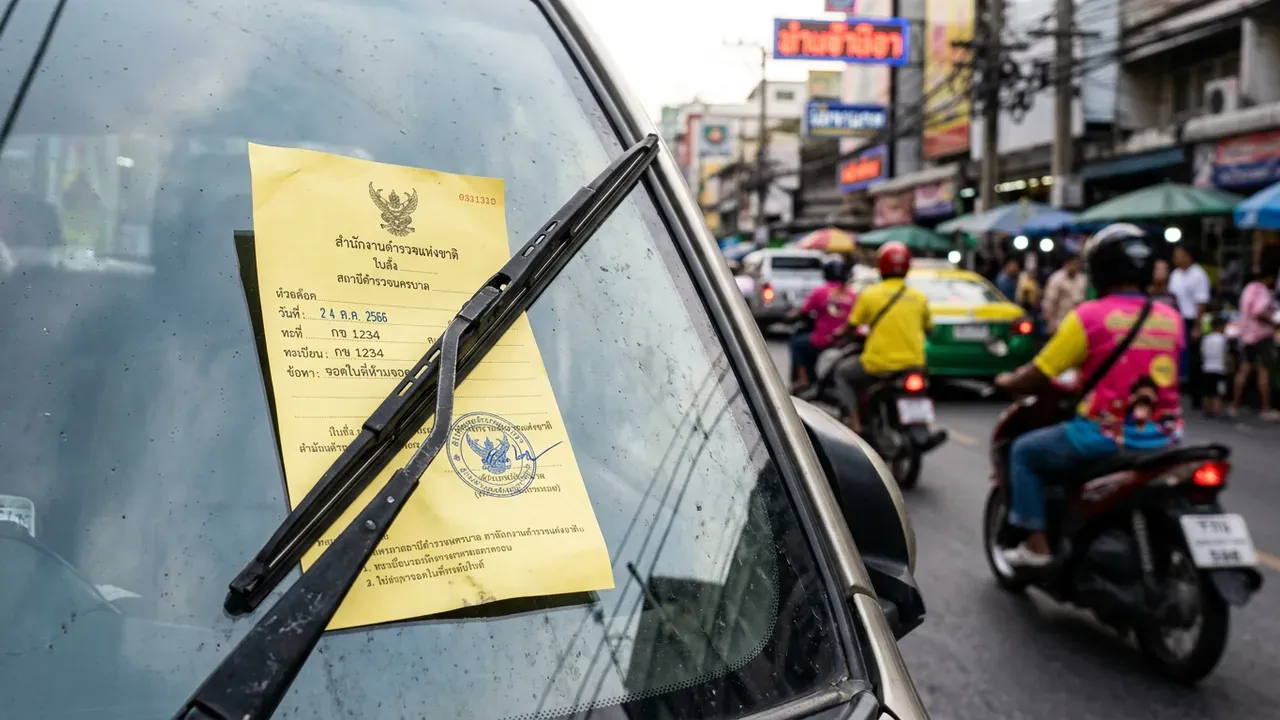
Police checkpoints targeting motorcyclists have become significantly more common across Thailand, particularly since the 2025 Safe Roads Project. Officers set up roadblocks and specifically check for:
- Valid driving license (Thai motorcycle license or IDP with Category A)
- Helmet (both rider and passenger)
- Vehicle registration
- Signs of intoxication
Where Checkpoints Are Most Common
| Location | Frequency | Notes |
|---|---|---|
| Phuket | Daily, multiple locations | Most aggressive enforcement; 20,901 arrests in one campaign |
| Koh Samui / Koh Phangan | Daily during high season | Island roads with limited alternative routes |
| Chiang Mai | Several times weekly | Old City gates, Nimman area, road to Doi Suthep |
| Pattaya | Several times weekly | Beach Road, Second Road, Jomtien |
| Pai | Regular during tourist season | Main road in/out of town |
| Bangkok | Less frequent for tourists | Focus on Thai riders; Sukhumvit, Silom areas |
What Happens at a Checkpoint
The procedure is straightforward: an officer waves you over and asks to see your driving license. If you produce a valid motorcycle license or IDP with Category A, you are waved through in under a minute. If you cannot produce a valid license, you are fined on the spot (500–2,000 THB, payable in cash). Some officers may hold your passport as security until the fine is paid at a local police station, though this practice is technically unauthorized.
Repeated fines add up fast. If you are riding daily without a license in a tourist area, you could easily be fined 3–5 times per week during high season.
Insurance Is Voided Without a License — The Real Financial Danger
The fines are manageable. The insurance consequences are not. This is the single most important reason to ride with a valid license.
How Insurance Works for Motorcycles in Thailand
Thailand has a layered insurance system for motor vehicles:
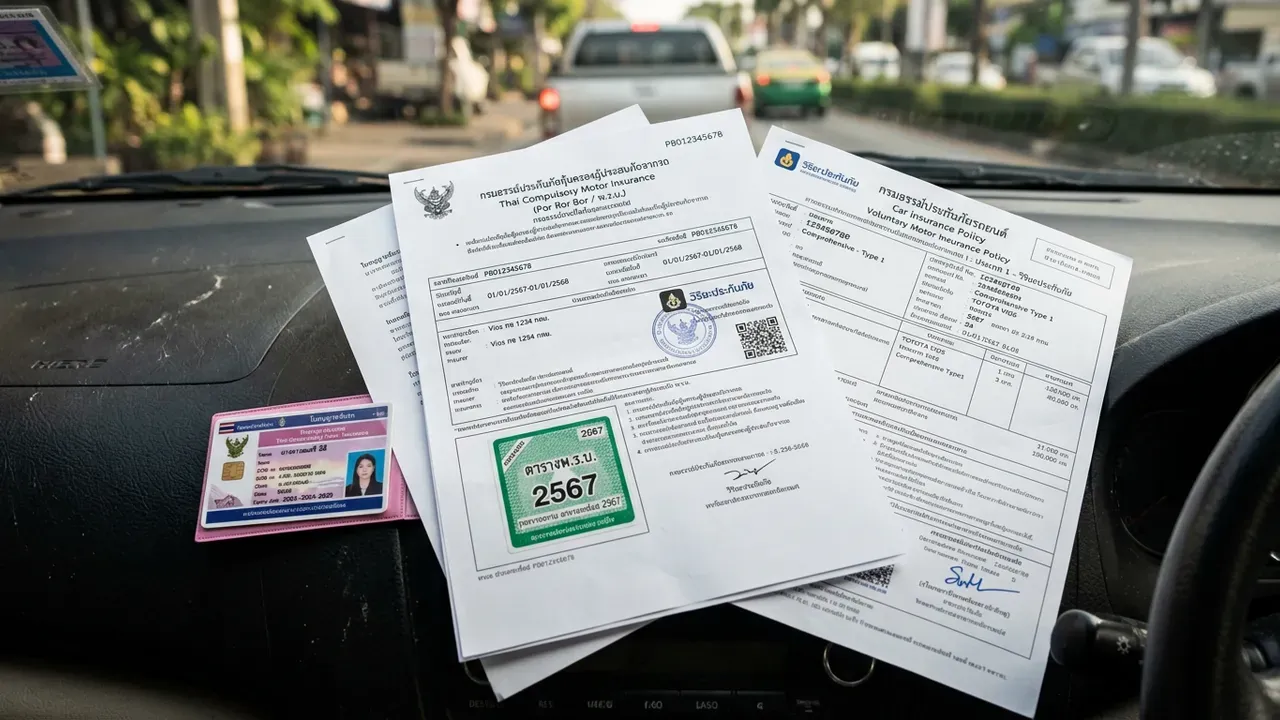
- Por Ror Bor (Compulsory Insurance) — Required by law for every registered vehicle. Covers up to 80,000 THB in medical expenses and 300,000 THB for death or permanent disability per person. Annual premiums: 161 THB (under 75cc) to 645 THB (over 150cc).
- Voluntary Insurance — Additional coverage you purchase. Ranges from basic third-party (Type 3, from ~2,400 THB/year for scooters) to comprehensive (Type 1, from ~9,000 THB/year for big bikes). Covers your own vehicle damage, theft, fire, and higher medical/liability limits.
- Travel Insurance — Your international policy from home.
Most policies contain a clause excluding coverage when the operator does not hold the legally required license for the vehicle being operated. This applies to the Por Ror Bor, voluntary Thai policies, AND your travel insurance from home.
What Uninsured Motorcycle Accidents Actually Cost
| Injury Type | Typical Cost (THB) | Approximate USD |
|---|---|---|
| Road rash treatment (minor) | 3,000–15,000 | $85–430 |
| Broken arm or collarbone | 50,000–150,000 | $1,400–4,300 |
| Broken leg (surgery required) | 100,000–300,000 | $2,900–8,600 |
| Head injury (surgery + ICU) | 500,000–2,000,000+ | $14,000–57,000+ |
| Spinal injury (long-term care) | 1,000,000–5,000,000+ | $29,000–143,000+ |
| Medical evacuation flight home | 1,500,000–3,500,000 | $43,000–100,000 |
Thai hospitals will treat you regardless of your ability to pay — but they will present the bill before discharge. Private hospitals (where most foreigners end up) are significantly more expensive than government hospitals. Without insurance, a serious motorcycle accident can be financially devastating.
Renting a Scooter as a Tourist: Rules, Risks, and Red Flags
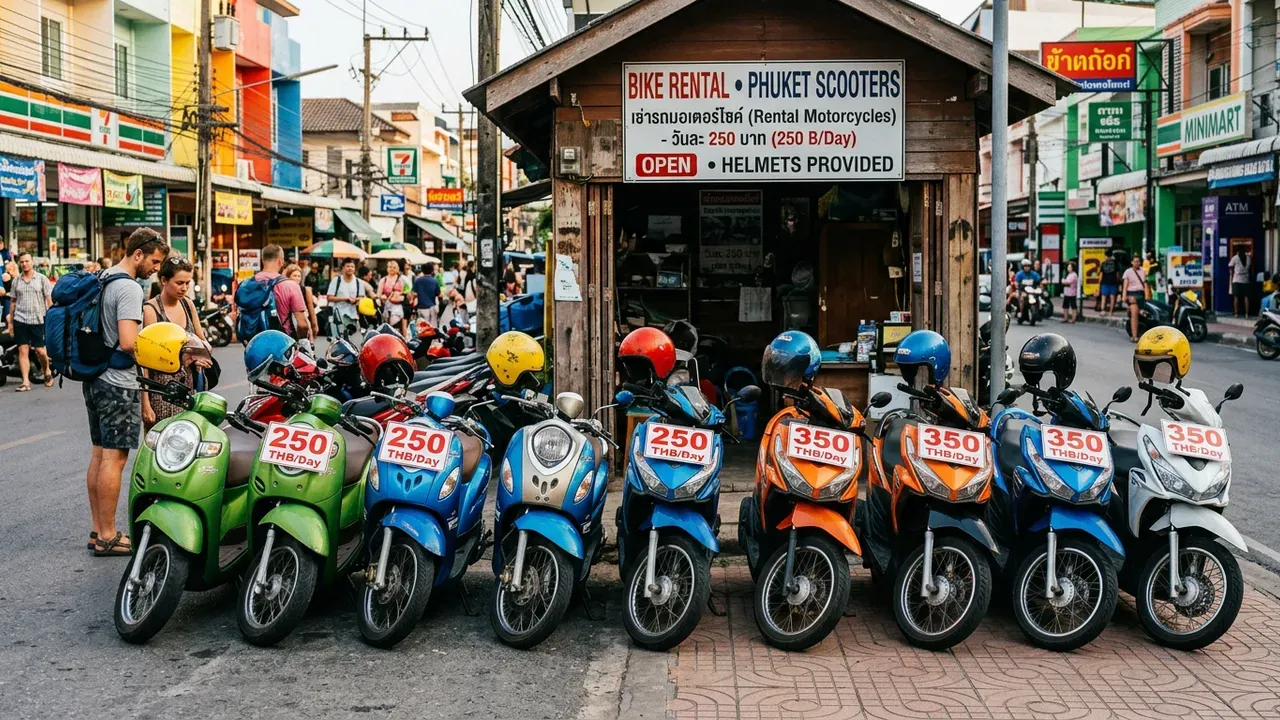
Scooter rental is a massive industry in tourist areas. Shops in Phuket, Koh Samui, Chiang Mai, Pai, Koh Lanta, Koh Tao, and Pattaya will rent you a scooter with nothing more than your passport and cash. But just because a shop rents you a scooter does not mean you are legal to ride it.
What You Need to Legally Rent and Ride
- Option A: Thai motorcycle driving license (requires non-immigrant visa)
- Option B: International Driving Permit with Category A motorcycle endorsement + your original home-country license
The rental shop's willingness to hand you the keys is NOT legal authorization. Rental operators profit from the rental regardless of your license status — your legal problems are not their concern.
Typical Rental Costs (2026)
| Vehicle Type | Daily Rate | Monthly Rate |
|---|---|---|
| 110cc scooter (Honda Click, Yamaha Finn) | 150–300 THB | 2,500–4,000 THB |
| 125cc automatic (Honda PCX, Yamaha NMAX) | 250–450 THB | 3,500–6,000 THB |
| 150cc+ manual motorcycle | 400–800 THB | 5,000–10,000 THB |
| Big bike (400cc+) | 800–2,500 THB | 12,000–35,000 THB |
Rental Red Flags to Watch For
- Passport as deposit: Never leave your passport. Offer a cash deposit or a photocopy instead. If you damage the bike and dispute the cost, the shop holds your only ID.
- "Insurance included": Ask for the policy details in writing. Many rental "insurance" policies are worthless or only cover third-party damage, not your injuries. Without a valid license, even legitimate insurance is voided.
- Pre-existing damage: Photograph the entire bike (every scratch, dent, and scuff) before riding away. Use video with a timestamp. Shops sometimes charge departing renters for damage that existed before the rental.
- No helmet provided: A reputable shop provides a proper helmet (not a flimsy half-shell). If they do not offer one, go elsewhere.
How to Get a Motorcycle License in Thailand
There are several paths depending on your situation:
Path 1: International Driving Permit (Tourists & Short Visits)
If you are visiting Thailand for a short trip (under 90 days), the IDP is your best option. Obtain it in your home country before traveling. Requirements:
- A valid home-country motorcycle license (full Category A or equivalent)
- Application through your national automobile association
- Cost: typically $15–30 USD
- Processing: 1–3 business days (some offer same-day)
- Validity: 1 year from issue date
Carry both the IDP and your original license when riding — the IDP alone is not valid without the original.
Path 2: Convert a Foreign Motorcycle License (Residents)
If you hold a valid motorcycle license from your home country and have a non-immigrant visa, you can convert it to a Thai motorcycle license. This is the fastest resident path — you skip the practical riding test. See our full license conversion guide.
Required documents:
- Passport with valid non-immigrant visa
- Residence certificate from Thai Immigration (issued within 30 days, costs 500 THB)
- Medical certificate from a Thai clinic (issued within 30 days, costs 100–500 THB)
- Original foreign motorcycle license + certified translation (if not in English)
- Passport-sized photos
You must pass: aptitude tests (color blindness, depth perception, peripheral vision, brake reaction) and the 50-question written theory test (need 45/50 or 90% to pass). No practical riding test required for conversion. Government fee: 155 THB. Total DIY cost: approximately 800–1,500 THB.
Path 3: Apply for a New Motorcycle License (No Foreign License)
If you do not hold any foreign motorcycle license, you apply fresh. This requires all the same documents plus passing the practical riding test. The process typically takes 2 days:
- Day 1: Document verification, aptitude tests, 5-hour training video, written theory test
- Day 2: Practical riding test (figure-8, narrow plank, slalom, emergency stop)
You must bring your own motorcycle for the practical test — the DLT does not provide one. Government fee: 105 THB for the 2-year temporary license. Full details in our Thai driving license guide.
Path 4: Convert Car License First, Then Add Motorcycle (Fastest Combo)
If you have a foreign car license but no motorcycle license, the most efficient approach is:
- Convert your foreign car license to Thai (no driving test, 2–3 hours)
- Apply for a new motorcycle license using your Thai car license — you skip the 5-hour training class and only need the written exam + practical test
- Often schedulable for the next day
Helmet Laws: Thailand's 2025 Crackdown
Helmets have been legally required for motorcycle riders and passengers in Thailand since 1995. Enforcement was historically lax, but that changed dramatically on June 1, 2025, when the nationwide Safe Roads Project quadrupled helmet fines:
| Violation | Before June 2025 | After June 2025 |
|---|---|---|
| Rider without helmet | 500 THB | 2,000 THB |
| Driver allowing passenger without helmet | 500 THB | 4,000 THB |
Head injuries are the leading cause of motorcycle fatalities in Thailand. The WHO estimates that proper helmet use reduces the risk of death by 42% and the risk of head injury by 69%.
Helmet Requirements
- Both rider and all passengers must wear helmets at all times on public roads
- The helmet must be a proper motorcycle helmet — bicycle helmets and novelty "eggshell" helmets do not meet the legal standard
- Full-face helmets provide the best protection; half-shells (common at rental shops) provide minimal protection
- Children are not exempt — all passengers must wear helmets regardless of age
Essential Safety Tips for Riding in Thailand
Thailand's roads are chaotic by Western standards. Here are survival tips from years of experience:
Before You Ride
- Get licensed. This is non-negotiable. A valid license keeps you legal and insured.
- Wear a proper helmet. Full-face preferred. Buy your own if renting long-term.
- Wear closed-toe shoes. Flip-flops are the uniform of Thai riders, but road rash on bare feet is agonizing and common. Ankle-covering shoes or boots are best.
- Wear long pants and a long-sleeve shirt. Skin on asphalt at even 30 km/h results in severe road rash.
- Check the bike before riding. Brakes, lights, horn, tires (check tread depth — many rental bikes run on bald tires), mirrors.
On the Road
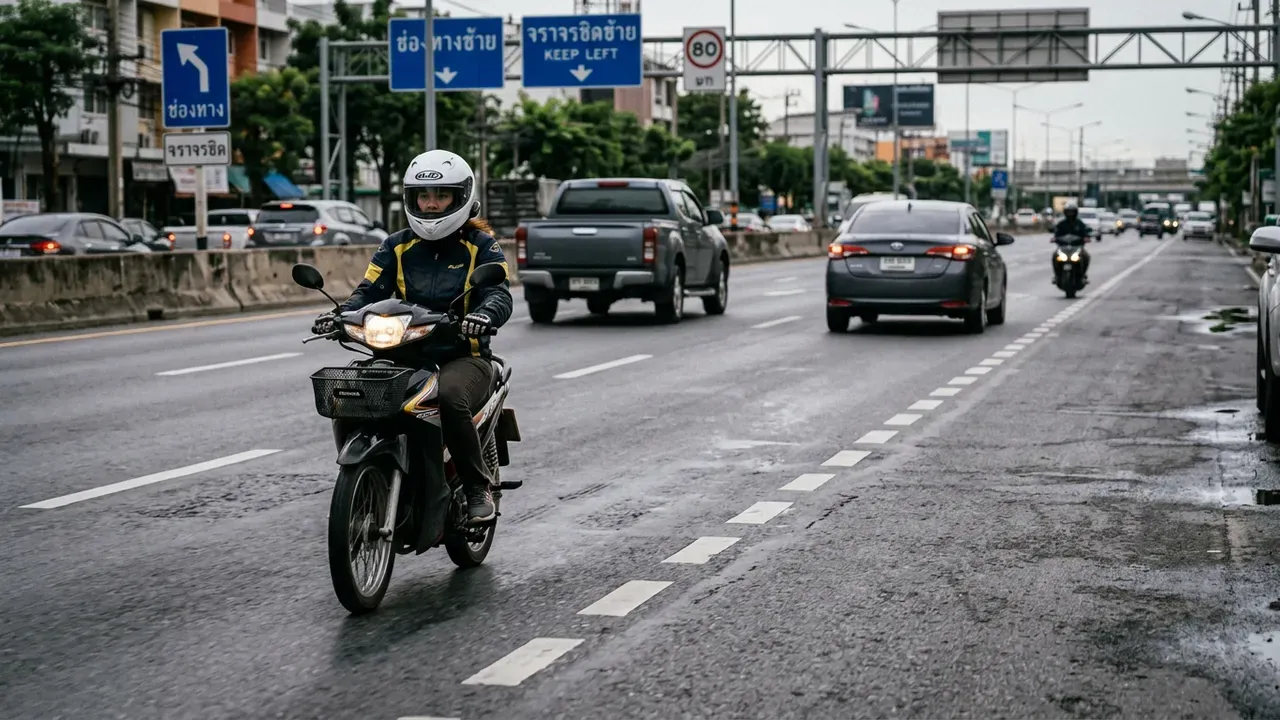
- Thailand drives on the LEFT. This catches many visitors from right-driving countries off guard, especially at intersections and roundabouts.
- Assume you are invisible. Thai drivers frequently do not check mirrors before turning or changing lanes. Defensive riding is essential.
- Watch for sand and gravel. Loose material on curves is the leading cause of single-vehicle scooter crashes, especially on hills (Pai canyon, Doi Suthep, island roads).
- Beware of dogs. Stray dogs are everywhere and will chase motorcycles. Do not swerve — maintain your line and speed up slightly.
- Rain changes everything. Thai roads become extremely slippery in rain, especially during the first 15 minutes of a downpour (oil floats to the surface). Reduce speed dramatically and avoid painted road markings, which become ice-like when wet.
- Avoid riding at night. Unlit roads, drunk drivers, vehicles without headlights, and animals on the road make nighttime riding significantly more dangerous.
- Never drink and ride. Thailand's legal blood alcohol limit is 50mg% (0.05%). Penalties include fines of 5,000–20,000 THB and up to 1 year in prison for a first offense. Beyond legal consequences, alcohol dramatically increases your risk of a fatal crash.
- Do not ride on motorways. Motorcycles are prohibited on Thailand's toll roads and motorways (e.g., Route 7 Bangkok–Pattaya motorway).
Motorcycle Speed Limits in Thailand
| Road Type | Speed Limit (Motorcycles) |
|---|---|
| Urban/city roads | 60 km/h (unless posted otherwise) |
| Rural highways | 80 km/h |
| Motorways/toll roads | Motorcycles PROHIBITED |
What to Do After a Motorcycle Accident in Thailand
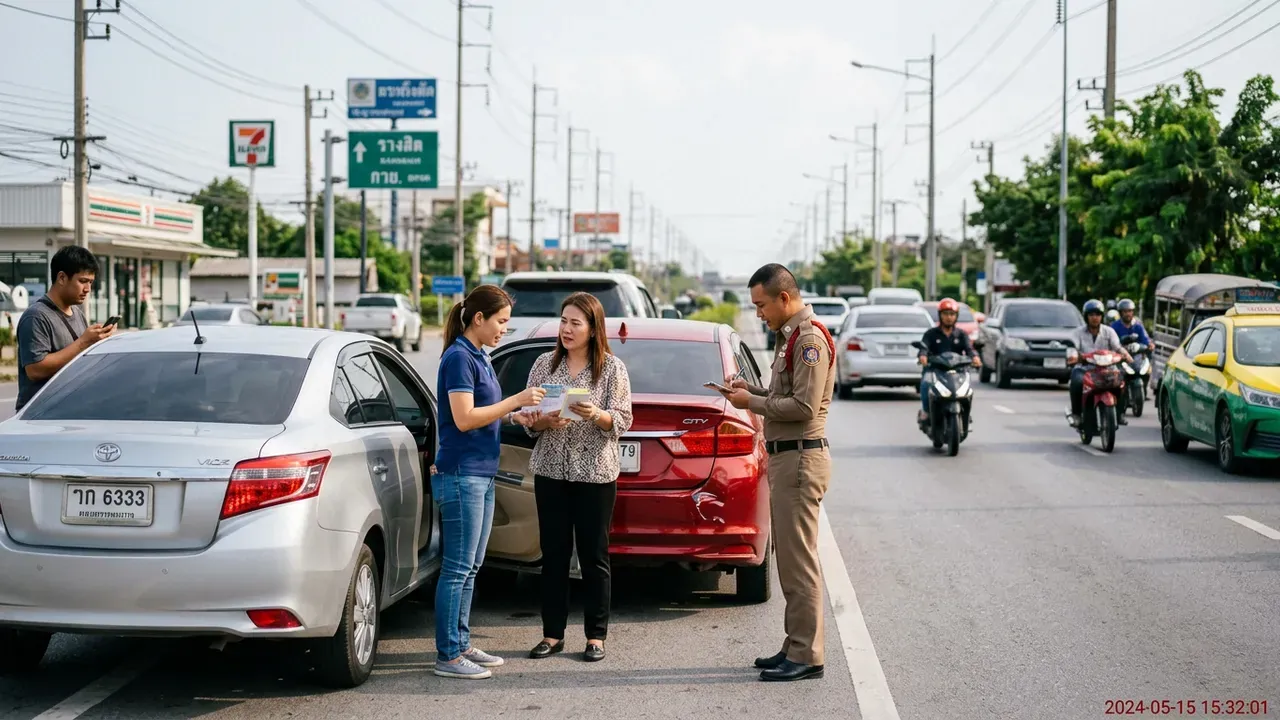
If you are involved in a motorcycle accident in Thailand, follow these steps:
Immediate Actions
- Check for injuries. Do not move seriously injured people unless they are in immediate danger (e.g., fire). Call 1669 (emergency medical services) or 191 (police) immediately.
- Move to safety if you are able. Get off the road to avoid secondary collisions.
- Do NOT leave the scene. Fleeing the scene of an accident is a criminal offense in Thailand and will void any insurance coverage.
- Call your insurance company hotline immediately. They will dispatch a representative ("Insurance Guy") to the scene to assist and mediate.
- File a police report within 24 hours. This is essential for any insurance claim. Go to the nearest police station with your license, passport, and any evidence.
- Document everything. Take photos and video of: the scene from multiple angles, vehicle damage, road conditions, your injuries, the other vehicle's license plate, and any traffic signs.
- Get witness contact information if possible.
- Do not sign anything you do not fully understand. If documents are in Thai, get them translated before signing. Do not admit fault verbally or in writing.
Important Numbers
| Service | Number |
|---|---|
| Emergency Medical Services | 1669 |
| Police | 191 |
| Tourist Police (English-speaking) | 1155 |
| Highway Police | 1193 |
Buying vs. Renting a Motorcycle in Thailand
If you plan to ride regularly in Thailand, the buy-vs-rent decision is important:
| Factor | Renting | Buying |
|---|---|---|
| Best for | Trips under 2–3 months | Stays over 3 months |
| Cost (125cc scooter) | 3,000–5,000 THB/month | 25,000–55,000 THB (used) or 45,000–70,000 THB (new) |
| Insurance | Usually minimal or none from shop | You can buy full comprehensive coverage |
| Maintenance | Shop's responsibility (in theory) | Your responsibility; cheap in Thailand |
| Vehicle condition | Often poor; bald tires, worn brakes | You control maintenance quality |
| Registration / Green Book | In shop's name | In your name (or shop if you lack a work permit). See our vehicle registration guide |
| Resale value | N/A | Good for popular models (Honda Click, PCX, NMAX) |
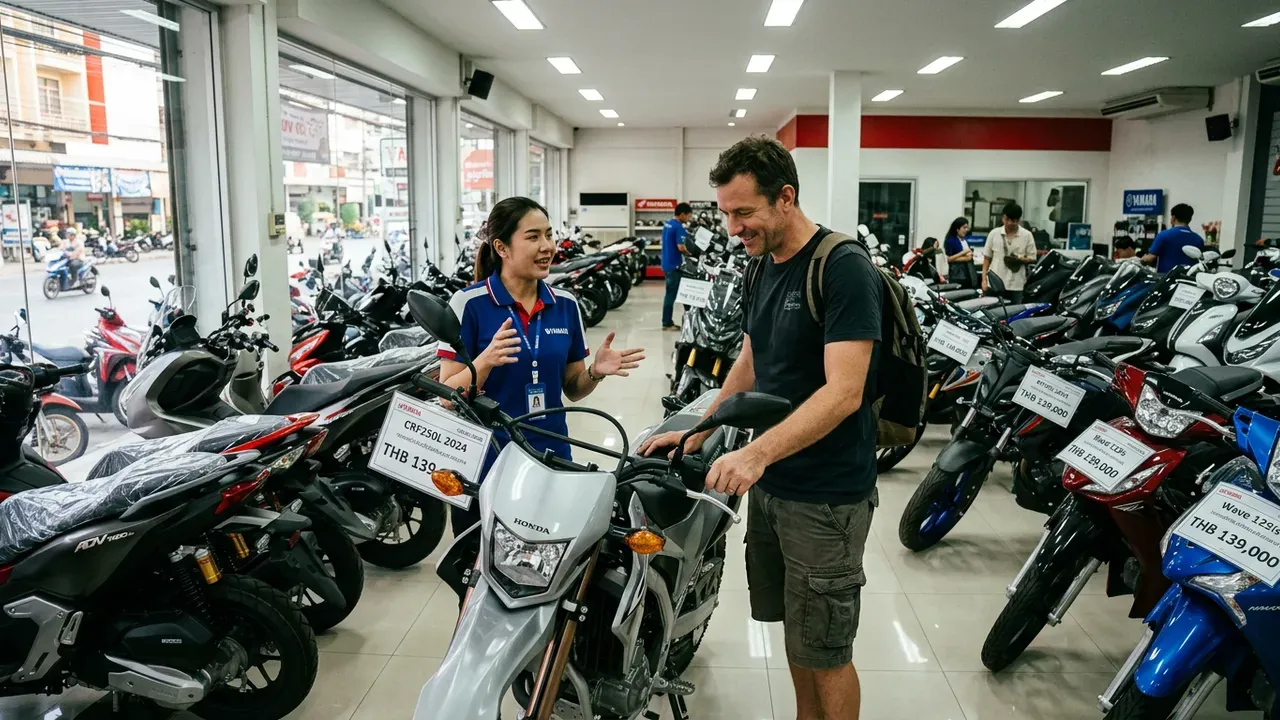
Popular Scooter and Motorcycle Models in Thailand (2026)
| Model | Type | New Price (THB) | Best For |
|---|---|---|---|
| Honda Click 125i | Automatic scooter | 52,000–60,000 | Daily commuting, most popular rental |
| Honda PCX 160 | Premium automatic | 82,000–92,000 | Comfort, longer distances, highway capable |
| Yamaha NMAX 155 | Premium automatic | 85,000–95,000 | Sport-touring scooter, ABS available |
| Honda Wave 110i | Semi-automatic | 38,000–45,000 | Budget commuter, extremely fuel efficient |
| Honda CB500X | Adventure motorcycle | 235,000–250,000 | Touring, long-distance, big bike starter |
| Kawasaki Z400 | Naked sport | 205,000–220,000 | Sport riding, city + weekend trips |
If you buy a motorcycle, you will need to handle vehicle registration and annual road tax. If buying from another person, you will also need a vehicle transfer. Foreigners can own motorcycles in Thailand, though the green book (registration) process is smoother with a work permit.
Electric Scooters and E-Bikes: Legal Status in Thailand 2026
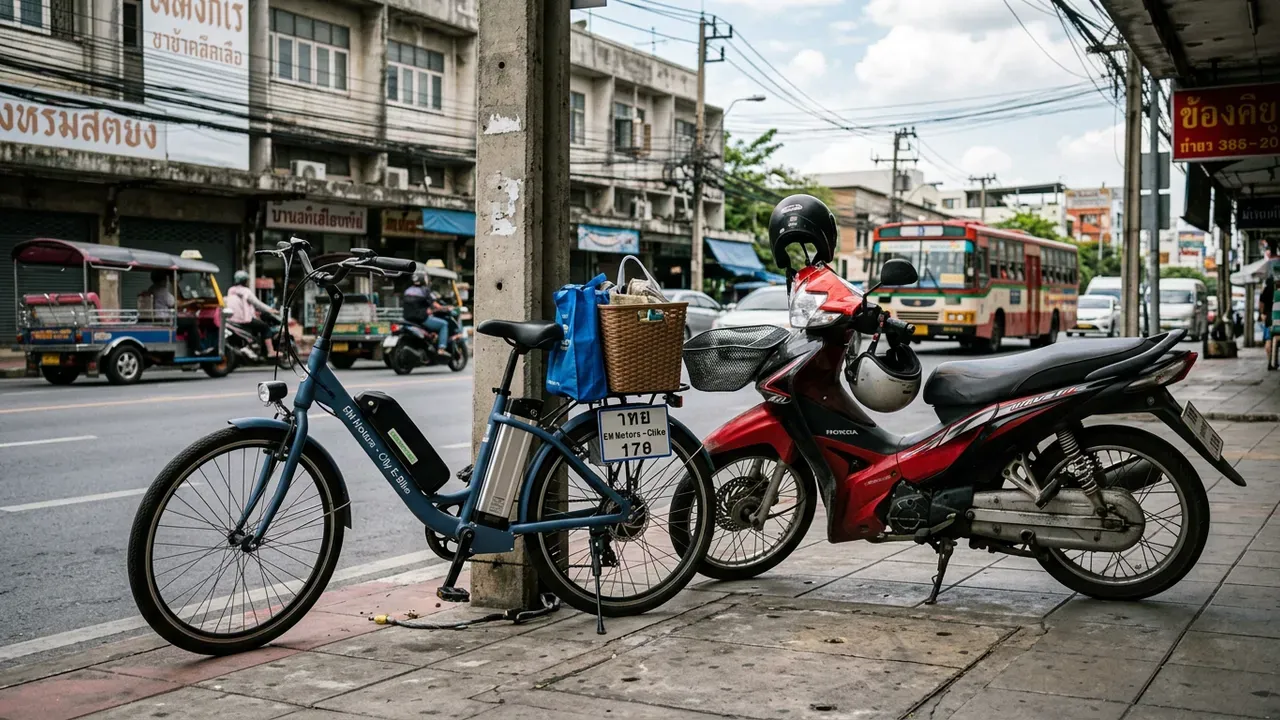
Electric two-wheelers are growing rapidly in Thailand but exist in a legal gray area:
- Electric motorcycles/scooters that are registered with the DLT and have license plates follow the same rules as petrol motorcycles — you need a motorcycle license to ride them.
- E-scooters (kick-style) with a top speed exceeding 25 km/h technically require registration and a license, but enforcement is inconsistent. They are not explicitly classified under current Thai vehicle law.
- Low-speed electric bicycles (pedal-assist with top speed under 25 km/h) are generally treated as bicycles and do not require a license.
For more on electric vehicles in Thailand, see our driving in Thailand guide.
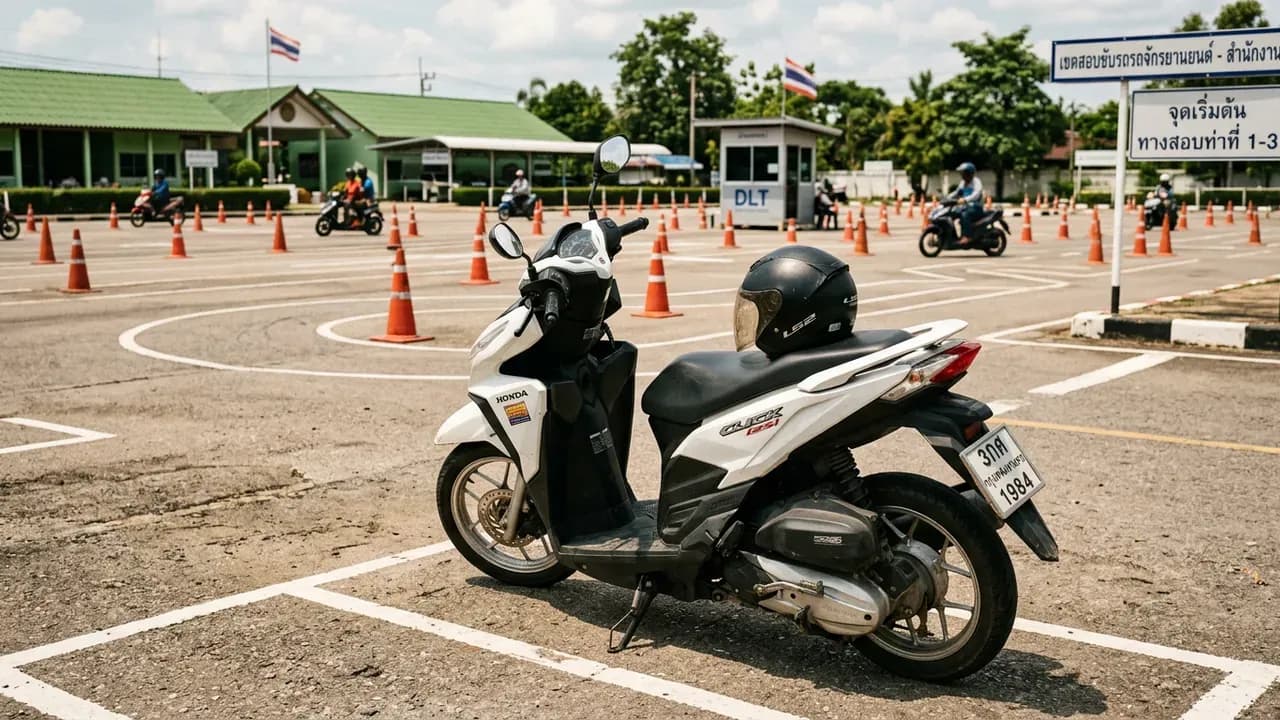
The DLT Motorcycle Practical Test: Quick Overview
If you apply for a new motorcycle license (rather than converting a foreign one), you must pass a practical riding test at the DLT. The test has four maneuvers:
- Figure-8: Ride a continuous figure-8 through two connected circles (~3–4 meter diameter) without putting a foot down or crossing the boundary
- Narrow plank (balance beam): Ride across a 15-meter-long, 30cm-wide raised platform at walking speed without falling off or putting a foot down
- Slalom: Weave through 5–7 cones placed 3–4 meters apart
- Emergency stop: Accelerate to 30–40 km/h, then stop within a marked 3–5 meter zone
You must bring your own motorcycle. Most people use an automatic scooter (Honda Click or similar), which eliminates clutch management and makes the test easier. Practice the figure-8 and narrow plank extensively — these are where most people fail.
For a detailed breakdown of each maneuver with passing techniques, see our complete motorcycle practical test guide.
Complete Cost Summary: Motorcycle Licensing in Thailand
| Item | Cost (THB) |
|---|---|
| DLT fee: 2-year temporary motorcycle license | 105 |
| DLT fee: Foreign license conversion | 155 |
| DLT fee: 5-year license renewal | 255 |
| Medical certificate | 100–500 |
| Residence certificate (Immigration) | 300–500 |
| Passport photos | 50–100 |
| License translation (if needed) | 200–600 |
| Total DIY cost | 600–1,500 |
| Using a service (full assistance) | 5,000–12,000 |
Compulsory Motorcycle Insurance (Por Ror Bor) Annual Premiums
| Engine Size | Annual Premium | Coverage |
|---|---|---|
| Under 75cc | 161 THB | Up to 80,000 THB medical per person; 300,000 THB death/permanent disability per person |
| 75cc–125cc | 323 THB | |
| Over 150cc | 645 THB |
Compare this to the cost of a single minor hospital visit without insurance (3,000–15,000 THB). Getting licensed and insured is overwhelmingly worth the small investment.
Related Guides for Driving and Riding in Thailand
For more detailed information on specific topics, see our other comprehensive guides:
- Thai Driving License Guide — Complete process for car and motorcycle licenses, documents, tests, and costs
- Convert Your Foreign License to Thai — Step-by-step conversion process, accepted countries, and required documents
- Vehicle Registration in Thailand — How to register a motorcycle or car, green book details, and annual road tax
- Vehicle Transfer Guide — Buying or selling a used motorcycle, ownership transfer process
- Driving in Thailand — General rules of the road, traffic signs, and driving tips for foreigners
Need help with this?
Our team handles the entire process — documents, preparation, and DLT escort. 98% first-attempt pass rate.