In This Article
Downloads & related guides
- Thai motorcycle licence for foreigners — the licence an electric motorbike needs, petrol or electric
- Vehicle registration in Thailand — plates, the green book and annual road tax
- Thailand traffic fines — every common fine, demerit points and the 2026 road-tax rule
- EV charging stations in Thailand — public charging networks for electric cars
Current Legal Status of Electric Bikes and Scooters
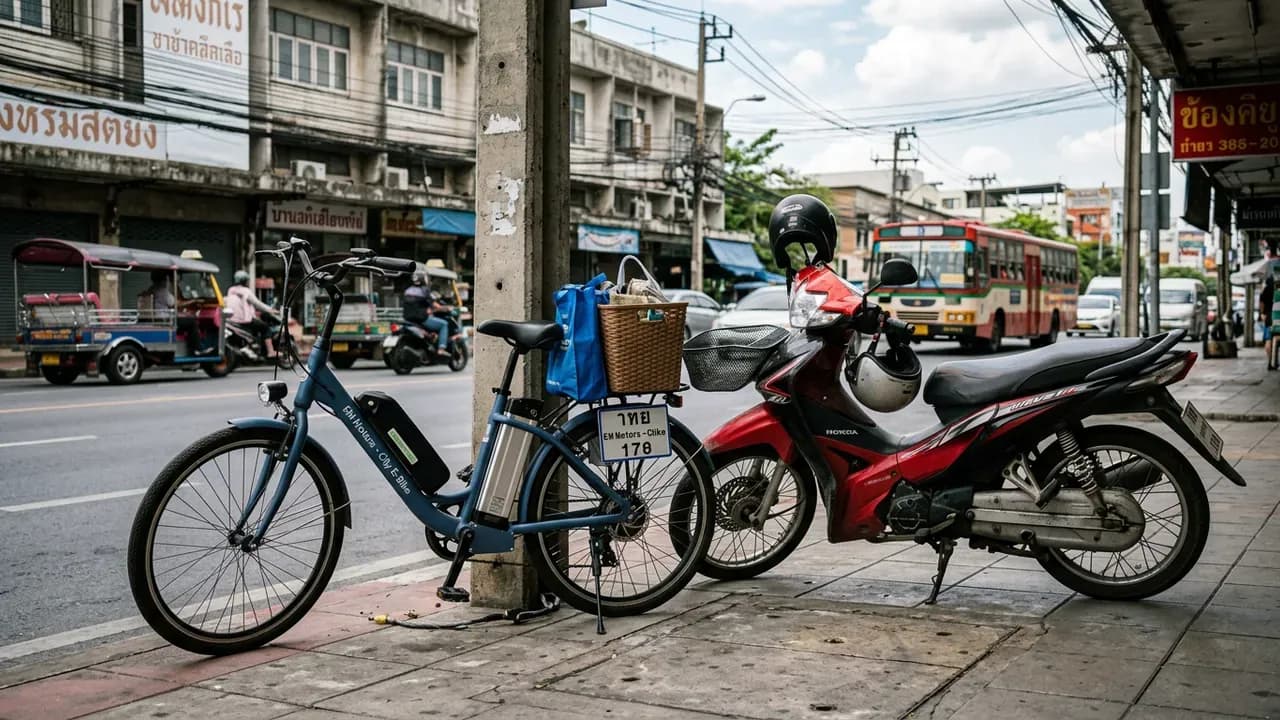
Short answer: an electric motorbike you sit on is legal if it is registered and you hold a motorcycle licence. A stand-up electric scooter is not legal on public roads. Thai law treats any two-wheeler driven by an engine or an electric motor as a motorcycle, and a motorcycle on a public road must carry registration plates. The DLT only registers electric motorcycles with a rated motor power of at least 250 watts and a top speed of at least 45 km/h. A seated electric scooter or motorbike that meets it is registered just like a petrol bike. Stand-up kick-style e-scooters don't fit any vehicle type the DLT registers, so they can't be registered, and an unregistered vehicle can't legally be used on a public road. The fine for that is up to 10,000 THB under the Motor Vehicle Act, plus up to 1,000 THB if you have no motorcycle licence. Enforcement is real: Phuket police banned e-scooters from public roads in 2022 after arresting tourists in Patong, Pattaya police and city officials suspended e-scooter rentals in May 2024, and in October 2026 Chiang Mai police repeated that electric scooters and electric unicycles can't be used on public roads. Private land is a different matter, and the Phuket notice still allowed e-scooters in parks. Pedal-assist e-bikes are the grey area: we have found no DLT or police statement that clears low-power e-bikes for road use, and they don't meet the registration criteria either.
Registration Requirements for Electric Vehicles
An electric motorcycle is registered at the DLT like a petrol one. You need the application form, the manufacturer's or importer's sales notice for the vehicle, proof that you acquired it (the sale contract, or the receipt and tax invoice), compulsory insurance (Por Ror Bor), and your ID: for a foreigner, that means your passport plus a residence certificate. The DLT then issues the plates and the green registration book, and the vehicle pays annual road tax like any other. The models that cause trouble are grey-market imports and small scooters below the 250 W and 45 km/h bar. With no sales notice from a Thai manufacturer or importer, or below the bar, the DLT can't register them, and riding one on a public road risks the 10,000 THB fine. Before you pay, ask the seller to show that the exact model can be registered and that the sales notice comes with it.
License Requirements: Same as Regular Motorcycles
The license requirement for electric motorcycles and scooters is straightforward: you need the same motorcycle driving license as you would for a gasoline motorcycle. There is no separate 'electric vehicle' license category in Thailand. A Thai motorcycle license (ใบอนุญาตขับรถจักรยานยนต์) covers both gasoline and electric motorcycles. For foreigners, this means you either need a Thai motorcycle license obtained at a DLT office, or an International Driving Permit (IDP) that includes motorcycle authorization (Category A). The process for getting a Thai motorcycle license is the same whether you plan to ride electric or petrol: the same aptitude checks, the same written test on traffic rules and signs, and the same practical riding test. Once you have the license, it covers all motorcycle types. If you already have a Thai car license, you still need a separate motorcycle license — a car license does not cover motorcycles (whether electric or gasoline) in Thailand. A licence does not make a stand-up e-scooter legal, though. The problem with those is the missing registration, not the rider.
Buying an Electric Scooter or Motorbike in Thailand
Thai showrooms sell both seated electric scooters and full-size electric motorbikes, and prices and models change too often for a list here to stay accurate. The checks that matter don't change. First, registration: confirm the exact model can be registered (at least 250 W rated power and 45 km/h top speed) and that the sale includes the sales notice the DLT needs. A cheap import without it is a vehicle you can only ride on private land. Second, service: check there is a service centre and a source of spare parts near where you live. Third, the battery: ask what a replacement costs and how long the battery warranty runs, and get the answer in writing. Range and charging time are the maker's figures; expect less range in real riding, especially with a passenger.
Charging Infrastructure in Thailand
Charging an electric scooter is a different matter from charging an electric car. Most electric scooters and motorbikes charge from an ordinary household socket (Thailand runs on 220 V), either with the battery removed and carried indoors or with the charger plugged into the bike. No special station is needed. The cost of a full charge is the battery's capacity in kWh multiplied by the price per unit on your electricity bill, which comes to a few baht for a typical scooter battery. If you live in a condo, check the building's rules before charging in your room or the car park. Public charging networks in Thailand are built for cars; our EV charging guide, linked at the top of this page, covers them.
Insurance for Electric Vehicles
Insurance for electric motorcycles and scooters follows the same structure as gasoline vehicles. Compulsory insurance (Por Ror Bor) is required for all registered vehicles, including electric ones, and using a vehicle without it carries a fine of up to 10,000 THB. It covers injury to people (up to 80,000 THB in medical costs and 500,000 THB for death or permanent disability, per person), not damage to your bike. Voluntary insurance is available from major Thai insurers including Viriyah, Bangkok Insurance, Thai Srimuang, and Dhipaya. However, not all insurers have electric vehicle-specific policies yet, and premiums may vary as insurers are still building risk data for electric vehicles. Some important considerations for insuring electric vehicles: battery damage can be extremely expensive to repair, so comprehensive (Class 1) coverage is recommended. Confirm whether the policy covers battery damage from flooding — a real risk during Thailand's rainy season. Check whether the policy covers fire damage from battery malfunction, as lithium-ion battery fires, while rare, are a known risk. The maker's battery warranty, if there is one, gives some protection on top. When insuring an electric vehicle, provide the insurer with the vehicle's registration details, including the fact that it is electric, to ensure proper coverage.
Make sure you are properly licensed
The most important step before driving in Thailand is having a valid license. We handle the entire process for you.