In This Article
Why Proof of Address Matters in Thailand
As a foreigner in Thailand, you will be asked for proof of address far more often than you might expect. The Department of Land Transport (DLT) requires it for driving license applications and renewals. Banks need it to open accounts. Immigration requires it for various visa processes. Condos and landlords may ask for it when signing leases. The challenge is that Thailand has no single, universal proof-of-address document like a utility bill tied to a national ID. Foreigners must piece together acceptable documents, and what one agency accepts, another may reject. Understanding which documents work where — and how to obtain them — saves enormous amounts of time and frustration. The most universally accepted document is the residence certificate from Immigration, but it is not always the easiest or cheapest to get.
Residence Certificate (Most Common for DLT)
The residence certificate is the gold standard proof of address for foreigners in Thailand. It is issued by Thai Immigration and confirms where you are living. This is the document the DLT specifically asks for when you apply for or renew a Thai driving license. To obtain one, visit your local Immigration office with your passport, two passport-sized photos, a copy of your lease or hotel booking, and the TM30 receipt showing your registered address. The fee is 200-500 THB depending on the office, and processing typically takes one to three working days, though some offices issue it same-day. The certificate is valid for only 30 days from the date of issue, so time your application carefully around your DLT visit. Some Immigration offices require an appointment; others accept walk-ins. The certificate will be in both Thai and English. You can also request the certificate using the TM.16 application form, which you can download from the Immigration website or pick up at the office.
TM30 Receipt
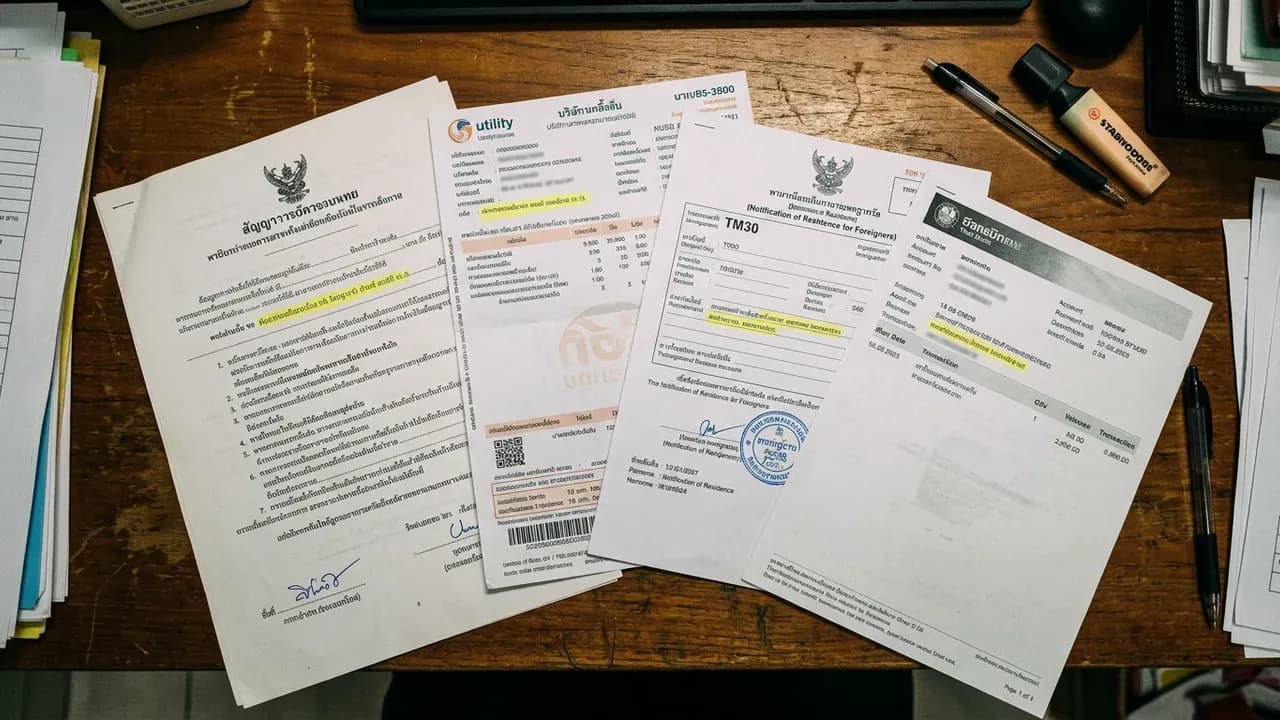
The TM.30 is a notification of residence that your landlord or hotel is legally required to file with Immigration within 24 hours of a foreigner checking in or moving in. The receipt you get (or can request from your landlord) serves as secondary proof of address. While the TM30 receipt alone is generally not accepted by DLT as the sole proof of address, it is an essential supporting document when applying for a residence certificate. Many landlords are unaware of the TM30 requirement or ignore it. If your landlord has not filed, you can file it yourself online through the Immigration Bureau's website or app. You will need the landlord's ID card number and a copy of the house registration book (tabien baan). Some DLT offices in tourist areas like Phuket and Chiang Mai have been known to accept a TM30 receipt combined with a lease agreement, but this is not standard policy — always bring a residence certificate to be safe.
Utility Bills (Electricity, Water)
Utility bills can serve as proof of address, but there is an important caveat: the bill must be in your name. Most rental properties in Thailand have electricity and water bills in the landlord's name, not the tenant's name. If you own a condo, the common area fee invoice (issued monthly by the juristic office) is usually in your name and works well. To get utility bills in your name as a renter, you would need to visit the local electricity authority (Provincial Electricity Authority or Metropolitan Electricity Authority) and the local waterworks authority with your lease agreement and passport to transfer the account. This process is straightforward but takes time. Electricity bills from the Provincial Electricity Authority (PEA) or Metropolitan Electricity Authority (MEA) are widely accepted. Water bills from the Metropolitan Waterworks Authority or Provincial Waterworks Authority also work. The bill should be recent — within three months. DLT generally prefers the residence certificate over utility bills, but banks commonly accept utility bills.
Bank Statements
A Thai bank statement showing your name and Thai address can serve as proof of address for some purposes, but this creates a chicken-and-egg problem: you often need proof of address to open the bank account in the first place. If you already have a Thai bank account, you can request an official letter from the bank confirming your address, or use a recent bank statement (within three months) that shows your Thai address. Bangkok Bank, Kasikorn Bank, and SCB all provide address confirmation letters for a small fee (usually 100 to 200 THB). These letters are useful for immigration extensions, condo purchases, and other official processes. However, DLT offices typically do not accept bank statements as proof of address for driving license applications — they specifically want the Immigration-issued residence certificate. Bank statements are more useful for opening accounts at other banks, applying for credit cards, or private business purposes.
Lease Agreement
A signed lease agreement (rental contract) shows your name and the address of the property you are renting. While useful as a supporting document, a lease alone is rarely accepted as standalone proof of address by government agencies. DLT does not accept lease agreements as proof of address. Immigration typically requires a lease as a supporting document when issuing a residence certificate, but the lease itself is not the certificate. For the lease to be useful, ensure it includes your full name as it appears on your passport, the complete address in both Thai and English, the landlord's name and ID number, the contract period, and signatures from both parties. Some banks will accept a lease agreement combined with your passport as proof of address when opening an account, particularly Bangkok Bank and Kasikorn Bank. Having a well-drafted lease in both Thai and English is always recommended regardless of its use as address proof.
Hotel Booking Confirmation
If you are staying in a hotel or serviced apartment, the hotel booking confirmation or a letter from the hotel confirming your stay can serve as proof of address in limited situations. Hotels are required to file TM30 notifications, so your stay is registered with Immigration. For DLT purposes, a hotel letter combined with a residence certificate is the standard approach. Some tourists on short stays have successfully used hotel booking confirmations at DLT offices in tourist areas, but this is not guaranteed. A hotel letter should include your full name, passport number, the hotel's name and address, dates of stay, and an official stamp or signature from management. For Immigration, a hotel booking is generally accepted when applying for a residence certificate, as it proves where you are staying. For banks, most branches will not accept a hotel booking as proof of address — they want something showing longer-term residence.
Which Documents DLT Accepts
The Department of Land Transport has the most specific requirements for proof of address. The standard and most widely accepted document is the residence certificate issued by Thai Immigration. This is what DLT staff are trained to look for, and presenting it avoids any arguments or confusion. Some DLT offices also accept a work permit (which contains your address), a yellow house book (tabien baan for foreigners), or a combination of TM30 plus lease agreement. However, acceptance of these alternatives varies by office and even by individual staff members. To avoid wasted trips, always bring the residence certificate. If you also have a work permit, bring that too. DLT does not accept utility bills, bank statements, or hotel bookings as standalone proof of address. The required documents for a DLT driving license application are: passport, residence certificate, medical certificate, and the appropriate application form. For renewals, you need the same documents plus your existing Thai license.
Documents Accepted by Banks and Immigration
Banks and Immigration have different standards from DLT. Thai banks typically accept a wider range of documents including utility bills in your name, lease agreements, employer letters confirming your address, or residence certificates. The easiest approach for opening a bank account is to bring your passport, a lease agreement, and a utility bill or employer letter. Some bank branches (especially in tourist areas) are more flexible than others. Immigration accepts hotel bookings, lease agreements, and TM30 receipts as supporting documents when you apply for visa extensions or residence certificates. For a 90-day report, Immigration only needs your passport and the TM.47 form — no separate proof of address is required since the TM30 already covers this. For a yellow tabien baan (foreigner house book), you need to apply at the local district office (amphoe) with your passport, lease or ownership documents, and a letter from the landlord or the landowner's house registration.
How to Get Each Document
Residence certificate: Visit Immigration with your passport, two photos, TM30 receipt, lease agreement, and 500 THB. Processing takes one to three days. TM30 receipt: Ask your landlord to file online at tm30.immigration.go.th, or file in person at Immigration. Utility bill in your name: Visit the local electricity or water authority with your passport, lease, and landlord's ID copy. Bank statement: Request at your bank branch; fee is 100 to 200 THB. Lease agreement: Negotiate with your landlord when signing; ensure it includes both Thai and English and is signed by both parties. Hotel letter: Ask the front desk or management to provide a letter on hotel letterhead. Yellow house book: Apply at your local amphoe with ownership or long-term lease documents, landlord consent, and your passport. Work permit address page: Your employer files this; ensure the address is current. Start with the residence certificate — it solves 90% of proof-of-address needs in Thailand and is the one document that every government agency accepts without question.
Make sure you are properly licensed
The most important step before driving in Thailand is having a valid license. We handle the entire process for you.