In This Article
Why Getting a Motorcycle License Is Non-Negotiable in Thailand
Thailand has no exemption for small motorcycles or automatic scooters. Every motorized two-wheeler — from a 50cc moped to a 1000cc sport bike — requires a valid motorcycle license under the Land Transport Act B.E. 2522. Your car license does not cover motorcycles. An IDP only covers motorcycles if it includes Category A.
The Consequences of Riding Without a License
- Police fines: 500–2,000 THB per offense at increasingly common checkpoints
- Helmet fines (since June 2025): 2,000 THB for rider, 4,000 THB for allowing helmetless passenger
- Insurance denied: Travel insurance, compulsory Por Ror Bor, and voluntary Thai insurance all void without a valid license
- Criminal liability: If you injure or kill someone while riding unlicensed, lack of license is an aggravating factor in criminal proceedings
- Financial ruin: Serious motorcycle injuries cost 100,000–2,000,000+ THB. Without insurance, you pay everything.
Thailand's Motorcycle Fatality Statistics
The numbers are stark: in 2024, Thailand recorded over 14,000 motorcycle-related deaths out of approximately 17,400 total road fatalities. Motorcycles account for over 80% of all road deaths. The WHO estimates motorcyclists represent 83.8% of Thailand's traffic fatalities, with head injuries as the leading cause of death. Thailand has approximately 32.7 road deaths per 100,000 people — one of the highest rates globally.
Getting a motorcycle license is not bureaucracy for its own sake. It is the single most important thing you can do to protect yourself legally and financially when riding in Thailand. The license keeps your insurance valid, which is your financial safety net in a country where motorcycle accidents are extraordinarily common.
Requirements and Documents You Need
Eligibility Requirements
- Age: At least 18 years old
- Visa: Non-immigrant visa or work permit (tourist visas are generally not accepted; some DLT offices accept retirement extensions and education visas)
- Physical fitness: Must pass aptitude tests at the DLT (color blindness, depth perception, peripheral vision, brake reaction time)
Required Documents Checklist
| Document | Where to Get It | Cost | Validity |
|---|---|---|---|
| Original passport with valid non-immigrant visa | Your embassy / Thai Immigration | — | Must be currently valid |
| Residence certificate | Thai Immigration office | 500 THB | 30 days from issue |
| Medical certificate | Any Thai clinic or hospital | 100–500 THB | 30 days from issue |
| Passport-sized photos | Photo shops (some DLT offices take on-site) | 50–100 THB | Recent |
| Foreign motorcycle license + translation (if converting) | Your home country + embassy/certified translator | 200–600 THB for translation | Must be currently valid |
As of 2025, all foreign license holders — including those converting — must take the written theory test. Only the practical riding test is waived for conversions.
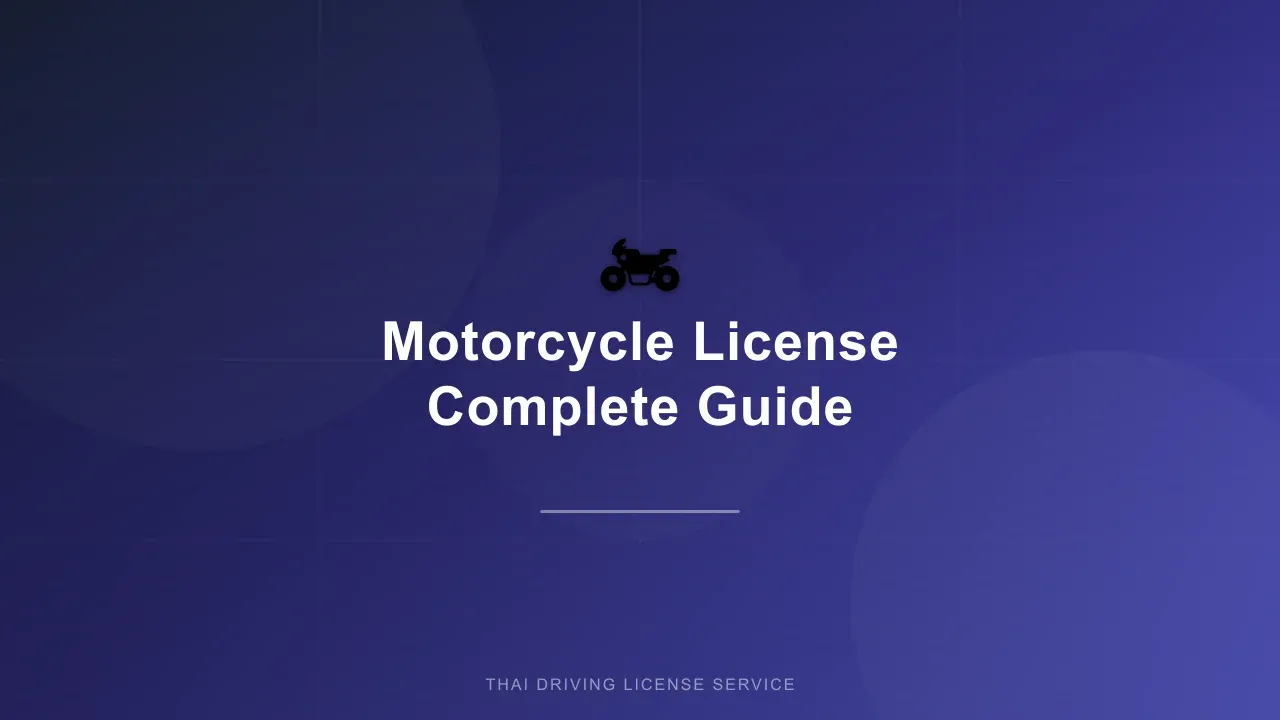
The Written Theory Test: 50 Questions, 90% to Pass
The written test for a motorcycle license is the same 50-question computer-based exam used for car licenses. You need 45 out of 50 correct (90%) to pass — you can only miss 5 questions.
Test Categories
- Traffic signs and road signs — identifying signs, their meanings, and required actions
- Traffic laws and rules — speed limits, right-of-way, parking, overtaking
- Safe driving practices — defensive driving, hazard awareness, weather conditions
- Traffic behavior — what to do in specific scenarios (accidents, breakdowns, emergencies)
- General driving knowledge — vehicle maintenance, insurance, licensing rules
Available Languages
English, Thai, Chinese, Japanese, Korean, Swedish, Dutch, Portuguese, Spanish, French, German, and Russian.
How to Prepare
- Study the official DLT handbook (available at the DLT office)
- Take practice tests online — the questions are drawn from a known question bank
- Focus on Thai-specific rules: speed limits (60 km/h in cities, 80 km/h on highways for motorcycles), motorcycle prohibition on motorways, left-hand driving rules
- Common trick questions involve right-of-way at uncontrolled intersections, blood alcohol limits (50mg%), and penalty amounts
If you fail, you can retake the test on the next business day. Most DLT offices offer the test between 8:00 AM and 11:00 AM. The test is not difficult if you prepare — most foreigners who fail simply did not study.
The Motorcycle Practical Test: Four Maneuvers
The practical test is conducted on a closed course at the DLT office (not on public roads). You must complete four maneuvers in sequence without critical errors. The entire test takes 10–15 minutes per applicant.
You Must Bring Your Own Motorcycle
The DLT does not provide test vehicles. Bring a motorcycle with valid registration that is in safe working condition (lights, brakes, horn, tires). Most applicants use automatic scooters (Honda Click 125, Yamaha NMAX, or similar) because they eliminate clutch management and make the test easier. Our service provides a motorcycle for the test if you do not have one.
The Four Maneuvers
| Maneuver | Description | Common Fail Reason |
|---|---|---|
| 1. Figure-8 | Ride a continuous figure-8 through two connected circles (~3–4m diameter) at low speed | Going too fast and running wide, or too slow and putting a foot down |
| 2. Narrow Plank | Ride across a 15m-long, 30cm-wide raised platform at walking speed (minimum 7–10 seconds) | Looking down at the plank instead of the far end; tense arms |
| 3. Slalom | Weave through 5–7 cones placed 3–4m apart in a smooth, rhythmic motion | Inconsistent speed; hitting a cone |
| 4. Emergency Stop | Accelerate to 30–40 km/h, then stop within a marked 3–5m zone | Grabbing front brake too hard; overshooting the zone |
Critical Errors That Cause Immediate Failure
- Putting a foot down (touching the ground) during any maneuver
- Riding outside the marked boundaries
- Hitting or knocking over cones
- Stalling the engine
- Falling off the plank
- Overshooting the emergency stop zone
You typically get one attempt per test day. If you fail, you can retake the test on the next business day. For detailed techniques to pass each maneuver, see our motorcycle practical test guide.
Converting a Foreign Motorcycle License to Thai
If you hold a valid motorcycle license from your home country, you can convert it to a Thai motorcycle license without taking the practical riding test. This is the fastest path for residents who already ride motorcycles. See our full license conversion guide.
Requirements for Conversion
- Your foreign license must specifically include a motorcycle category or endorsement
- You still take the written theory test (mandatory since 2025) and aptitude/fitness tests
- The practical riding test is waived
Motorcycle License Categories by Country
| Country/Region | Motorcycle Category on License |
|---|---|
| European Union | Category A, A2, or A1 |
| United States | Class M endorsement |
| United Kingdom | Category A, A2, or A1 |
| Australia | Class R or RE |
| Canada | Class 6 (varies by province) |
| Japan | 大型自動二輪 or 普通自動二輪 |
If your license is not in English or Thai, you need a certified translation (embassy-certified or court-certified preferred). Bring both the original and translation. The conversion process typically takes 2–4 hours at the DLT, including document verification, written test, aptitude tests, photo, and card printing.
Government fee for conversion: 155 THB.
Complete Costs and Timeline
Government and Document Fees
| Item | Cost (THB) |
|---|---|
| 2-year temporary motorcycle license (new application) | 105 |
| Foreign license conversion | 155 |
| 5-year license renewal | 255 |
| Medical certificate | 100–500 |
| Residence certificate (Immigration) | 300–500 |
| Passport photos | 50–100 |
| License translation (if needed) | 200–600 |
| Total DIY cost | 600–1,500 |
| Using a full-service provider | 5,000–12,000 |
Timeline
Document preparation: 1–5 business days (residence certificate from Immigration takes 1–3 days; medical certificate takes 30 minutes at any clinic).
At the DLT:
- Conversion: 1 day (2–4 hours of processing)
- New license: 1–2 days. Day 1: document verification, aptitude tests, 5-hour training, written test. Day 2: practical riding test.
- At less crowded offices (Pattaya, Hua Hin), both days can sometimes be compressed into one.
- At busy Bangkok offices, budget 2 separate visits.
Motorcycle Insurance Costs
Once licensed, keep your motorcycle properly insured:
- Compulsory insurance (Por Ror Bor): 161–645 THB/year depending on engine size. Covers up to 80,000 THB medical per person, 300,000 THB for death/permanent disability.
- Voluntary Type 3 (third-party): From ~2,400 THB/year for scooters
- Voluntary Type 1 (comprehensive): From ~9,000 THB/year for big bikes — covers your own vehicle damage, theft, fire, and higher liability limits
Compare the annual insurance cost (a few hundred to a few thousand baht) to the cost of a single hospital visit without coverage (tens or hundreds of thousands of baht). Insurance is one of the best investments you can make as a rider in Thailand.
Need help with this?
Our team handles the entire process — documents, preparation, and DLT escort. 98% first-attempt pass rate.